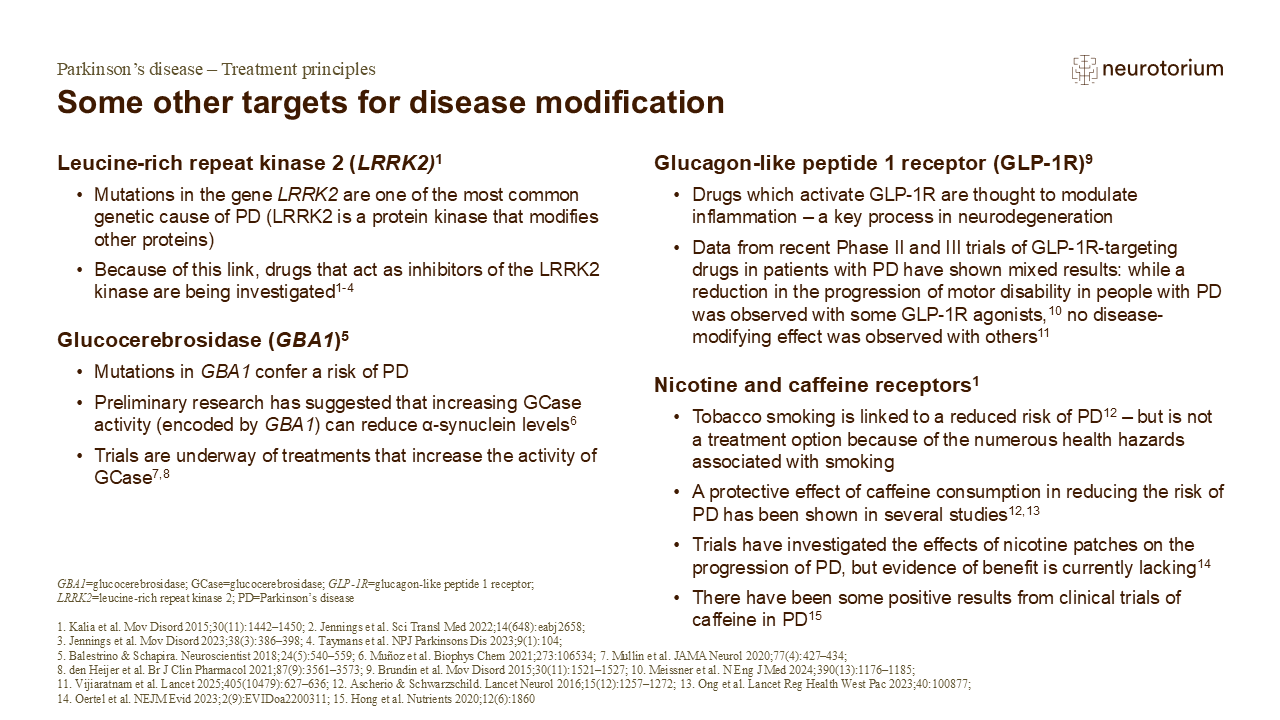
The discovery of key genes that increase the risk of developing PD has helped researchers to understand much of the molecular pathways involved in the disease.1 One of these genes, LRRK2, has provided a novel mechanism for a potential therapy.1 Abnormal variants of this gene, which increase PD risk, are known to enhance the function of this kinase enzyme, so researchers are actively developing agents to inhibit the kinase function.1
Individuals with mutations in the GBA1 gene can suffer from the lysosomal storage disorder ‘Gaucher disease’.5 The GBA1 gene encodes a protein that converts glucosylceramide into ceramide and glucose; deficiency in the GBA protein leads to a build-up of undegraded substrates.16 However, mutations in the GBA1 gene can also confer an increased risk of developing PD, and those who do develop PD may have a more severe disease progression (including cognitive decline).5,17 Although the molecular mechanism underlying this connection is unknown, GBA1 is being explored as a potential therapeutic target in the treatment of PD.5 Unfortunately, a clinical trial of venglustat, a glucosylceramide synthase inhibitor targeting the GBA1 pathway, showed no beneficial treatment effect compared with placebo.18
The gut peptide GLP-1 and its receptor have been investigated as a potential therapeutic target as it has been shown to promote synapse preservation, reduce protein aggregation, and reduce inflammation.9-11 Placebo-controlled trials exploring this target using a slow-release, weekly injection of a GLP-1 receptor agonist have shown mixed results.10,11
Coffee drinking is associated with a reduced risk of PD and caffeine itself may provide some symptomatic relief to patients with the disease.1,12 Caffeine binds to α-synuclein, inducing conformational changes that prevent its aggregation.19 Caffeine may act as an antioxidant, reducing oxidative stress and therefore slowing the progression of PD.19 It also increases dopamine release and the number of dopamine receptors in the striatum, and is an adenosine antagonist.19 For all of these reasons, the therapeutic effects of caffeine are being tested in clinical trials.1
Epidemiological studies have shown that smokers are considerably less likely to develop PD.1,20 A history of smoking reduces the risk of PD by approximately 36%, compared with non-smokers.20 Clinical trials have attempted to determine whether or not nicotine is the main cause of this protective effect.1
Beyond the targets mentioned here, there are other molecular targets of PD research that many hope will lead to new treatments – both symptomatic therapies and potential new disease-modifying agents.21
References:
1. Kalia LV, Kalia SK, Lang AE. Disease-modifying strategies for Parkinson’s disease. Mov Disord 2015; 30 (11): 1442–1450.
2. Jennings D, Huntwork-Rodriguez S, Henry AG, et al. Preclinical and clinical evaluation of the LRRK2 inhibitor DNL201 for Parkinson’s disease. Sci Transl Med 2022; 14 (648): eabj2658.
3. Jennings D, Huntwork-Rodriguez S, Vissers MFJM, et al. LRRK2 inhibition by BIIB122 in healthy participants and patients with Parkinson’s disease. Mov Disord 2023; 38 (3): 386–398.
4. Taymans JM, Fell M, Greenamyre T, et al. Perspective on the current state of the LRRK2 field. NPJ Parkinsons Dis 2023; 9 (1): 104.
5. Balestrino R, Schapira AHV. Glucocerebrosidase and Parkinson disease: molecular, clinical, and therapeutic implications. Neuroscientist 2018; 24 (5): 540–559.
6. Muñoz SS, Petersen D, Marlet FR, et al. The interplay between glucocerebrosidase, α-synuclein and lipids in human models of Parkinson’s disease. Biophys Chem 2021; 273: 106534.
7. Mullin S, Smith L, Lee K, et al. Ambroxol for the treatment of patients with Parkinson disease with and without glucocerebrosidase gene mutations: a nonrandomized, noncontrolled trial. JAMA Neurol 2020; 77 (4): 427–434.
8. den Heijer JM, Kruithof AC, van Amerongen G, et al. A randomized single and multiple ascending dose study in healthy volunteers of LTI-291, a centrally penetrant glucocerebrosidase activator. Br J Clin Pharmacol 2021; 87 (9): 3561–3573.
9. Brundin P, Atkin G, Lamberts JT. Basic science breaks through: new therapeutic advances in Parkinson’s disease. Mov Disord 2015; 30 (11): 1521–1527.
10. Meissner WG, Remy P, Giordana C, et al. Trial of lixisenatide in early Parkinson’s disease. N Eng J Med 2024; 390 (13): 1176–1185.
11. Vijiaratnam N, Girges C, Auld G, et al. Exenatide once a week versus placebo as a potential disease-modifying treatment for people with Parkinson’s disease in the UK: a phase 3, multicentre, double-blind, parallel-group, randomised, placebo-controlled trial. Lancet 2025; 405 (10479): 627–636.
12. Ascherio A, Schwarzschild MA. The epidemiology of Parkinson’s disease: risk factors and prevention. Lancet Neurol 2016; 15 (12): 1257–1272.
13. Ong Y-L, Deng X, Li H-H, et al. Caffeine intake interacts with Asian gene variants in Parkinson’s disease: a study in 4488 subjects. Lancet Reg Health West Pac 2023; 40: 100877.
14. Oertel WH, Müller H-H, Unger MM, et al. Transdermal nicotine treatment and progression of early Parkinson’s disease. NEJM Evid 2023; 2 (9): EVIDoa2200311.
15. Hong CT, Chan L, Bai C-H. The effect of caffeine on the risk and progression of Parkinson’s disease: a meta-analysis. Nutrients 2020; 12 (6): 1860.
16. Sardi SP, Cedarbaum JM, Brundin P. Targeted therapies for Parkinson’s disease: from genetics to the clinic. Mov Disord 2018; 33 (5): 684–696.
17. Cilia R, Tunesi S, Marotta G, et al. Survival and dementia in GBA-associated Parkinson’s disease: the mutation matters. Ann Neurol 2016; 80 (5): 662–673.
18. Giladi N, Alcalay RN, Cutter G, et al. Safety and efficacy of venglustat in GBA1-associated Parkinson’s disease: an international, multicentre, double-blind, randomised, placebo-controlled, phase 2 trial. Lancet Neurol 2023; 22 (8): 661–671.
19. Negida A, Elfil M, Attia A. Caffeine; the forgotten potential for Parkinson’s disease. CNS Neurol Disord Drug Targets 2017; 16 (6): 652–657.
20. Noyce AJ, Bestwick JP, Silveira-Moriyama L, et al. Meta-analysis of early nonmotor features and risk factors for Parkinson disease. Ann Neurol 2012; 72 (6): 893–901.
21. McFarthing K, Buff S, Rafaloff G, et al. Parkinson’s disease drug therapies in the clinical trial pipeline: 2023 update. J Parkinsons Dis 2023; 13 (4): 427–439.