

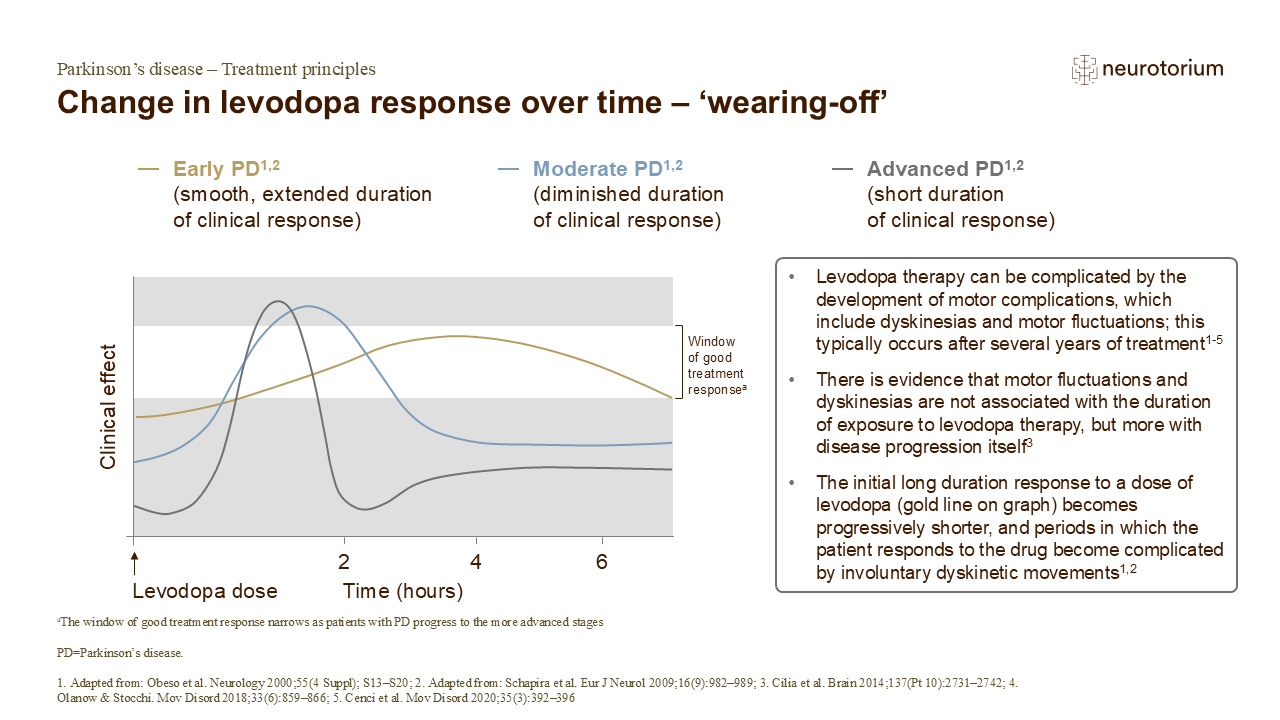
Levodopa is the major symptomatic therapy for PD and provides benefit to virtually all patients.1 During the early stage, the effects of levodopa tend to be long-lasting, and motor complications usually take a long time to develop.1 Beyond this early stage, however, patients may struggle to maintain good symptom control as the duration of response to levodopa therapy becomes progressively shorter.1 This problem is known as ‘wearing-off’.6
‘Wearing-off’ is a predictable recurrence of PD symptoms that precedes a scheduled dose of levodopa and usually improves with medication.6 By contrast, the less predictable fluctuations – sometimes called ‘yo‑yoing’ – are associated with more advanced stages of PD.7
However, it has been argued that there is no reason to delay the initiation of levodopa therapy in patients with PD, because the onset of motor fluctuations and dyskinesias are associated with the duration of the disease, rather than exposure to levodopa.3
4. Olanow CW, Stocchi F. Levodopa: A new look at an old friend. Mov Disord 2018; 33 (6): 859–866.
5. Cenci MA, Riggare S, Pahwa R et al. Dyskinesia matters. Mov Disord 2020; 35 (3): 392–396.