

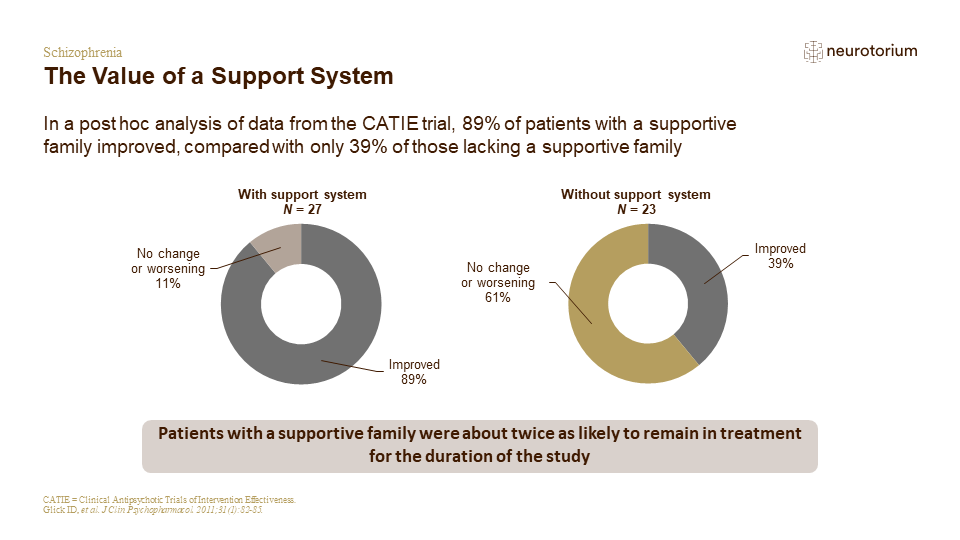
In a post hoc analysis of data from the CATIE study, 50 patients were dichotomized into 2 groups:
- The first group had a family/significant other—available and mostly supportive—to work collaboratively to facilitate adherence with the treatment team (n=27).
- The second group either did not have family/significant other support because there was no one available, the patient-family unit was in a highly conflicted struggle, or the family would not/could not come in regularly for treatment visits (n=23).
Outcome ratings were based on the author’s ratings of outcome as well as the outcome ratings in the CATIE database.
It was demonstrated that having a family available and supportive improves outcome.
- 24 of the 27 patients (89%) with supportive families improved.
- 14 of the 23 patients (61%) of the patients with a nonavailable nonsupportive group showed no change or worsened.
Improved outcomes may be mediated by improving long-term adherence.
- 23 of the 27 patients (85%) with supportive families remained in treatment for the entire study.
- 10 of the 23 patients (43%) without a supportive family remained in treatment for the entire study.
Reference:
Glick ID, Stekoll AH, Hays S. The role of the family and improvement in treatment maintenance, adherence, and outcome for schizophrenia. J Clin Psychopharmacol. 2011; 31(1): 82-85.