

Please note, this slide builds
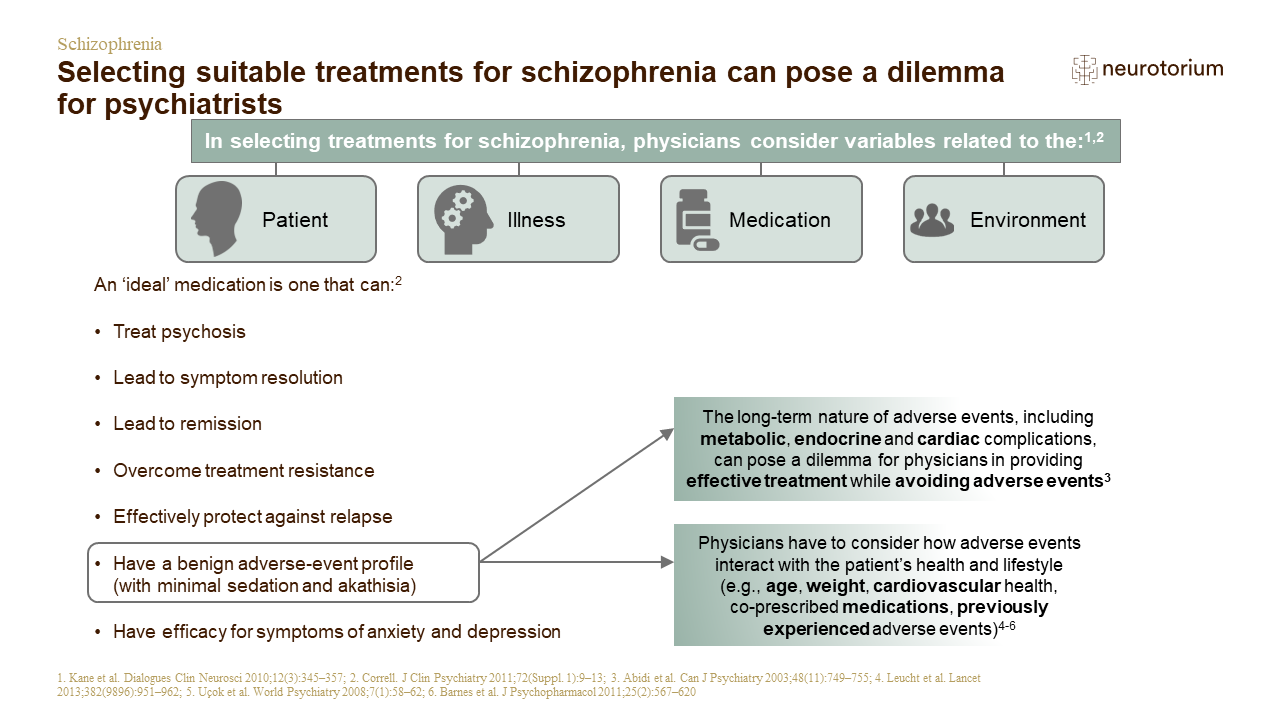
Key message: When selecting treatments for schizophrenia, physicians have to consider many variables, including the patient’s health and lifestyle, co-prescribed medications, and previously experienced adverse events.
Background
In selecting treatments for schizophrenia, clinicians have to consider variables related to the patient (e.g., age, history of response), the illness (e.g., duration, symptom type, comorbidity), the medication (e.g., pharmacodynamics, pharmacokinetics, efficacy, tolerability, cost) and the patient’s environment.[Kane & Correll, 2010; Correll, 2011]
The ideal antipsychotic would:[Correll, 2011]
- Reduce excess dopamine levels in the mesolimbic pathway and/or associative striatum to treat psychosis, while maintaining adequate dopamine levels where dopamine is needed.
- Cause minimal histaminergic blockade (associated with sedation, weight gain, and metabolic complications), cholinergic blockade (associated with dry mouth, constipation and impaired cognition), and α1-adrenergic blockade (associated with orthostasis).
- Have a sufficiently broad gap between efficacy and toxicity, so that dosing could be increased as needed without triggering excessive adverse events.
- Have efficacy for depression and anxiety.
- Cause no or minimal extrapyramidal symptoms (EPS) and akathisia, and have little risk of tardive dyskinesia (TD).
- Be weight-neutral, cause no metabolic abnormalities, and reverse weight gain and/or lipid abnormalities.
References:
Kane JM, Correll CU. Pharmacologic treatment of schizophrenia. Dialogues Clin Neurosci 2010; 12 (3): 345–357.
Correll CU. What are we looking for in new antipsychotics? J Clin Psychiatry 2011; 72 (Suppl. 1): 9–13.
Other references used on slide
Abidi S, Bhaskara SM. From chlorpromazine to clozapine – antipsychotic adverse effects and the clinician’s dilemma. Can J Psychiatry 2003; 48 (11): 749–755.
Leucht S, Cipriani A, Spineli L, et al. Comparative efficacy and tolerability of 15 antipsychotic drugs in schizophrenia: a multiple-treatments meta-analysis. Lancet 2013; 382 (9896): 951–962.
Uçok A, Gaebel W. Side effects of atypical antipsychotics: a brief overview. World Psychiatry 2008; 7 (1): 58–62.
Barnes TR; Schizophrenia Consensus Group of British Association for Psychopharmacology. Evidence-based guidelines for the pharmacological treatment of schizophrenia: recommendations from the British Association for Psychopharmacology. J Psychopharmacol 2011; 25 (5): 567–620.