

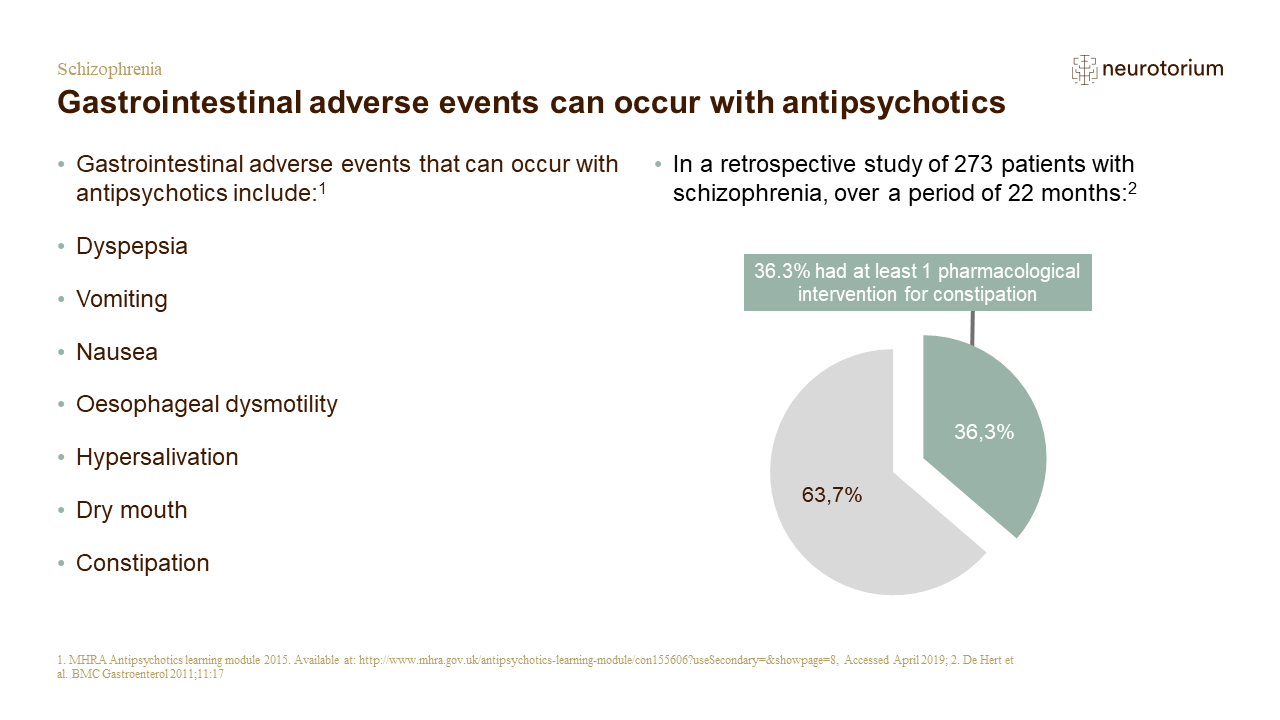
Key message: Gastrointestinal adverse events, such as constipation, can occur with antipsychotics.
Background
- This was a retrospective study in patients with schizophrenia consecutively admitted, between 2007–2009, and treated with antipsychotic medication.[De Hert et al., 2011]
- Various electronic patient data were linked to evaluate the prevalence and severity of constipation in patients with schizophrenia under routine treatment conditions.[De Hert et al., 2011]
- Constipation was defined as having at least one new prescription of a laxative.[De Hert et al., 2011]
- Over the 22-month observation period, there were 371 admissions of 273 individual patients with schizophrenia.[De Hert et al., 2011] The mean age of the sample was 40.1 years (range 17–82) and 65.6% were male.[De Hert et al., 2011] Over a period of 22 months, 36.3% of patients (n=99) received a pharmacological treatment for constipation at least once.[De Hert et al., 2011]
- On average, medication for constipation was prescribed for 273 days. Severe cases that were unresponsive to initial treatment, underwent plain X-ray of the abdomen. In 68.4% of patients, faecal impaction was found.[De Hert et al., 2011]
- A high prevalence of constipation, often severe and needing medical intervention, was confirmed during the study period.[De Hert et al., 2011]
Reference:
De Hert M, Dockx L, Bernagie C, et al. Prevalence and severity of antipsychotic related constipation in patients with schizophrenia: a retrospective descriptive study. BMC Gastroenterol 2011; 11: 17.
Other reference used on slide:
MHRA Antipsychotics learning module 2015. Available at https://www.mhra.gov.uk/antipsychotics-learning-module/con155606?useSecondary=&showpage=8. Accessed April 2019.