

Please note, this slide builds.
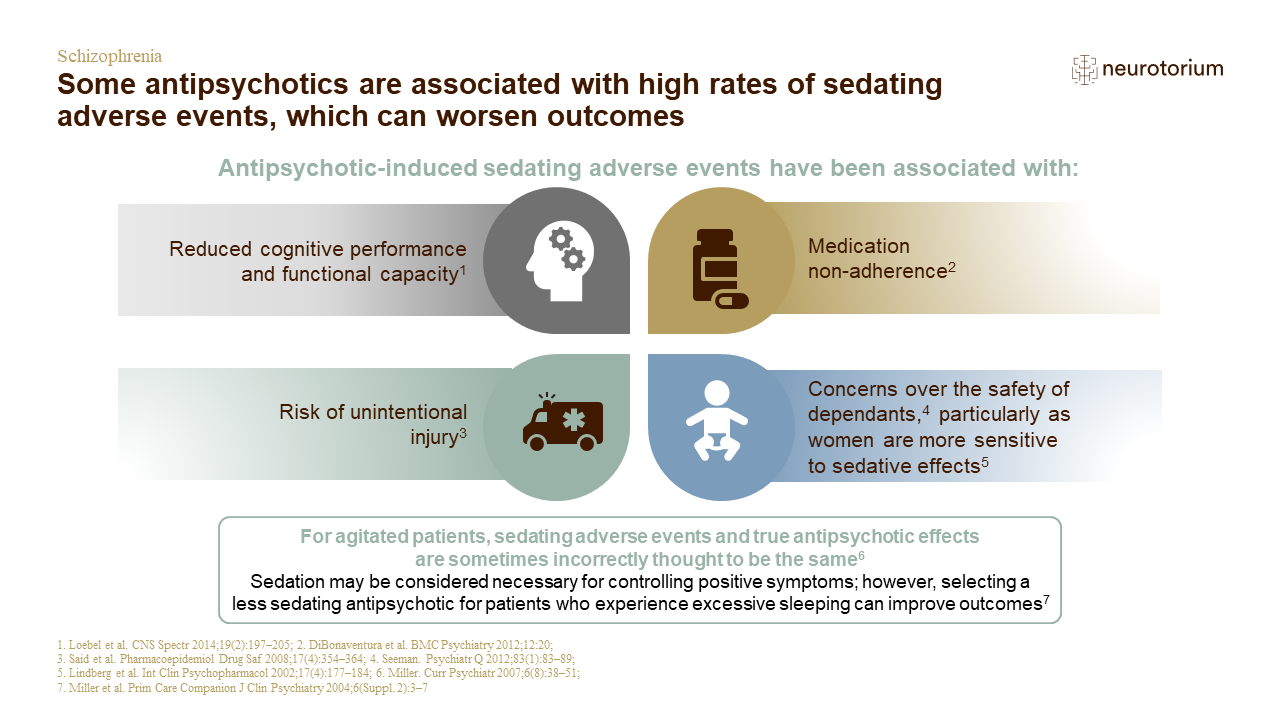
Key message: The sedative adverse events of antipsychotics may have significant consequences for patients, leading to medication non-adherence, increased risk of unintentional injury, and reduced cognitive performance and functional capacity. Sedation can have a severe impact on many aspects of patient life, such as preventing patients from gaining improvement from treatment, interfering with functioning and quality of life, and reducing adherence to medication.
Background
- Data were analized from a 2007‒2008 US survey of adults who self-reported a diagnosis of schizophrenia and were currently using an antipsychotic medication (n=876).[DiBonaventura et al., 2012]
- Adherence was defined as a score of zero on the MMAS.[DiBonaventura et al., 2012] The MMAS items include the presence or absence of the following non-adherent behaviours: forgetting to take medication, careless at times about taking medication, stopping medication when feeling better, and stopping medication when feeling worse.[DiBonaventura et al., 2012]
- A single logistic regression model assessed the relationship between adverse-event clusters and adherence.[DiBonaventura et al., 2012]
- The adverse-event cluster of sedation/cognition (which included sedation, difficulty thinking or concentrating, sleepiness, and dizziness) was associated with a lower likelihood of adherence – sedation/cognition (odds ratio [OR]: 0.70, p=0.033).[DiBonaventura et al., 2012]
Reference:
DiBonaventura M, Gabriel S, Dupclay L, et al. A patient perspective of the impact of medication side effects on adherence: results of a cross-sectional nationwide survey of patients with schizophrenia. BMC Psychiatry 2012; 12: 20.
References used on slide:
Lindberg N, Virkkunen M, Tani P, et al. Effect of a single-dose of olanzapine on sleep in healthy females and males. Int Clin Psychopharmacol 2002; 17 (4): 177–184.
Loebel AD, Siu CO, Cucchiaro JB, et al. Daytime sleepiness associated with lurasidone and quetiapine XR: results from a randomized double-blind, placebo-controlled trial in patients with schizophrenia. CNS Spectr 2014; 19 (2): 197–205.
Miller DD. Atypical antipsychotics: sleep, sedation, and efficacy. Prim Care Companion J Clin Psychiatry 2004; 6 (Suppl. 2): 3–7. Miller DD. Sedation with antipsychotics. Curr Psychiatr 2007; 6 (8): 38–51.
Said Q, Gutterman EM, Kim MS, et al. Somnolence effects of antipsychotic medications and the risk of unintentional injury. Pharmacoepidemiol Drug Saf 2008; 17 (4): 354–364.
Seeman MV. Antipsychotic-induced somnolence in mothers with schizophrenia. Psychiatr Q 2012; 83 (1): 83–89.