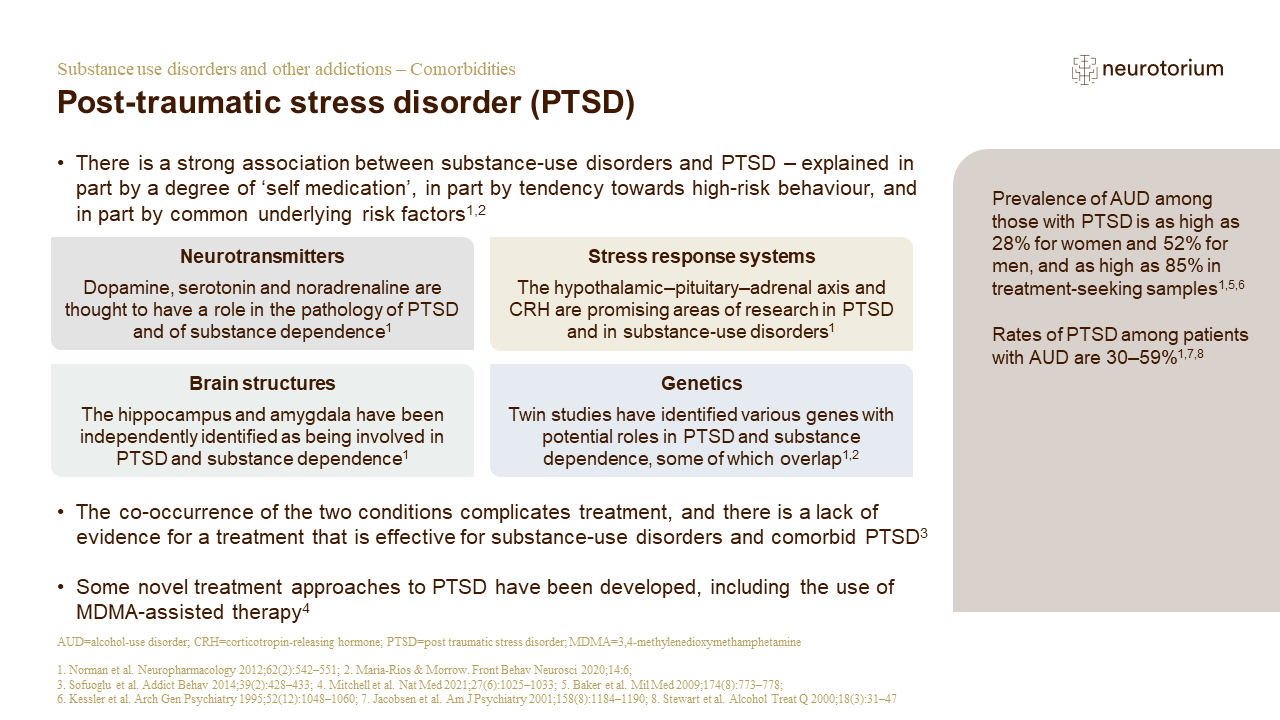
The relationship between substance-use disorders and post-traumatic stress disorder (PTSD) is complex, i.e., bidirectional and with other mediating interconnected risk factors.[1,2] However, it is a difficult relationship to study, partly due to the intricacies of study design; many studies of PTSD exclude people with substance-use disorders in their recruitment criteria, and likewise many studies of addiction exclude individuals with PTSD.[1] There is evidence that people exposed to adverse childhood experiences (including physical, sexual, or emotional abuse, exposure to domestic violence, household mental illness or substance abuse; i.e., trauma) are at an increased risk of developing substance-use disorders.[9] Some research suggests that substance-use disorders and PTSD may share common underlying mechanisms of stress and negative affect.[1] However, more research is needed to translate such mechanistic insights into potential therapies for patients.[1,2]
References:
[1] Norman SB, Myers US, Wilkins KC, et al. Review of biological mechanisms and pharmacological treatments of comorbid PTSD and substance use disorder. Neuropharmacology 2012; 62 (2): 542–551.
[2] María-Ríos CE, Morrow JD. Mechanisms of shared vulnerability to post-traumatic stress disorder and substance use disorders. Front Behav Neurosci 2020; 14: 6.
[3] Sofuoglu M, Rosenheck R, Petrakis I. Pharmacological treatment of comorbid PTSD and substance use disorder: recent progress. Addict Behav 2014; 39 (2): 428–433.
[4] Mitchell JM, Bogenschutz M, Lilienstein A, et al. MDMA-assisted therapy for severe PTSD: a randomized, double-blind, placebo-controlled phase 3 study. Nat Med 2021; 27 (6): 1025–1033.
[5] Baker DG, Heppner P, Afari N, et al. Trauma exposure, branch of service, and physical injury in relation to mental health among US veterans returning from Iraq and Afghanistan. Mil Med 2009; 174 (8): 773–778.
[6] Kessler RC, Sonnega A, Bromet E, Hughes M, Nelson CB. Posttraumatic-stress-disorder in the National Comorbidity Survey. Arch Gen Psychiatry 1995; 52 (12): 1048–1060.
[7] Jacobsen LK, Southwick SM, Kosten TR. Substance use disorders in patients with posttraumatic stress disorder: a review of the literature. Am J Psychiatry 2001; 158 (8): 1184–1190.
[8] Stewart SH, Conrod PJ, Samoluk SB, et al. Posttraumatic stress disorder symptoms and situation-specific drinking in women substance abusers. Alcohol Treat Q 2000; 18 (3): 31–47.
[9] Grummitt L, Barrett E, Kelly E, Newton N. An umbrella review of the links between adverse childhood experiences and substance misuse: what, why, and where do we go from here? Subst Abuse Rehabil 2022; 13: 83–100.