

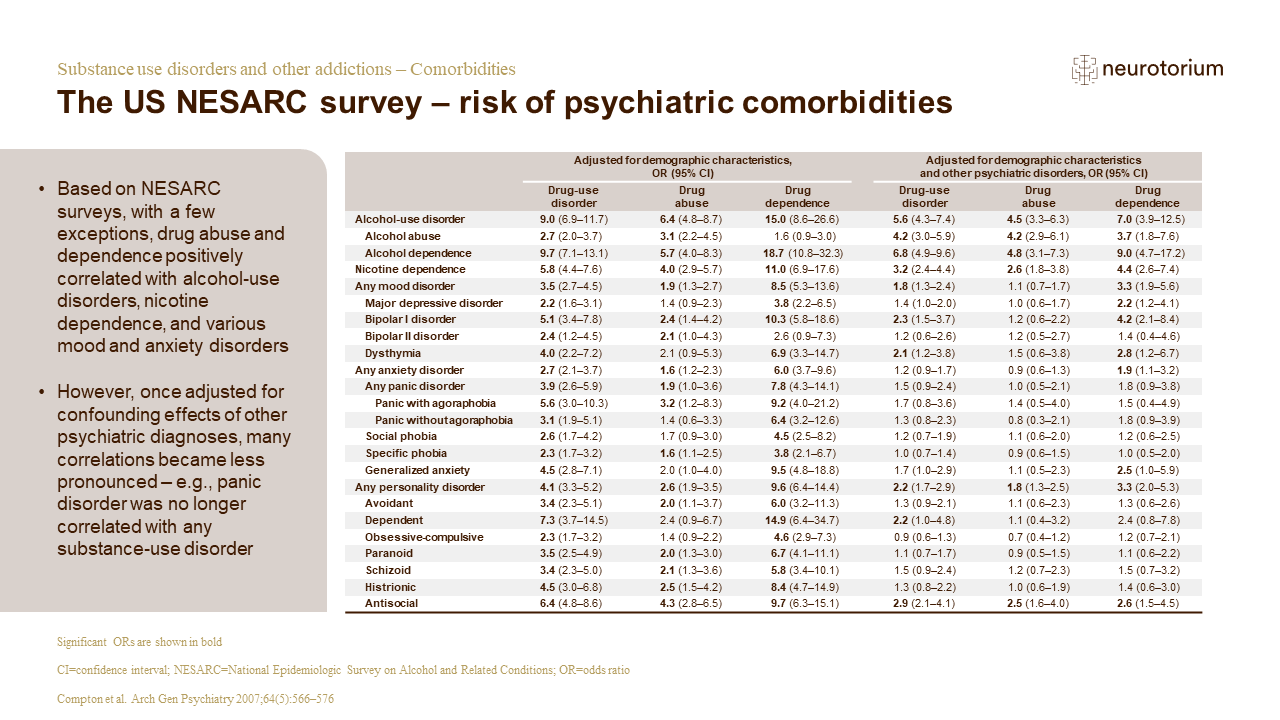
Results from across the NESARC datasets show consistent results – that comorbidity is common in patients with substance-use disorders.[2] However, individual relationships between specific comorbidities are complex.[2] When the data were adjusted for the potentially confounding effects of other demographic variables and diagnoses, often individual associations with specific comorbidities were reduced or eliminated.[1,2] This suggests a complex set of relationships between the various substance-use disorders and clusters of comorbidities that cannot be easily studied using pair-wise comparisons.[2]
References:
[1] Compton WM, Thomas YF, Stinson FS, Grant BF. Prevalence, correlates, disability, and comorbidity of DSM-IV drug abuse and dependence in the United States: results from the national epidemiologic survey on alcohol and related conditions. Arch Gen Psychiatry 2007; 64 (5): 566–576.
[2] Hasin DS, Grant BF. The National Epidemiologic Survey on Alcohol and Related Conditions (NESARC) Waves 1 and 2: review and summary of findings. Soc Psychiatry Psychiatr Epidemiol 2015; 50 (11): 1609–1640.