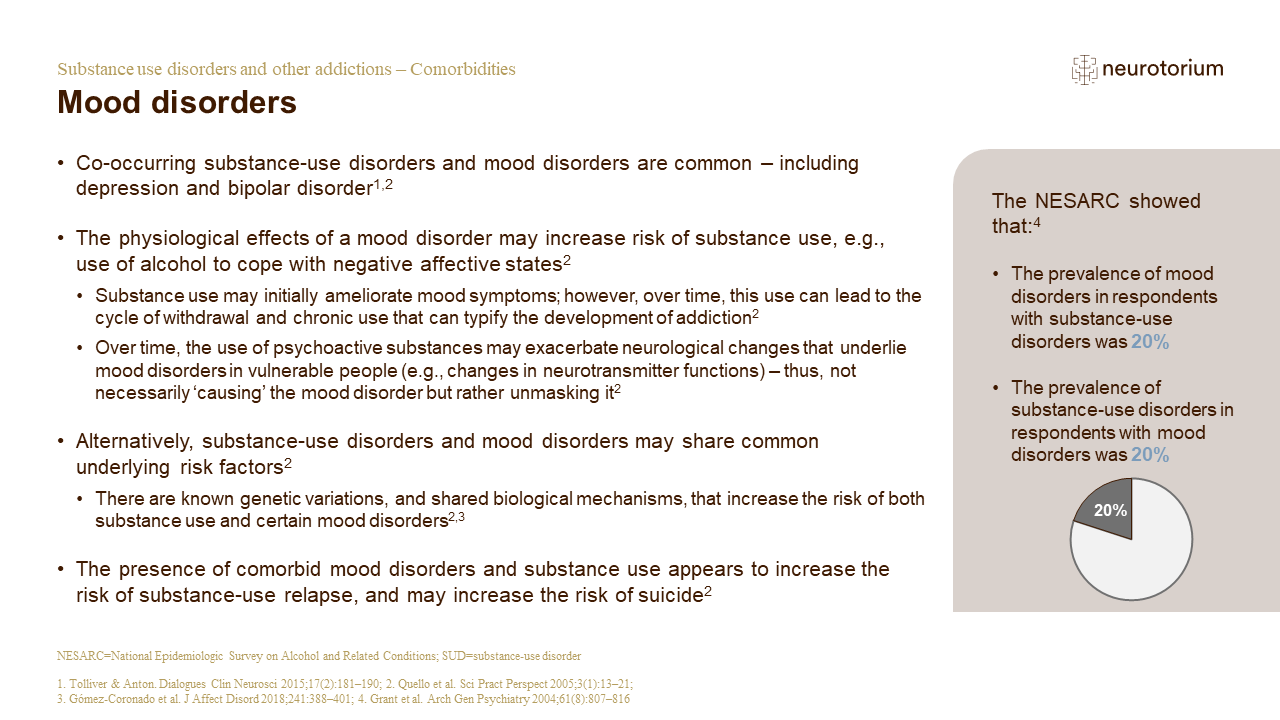
A systematic review investigated substance use as a risk factor for developing bipolar disorder.[6] The review found broad support that many different substances (including cannabis, nicotine, and alcohol) increase the incidence of bipolar disorder.[6] However – as outlined on the slide – the causal interrelationships between substance-use disorders and mood disorders are complex.[1,2,3] Whatever the causality, the importance of recognising the comorbidity of mood disorders and substance-use disorders and other addictions is highlighted by the difficulty of treating depressive symptoms in people with addictions,[5] and the rates of suicide in people with such comorbidities.[2]
References:
[1] Tolliver BK, Anton RF. Assessment and treatment of mood disorders in the context of substance abuse. Dialogues Clin Neurosci 2015; 17 (2): 181–190.
[2] Quello SB, Brady KT, Sonne SC. Mood disorders and substance use disorder: a complex comorbidity. Sci Pract Perspect 2005; 3 (1): 13–21.
[3] Gómez-Coronado N, Sethi R, Bortolasci CC, et al. A review of the neurobiological underpinning of comorbid substance use and mood disorders. J Affect Disord 2018; 241: 388–401.
[4] Grant BF, Stinson FS, Dawson DA, et al. Prevalence and co-occurrence of substance use disorders and independent mood and anxiety disorders: results from the National Epidemiologic Survey on Alcohol and Related Conditions. Arch Gen Psychiatry 2004; 61 (8): 807–816.
[5] Agabio R, Trogu E, Pani PP. Antidepressants for the treatment of people with co-occurring depression and alcohol dependence. Cochrane Database Syst Rev 2018; 4 (4): CD008581.
[6]Lalli M, Brouillette K, Kapczinski F, de Azevedo Cardoso T. Substance use as a risk factor for bipolar disorder: a systematic review. J Psychiatr Res 2021; 144: 285–295.