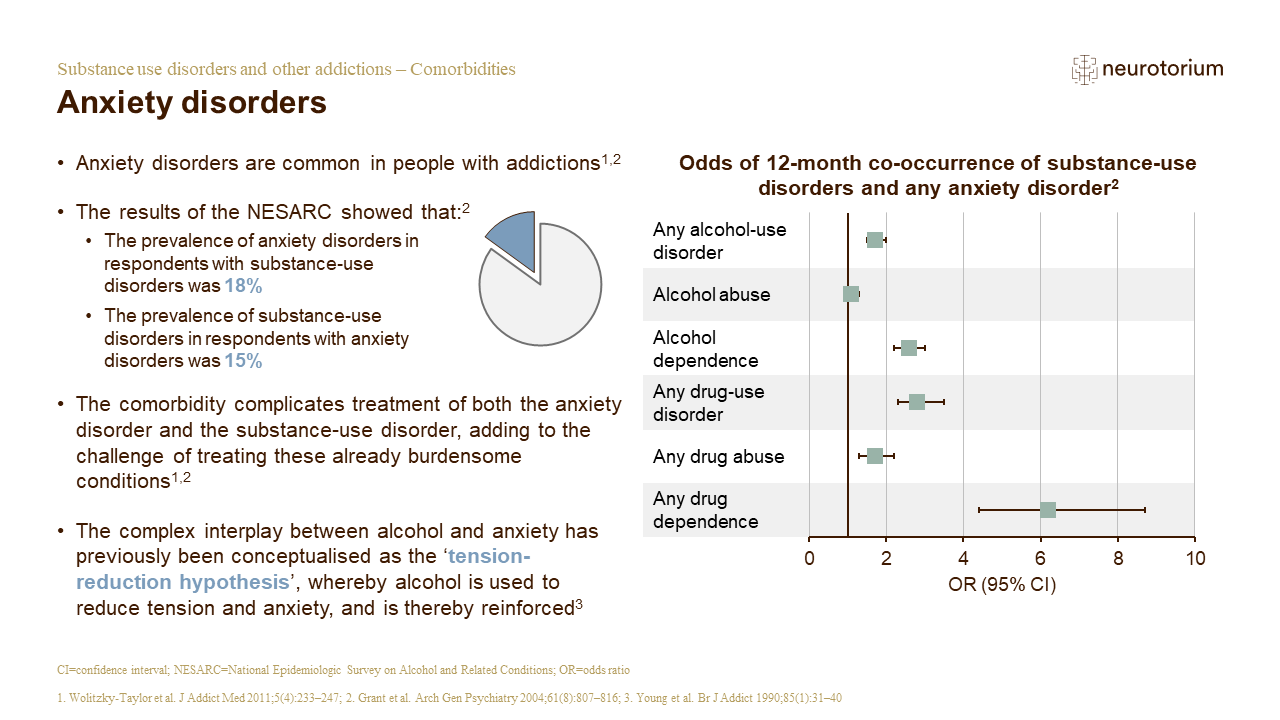
Researchers used data from the Australian National Survey of Mental Health and Wellbeing, a household survey including 8,841 Australians aged 16–85 years old, to study the comorbidities of substance-use disorder and anxiety disorders.[4] The 12-month prevalence of substance-use disorder was 5%.[4] Of the 5% who had a substance-use disorder, 35% had one or more coexisting anxiety or mood disorders – commonly major depression, social phobia, post-traumatic stress disorder, or generalised anxiety disorder.[4] The additional comorbidity was found to lead to a greater number of lost days of productivity, and greater impairment.[4]
Reference:
[1] Wolitzky-Taylor K, Operskalski JT, Ries R, et al. Understanding and treating comorbid anxiety disorders in substance users: review and future directions. J Addict Med 2011; 5 (4): 233–247.
[2] Grant BF, Stinson FS, Dawson DA, et al. Prevalence and co-occurrence of substance use disorders and independent mood and anxiety disorders: results from the National Epidemiologic Survey on Alcohol and Related Conditions. Arch Gen Psychiatry 2004; 61 (8): 807–816.
[3] Young RM, Oei TP, Knight RG. The tension reduction hypothesis revisited: an alcohol expectancy perspective. Br J Addict 1990; 85 (1): 31–40.
[4] Prior K, Mills K, Ross J, Teesson M. Substance use disorders comorbid with mood and anxiety disorders in the Australian general population. Drug Alcohol Rev 2017; 36 (3): 317–324.