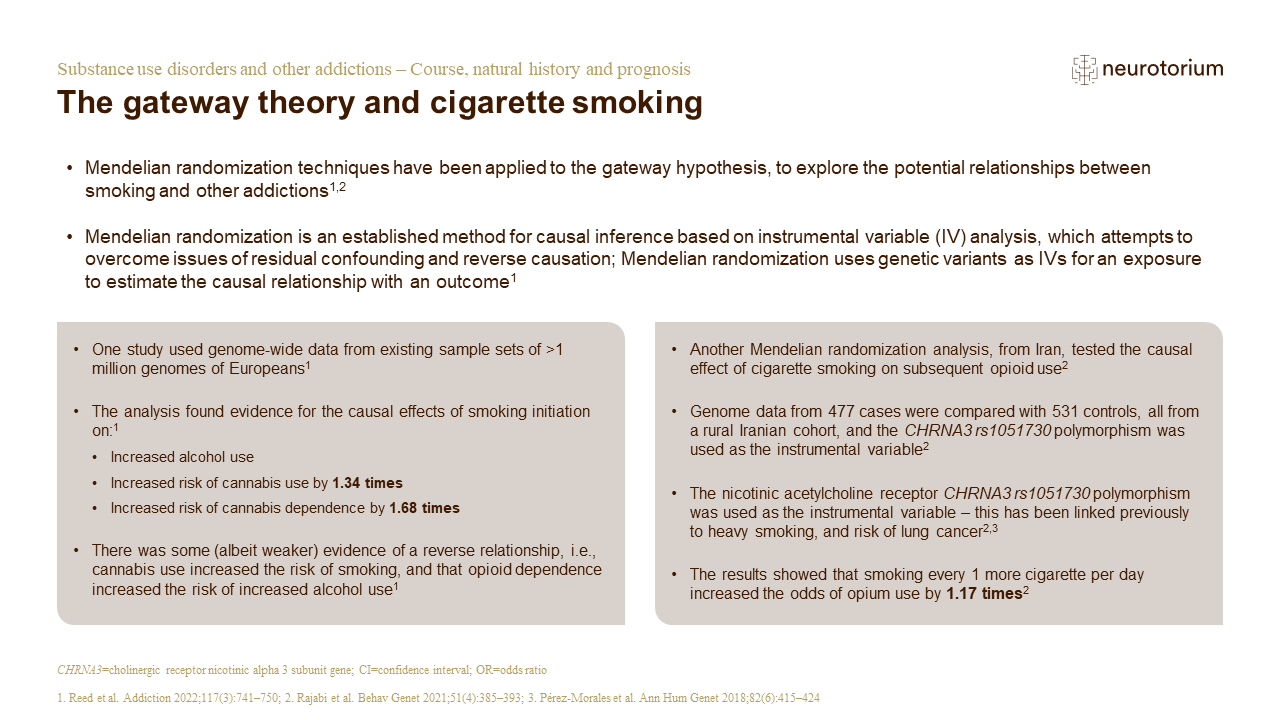
As outlined on the slide, some researchers have used Mendelian randomization techniques to study the gateway hypothesis, particularly relating to cigarettes and e-cigarette smoking.[1,2] In the study on the slide, a two-sample Mendelian randomization technique was applied to investigate the possible causal relationship between smoking and alcohol consumption, or the substance-use outcomes of cannabis, cocaine, or opioids.[1] However, these methods have been criticized, including the suitability of the use of CHRNA3 rs1051730 as an instrumental variable, and the formulation of research statements defining the hypotheses.[4,5]
References:
[1] Reed ZE, Wootton RE, Munafò MR. Using Mendelian randomization to explore the gateway hypothesis: possible causal effects of smoking initiation and alcohol consumption on substance use outcomes. Addiction 2022; 117 (3): 741–750.
[2] Rajabi A, Shojaei A, Janani L, et al. Cigarette smoking behavior a gateway to opium use disorder: a Mendelian randomization analysis. Behav Genet 2021; 51 (4): 385–393.
[3] Pérez-Morales R, González-Zamora A, González-Delgado MF, et al. CHRNA3 rs1051730 and CHRNA5 rs16969968 polymorphisms are associated with heavy smoking, lung cancer, and chronic obstructive pulmonary disease in a Mexican population. Ann Hum Genet 2018; 82 (6): 415–424.
[4] Vanyukov MM. A gateway that never was. Behav Genet 2022a; 52 (1): 65–68.
[5] Vanyukov MM. There is no causality in the ‘gateway hypothesis’: another test gone amiss. Addiction 2022b; 117 (4): 1174–1175.