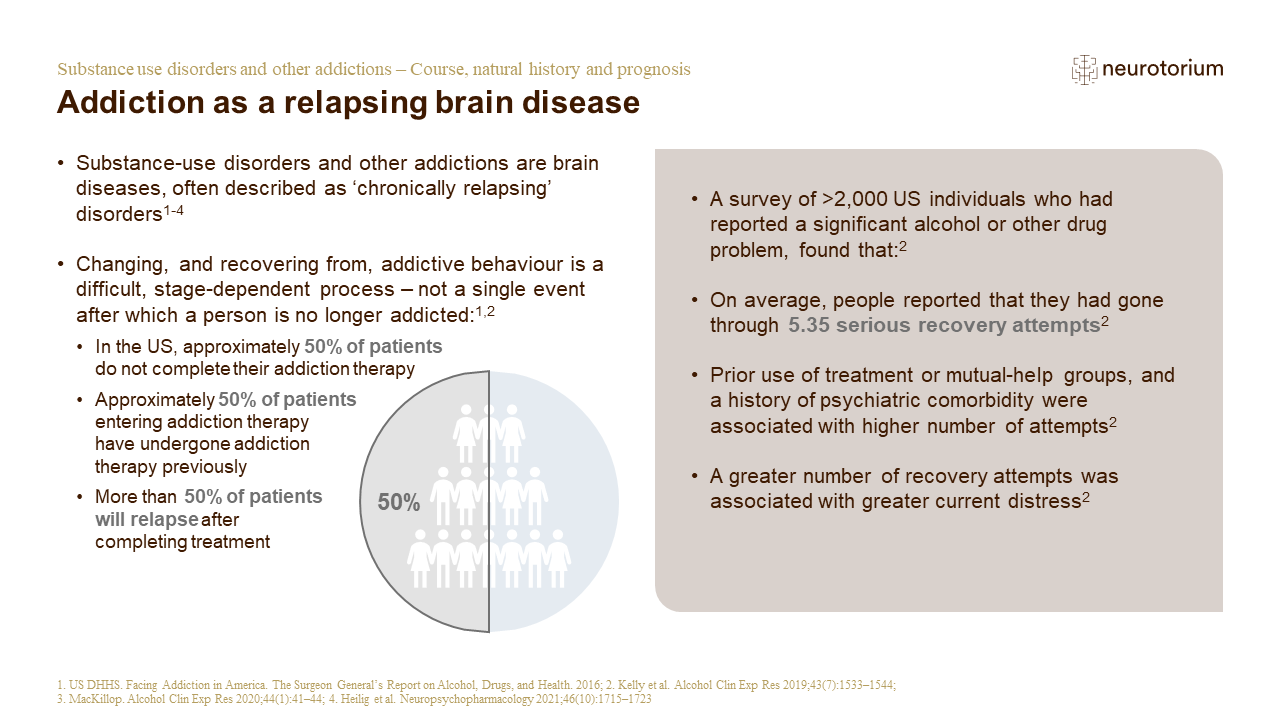
Addiction is a chronic brain disease, with potential outcomes ranging from relapse (a return to substance use) to remission (regaining health and social function).[1] Moreover, addiction is a widespread condition across the globe; healthcare providers, policymakers, and law enforcement agents need the necessary tools and understanding to tackle the addiction epidemic.[1]
Reference:
[1] United States Department of Health & Human Services. Facing Addiction in America. The Surgeon General’s Report on Alcohol, Drugs, and Health. 2016.
[2] Kelly JF, Greene MC, Bergman BG, et al. How many recovery attempts does it take to successfully resolve an alcohol or drug problem? Estimates and correlates from a national study of recovering U.S. adults. Alcohol Clin Exp Res 2019; 43 (7): 1533–1544.
[3] MacKillop J. Is addiction really a chronic relapsing disorder?: Commentary on Kelly et al. “How many recovery attempts does it take to successfully resolve an alcohol or drug problem? Estimates and correlates from a national study of recovering U.S. adults”. Alcohol Clin Exp Res 2020; 44 (1): 41–44.
[4] Heilig M, MacKillop J, Martinez D, et al. Addiction as a brain disease revised: why it still matters, and the need for consilience. Neuropsychopharmacology 2021; 46 (10): 1715–1723.