

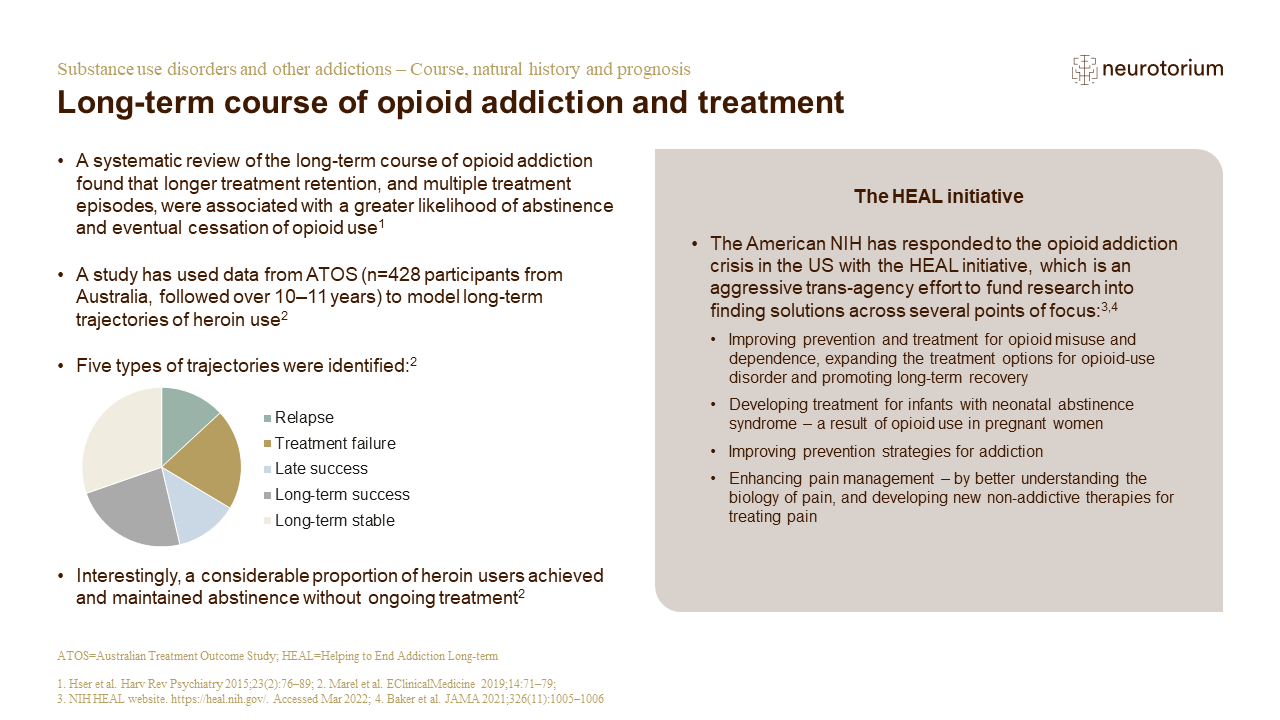
The analysis of the Australian Treatment Outcome Study (ATOS) data was among the first to provide meaningful insights into how long-term heroin use leads to greater healthcare system use and resource utilisation.[2,5] A sample of 428 people with heroin dependence were followed for 10–11 years, and five different treatment trajectories were modelled, ranging from ‘relapse’ to ‘long-term stability’, as shown on the slide.[2] These categories were defined based on treatment outcomes and trajectories, e.g., those in the ‘long-term success’ joint trajectory group spent fewer days in treatment than the ‘long-term stable’, ‘late success’, and ‘treatment failure’ groups; had also fewer treatment episodes, and fewer detoxification episodes.[2] Interestingly, a considerable proportion of people were able to maintain abstinence in the absence of treatment, whereas others continued opioid use in spite of treatment – although the authors keenly acknowledge the importance of treatment in recovery from heroin and opioid dependence.[2]
References:
[1] Hser YI, Evans E, Grella C, Ling W, Anglin D. Long-term course of opioid addiction. Harv Rev Psychiatry 2015; 23 (2): 76–89.
[3] NIH HEAL website. https://heal.nih.gov/. Accessed March 2022.