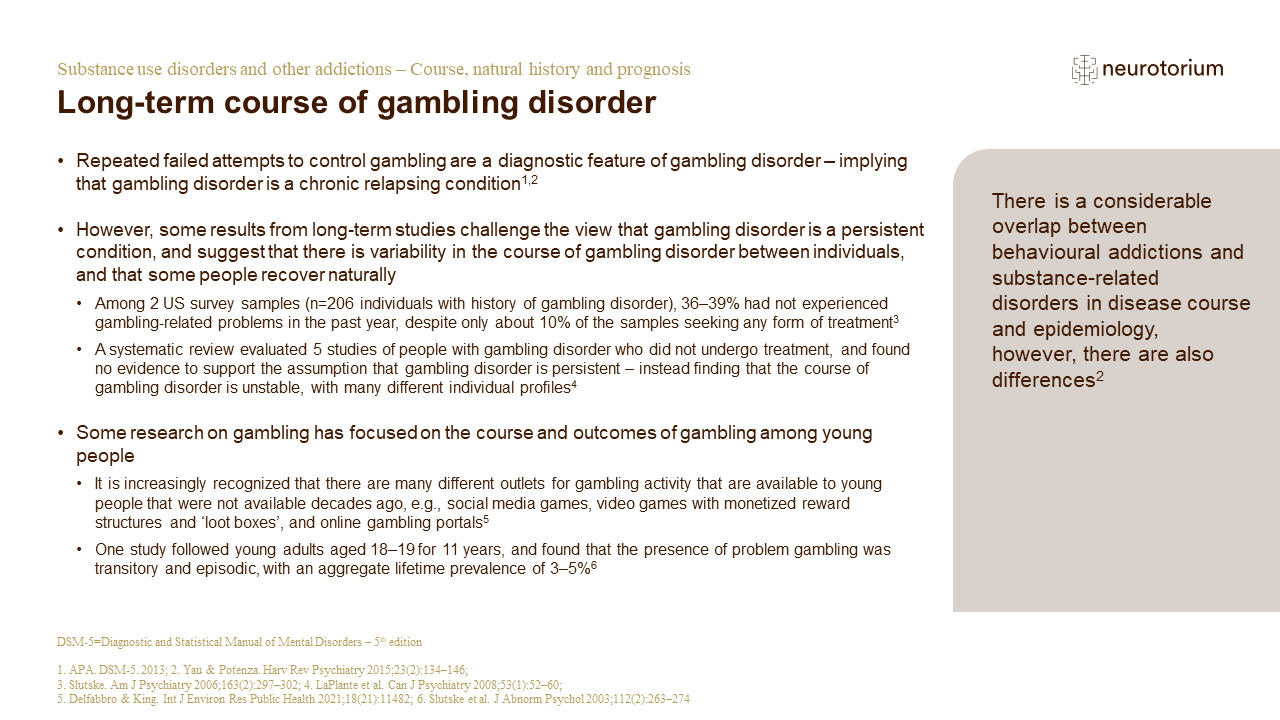
Behavioural addictions, and their disease course and response to treatment, remain poorly understood – despite the need to develop effective treatment strategies.[2] There is some hope, that because of the overlap between behavioural addictions and substance-related disorders, the advances in understanding that decades of research have brought to bear on the latter may help in understanding the former.[2]
However, in common with many fields of addiction study, there are some points of contention to researching problem gambling, particularly among young people, including the validity of some measures that are used.[5] Agreement on such methodological considerations will help future research into issues such as whether exposure as a young person to simulated gambling activities (e.g., ‘loot boxes’ in video games) acts to normalize gambling behaviour, and increase the risk of gambling disorder later in life.[5]
References:
[1] American Psychiatric Association (APA). Diagnostic and Statistical Manual of Mental Disorders, 5th edition. American Psychiatric Association, 2013.
[2] Yau YHC, Potenza MN. Gambling disorder and other behavioral addictions: recognition and treatment. Harv Rev Psychiatry 2015; 23 (2): 134–146.
[3] Slutske WS. Natural recovery and treatment-seeking in pathological gambling: results of two U.S. national surveys. Am J Psychiatry 2006; 163 (2): 297–302.
[4] LaPlante DA, Nelson SE, LaBrie RA, Shaffer HJ. Stability and progression of disordered gambling: lessons from longitudinal studies. Can J Psychiatry 2008; 53 (1): 52–60.
[5] Delfabbro P, King DL. Contentious issues and future directions in adolescent gambling research. Int J Environ Res Public Health 2021; 18 (21): 11482.
[6] Slutske WS, Jackson KM, Sher KJ. The natural history of problem gambling from age 18 to 29. J Abnorm Psychol 2003; 112 (2): 263–274.