

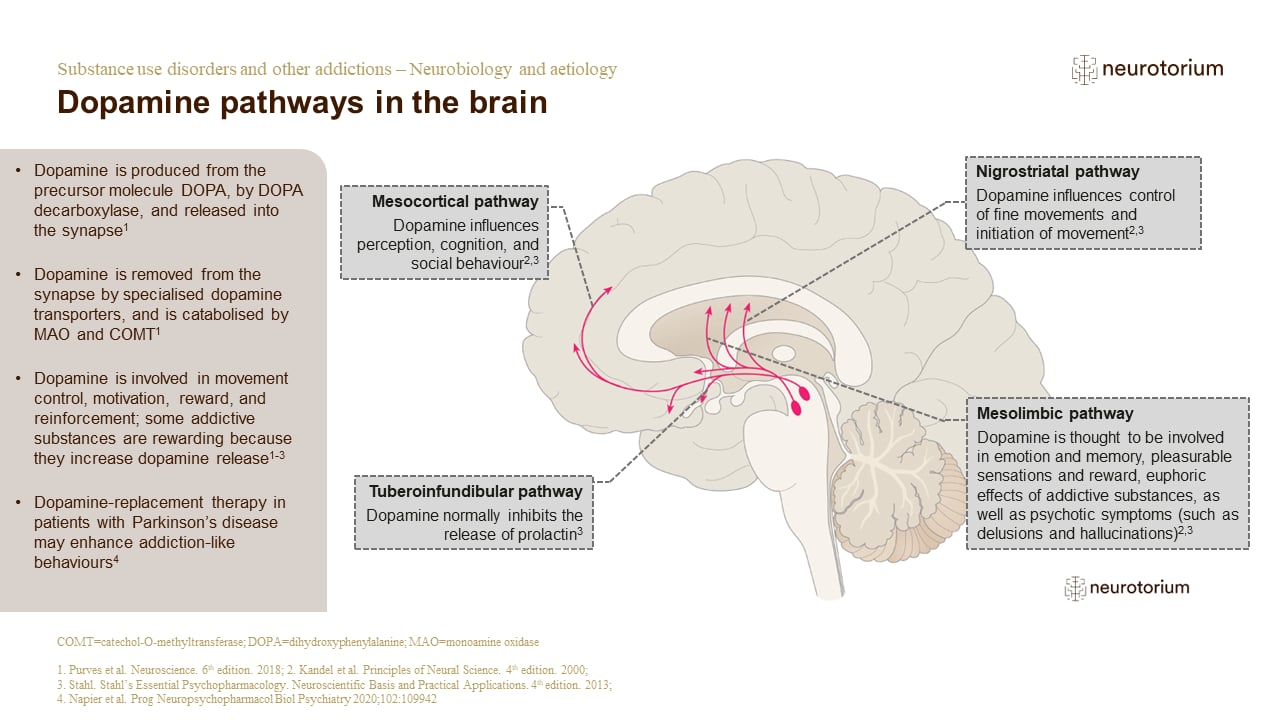
Dopamine receptors influence the activity of the second messenger, cyclic AMP, which is involved in many biochemical processes within a neuron.[2] Dopamine receptor subtypes D1 and D5 increase levels of cyclic AMP, whereas D2, D3, and D4 subtypes decrease levels of cyclic AMP.[2] Thus, depending which receptor subtype the neurotransmitter binds with on the postsynaptic neuron, dopamine can increase or decrease activity in the postsynaptic neuron.[2]
Dopamine is critical to the underlying disease state of many conditions, including Parkinson’s disease, which is characterised by a dearth of dopamine, and schizophrenia, which appears to be caused by an overactivity of dopamine within certain brain regions.[3] Furthermore, many addictive substances work by altering the effect of dopamine within the brain.[1] For instance, cocaine appears to act by inhibiting the reuptake of dopamine, which leads to an increased concentration of dopamine in the synapse, thus prolonging the action of dopamine.[1]
References:
[1] Purves D, Augustine GJ, Fitzpatrick D, et al. (eds). Neuroscience. 6th edition. Sunderland, MA: Sinauer Associates, Inc. 2018.