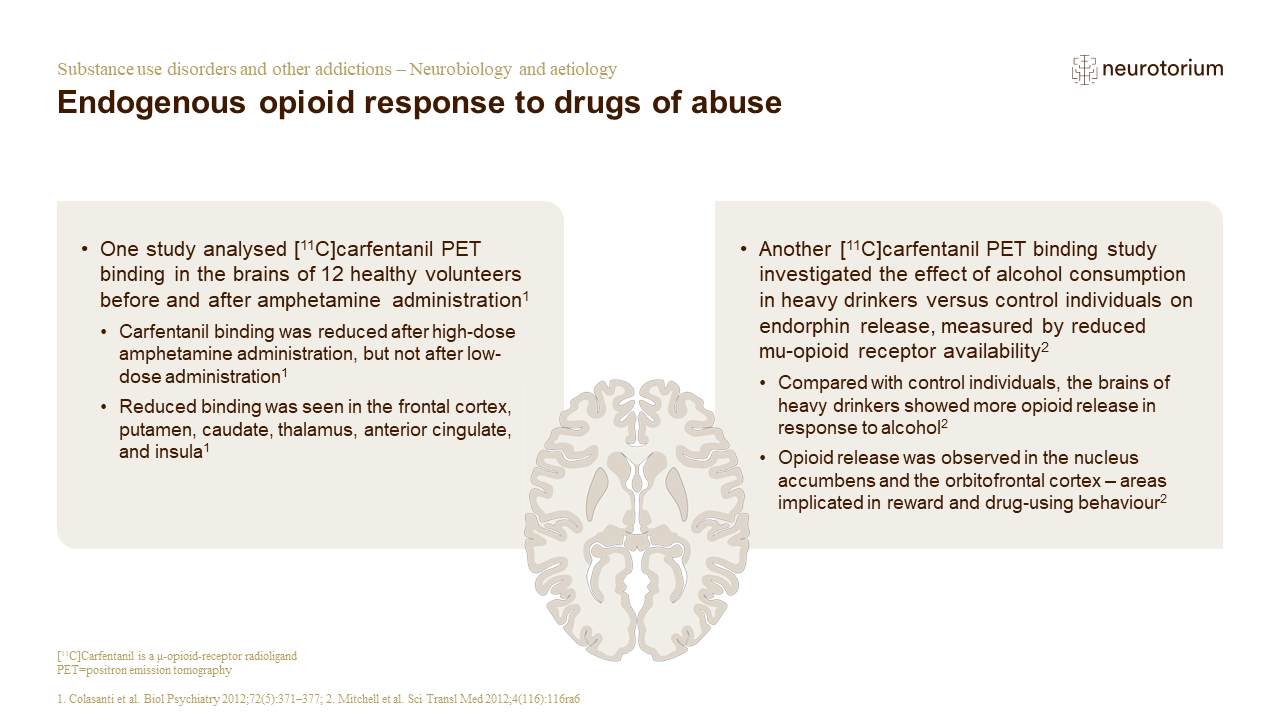
Multiple lines of evidence link the endogenous opioid system with the process of addiction. Research has suggested that the opioid system can be activated by substance use,[1,2] that mu-opioid receptor activity in cortical regions can predict substance-use relapse,[3] and that polymorphism in the OPRM1 gene encoding the mu-opioid receptor can change dopamine responses to alcohol.[5] Taken together, the endogenous opioid system of the brain is important in the pathogenesis of addiction, and as such is an attractive target for developing therapies for substance-use disorders.[4]
References:
[1] Colasanti A, Searle GE, Long CJ, et al. Endogenous opioid release in the human brain reward system induced by acute amphetamine administration. Biol Psychiatry 2012; 72 (5): 371–377.
[2] Mitchell JM, O’Neil JP, Janabi M, et al. Alcohol consumption induces endogenous opioid release in the human orbitofrontal cortex and nucleus accumbens. Sci Transl Med 2012; 4 (116): 116ra.
[3] Gorelick DA, Kim YK, Bencherif B, et al. Brain mu-opioid receptor binding: relationship to relapse to cocaine use after monitored abstinence. Psychopharmacology (Berl) 2008; 200 (4): 475–486.
[4] Nutt DJ, Nestor LJ. The Opioid System and Addiction. In: Nutt DJ, Nestor LJ (eds). Addiction, 2nd edition. Oxford University Press, 2018.
[5] Ramchandani VA, Umhau J, Pavon FJ, et al. A genetic determinant of the striatal dopamine response to alcohol in men. Mol Psychiatry 2011; 16 (8): 809–817.