

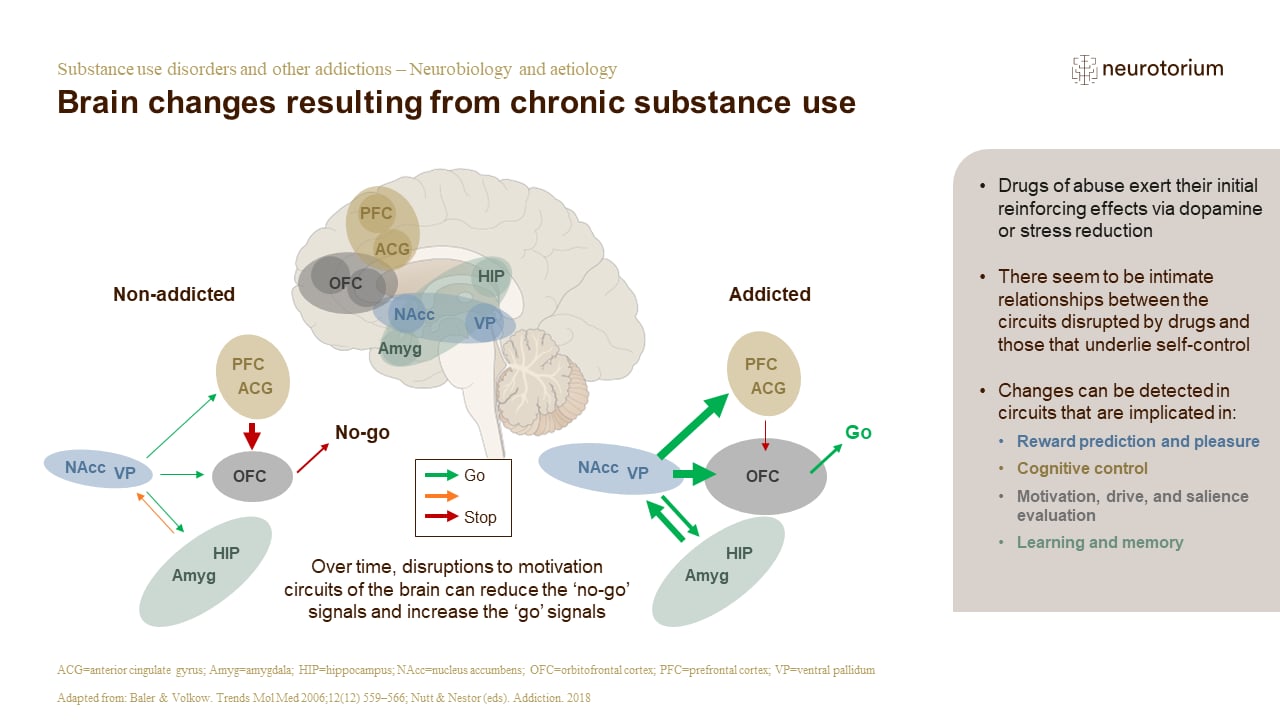
Many regions and circuits in the brain are involved in the control of motivation, which can be dysregulated by substance-use disorders and other addictions.[2] There are four key independent and overlapping circuits implicated in addiction, as shown on the slide, consisting of:[1,2]
1. reward prediction and pleasure (in blue), located within the nucleus accumbens and ventral pallidum
2. cognitive control (in gold), located within the prefrontal cortex and cingulate gyrus
3. motivation, drive, and salience evaluation (in grey) located within the orbitofrontal cortex
4. learning and memory (in green), located within the amygdala and hippocampus.
Over time, changes within these circuits in the brain can lead a person from ‘liking’ a substance or activity, to ‘wanting’ that substance or activity.[2] As addiction develops, the amount of ‘wanting’ increases, and dysregulation of the motivation circuits of the brain leads to reduced control over substance-taking behaviour, and a switch from ‘no-go’ to ‘go’ signals.[2]
References:
[1] Baler RD, Volkow ND. Drug addiction: the neurobiology of disrupted self-control. Trends Mol Med 2006; 12 (12): 559–566.