

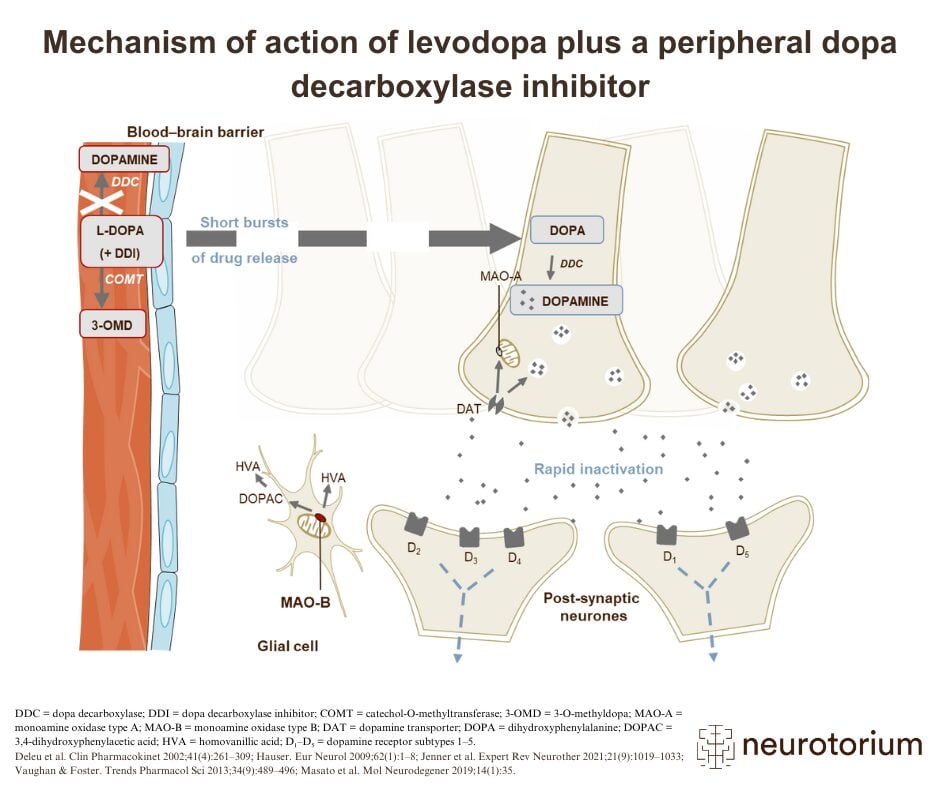
This illustration shows the mechanism of action of levodopa, one of the most effective symptomatic treatments for Parkinson’s disease, when taken in combination with a dopa decarboxylase inhibitor (DDI). Levodopa can be metabolized to dopamine on either side of the blood–brain barrier.1 It is therefore usually administered with a DDI and with a catechol-O-methyltransferase (COMT) inhibitor to prolong the peripheral levodopa half-life and to increase levodopa availability within the central nervous system.2,3
After passing the blood–brain barrier, levodopa is metabolized by dopa decarboxylase (DDC, also known as aromatic L-amino acid decarboxylase) to dopamine, which is released into the synapse, where it binds to the dopamine receptors (D1, D2, D3, D4 and D5) on post-synaptic neurons.1 Dopamine is then cleared from the synapse either through reuptake into the dopamine neuron by the dopamine transporter (DAT),4 or catabolized by the mitochondrial monoamine oxidase (A or B) into metabolites such as DOPAC (3,4-dihydroxyphenylacetic acid) and HVA (homovanillic acid).5
DDC = dopa decarboxylase; DDI = dopa decarboxylase inhibitor; COMT = catechol-O-methyltransferase; 3-OMD = 3-O-methyldopa; MAO-A = monoamine oxidase type A; MAO-B = monoamine oxidase type B; DAT = dopamine transporter; DOPA = dihydroxyphenylalanine; DOPAC = 3,4-dihydroxyphenylacetic acid; HVA = homovanillic acid; D₁–D₅ = dopamine receptor subtypes 1–5.
Related content
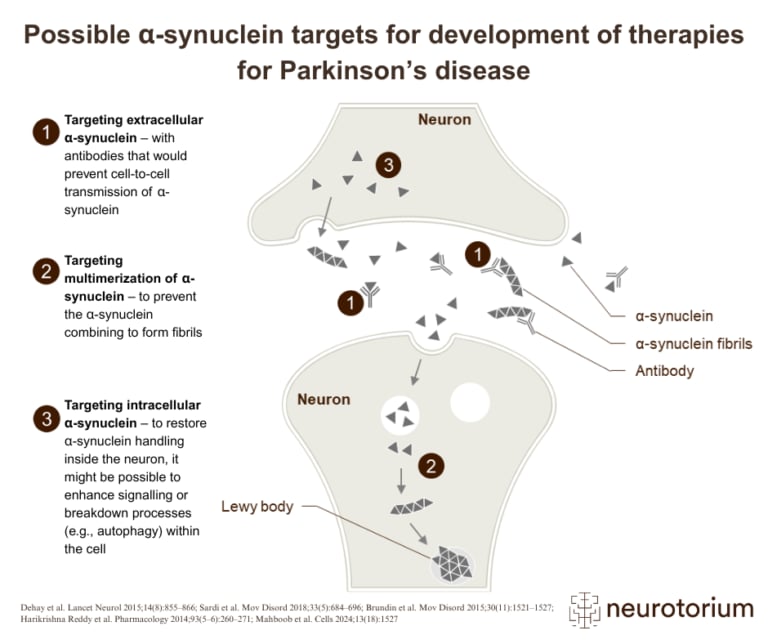
Overview of three therapeutic strategies targeting alpha-synuclein in the development of disease-modifying treatments for Parkinson’s disease
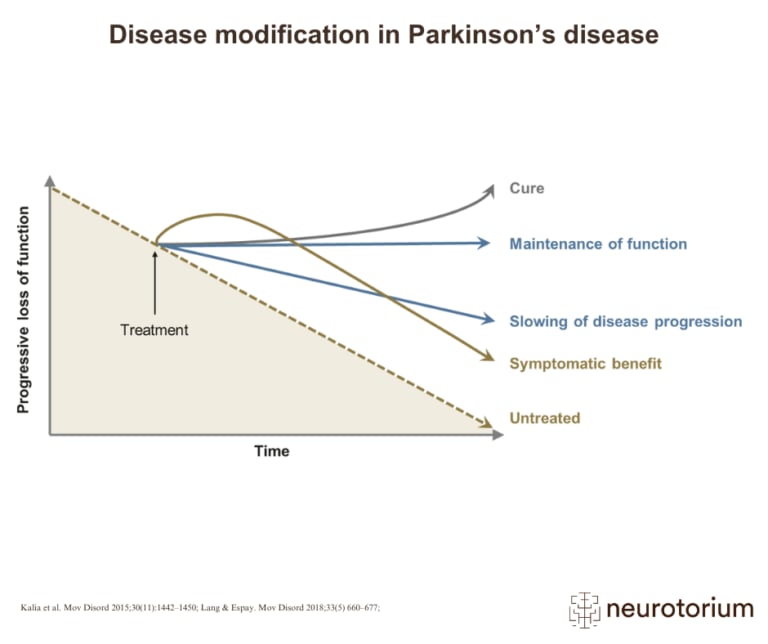
Graphical representation of how various treatment strategies can impact disease progression in Parkinson’s disease, from symptom relief to potential cure
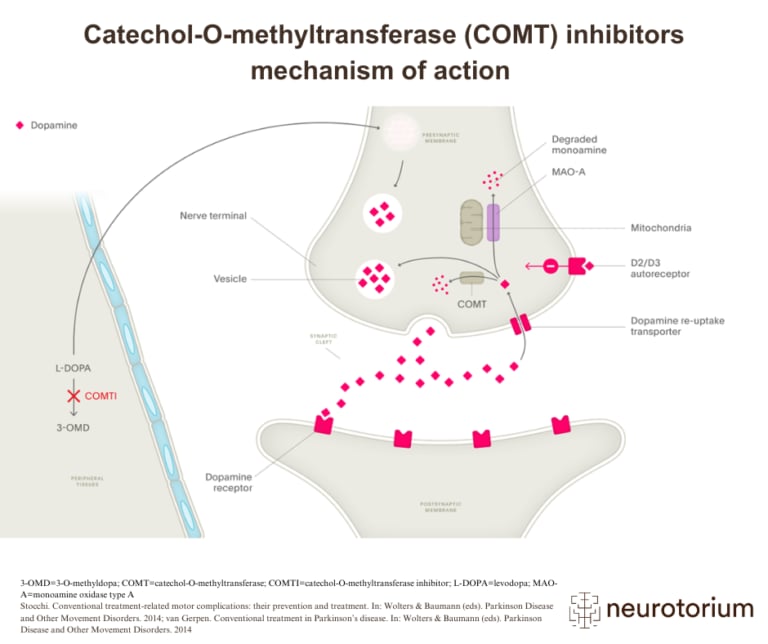
Illustration of how COMT inhibitors increase dopamine availability in Parkinson’s disease by preventing the breakdown of L-DOPA