

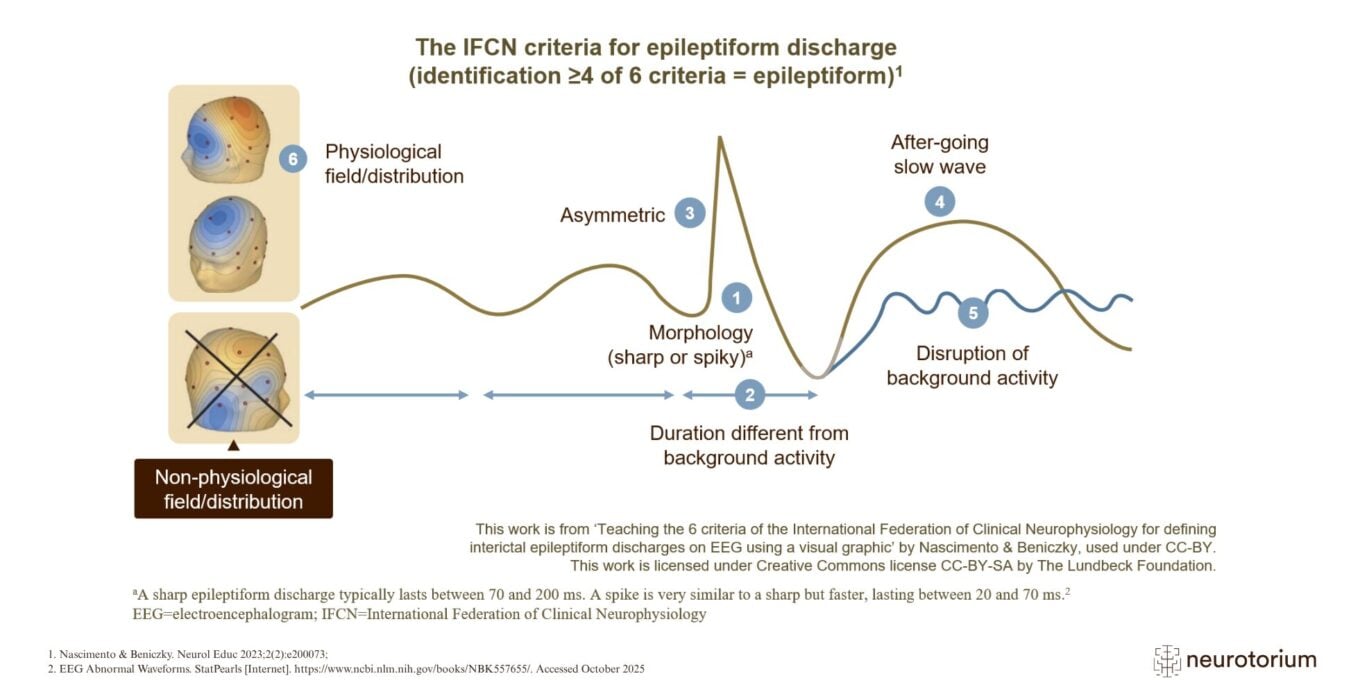
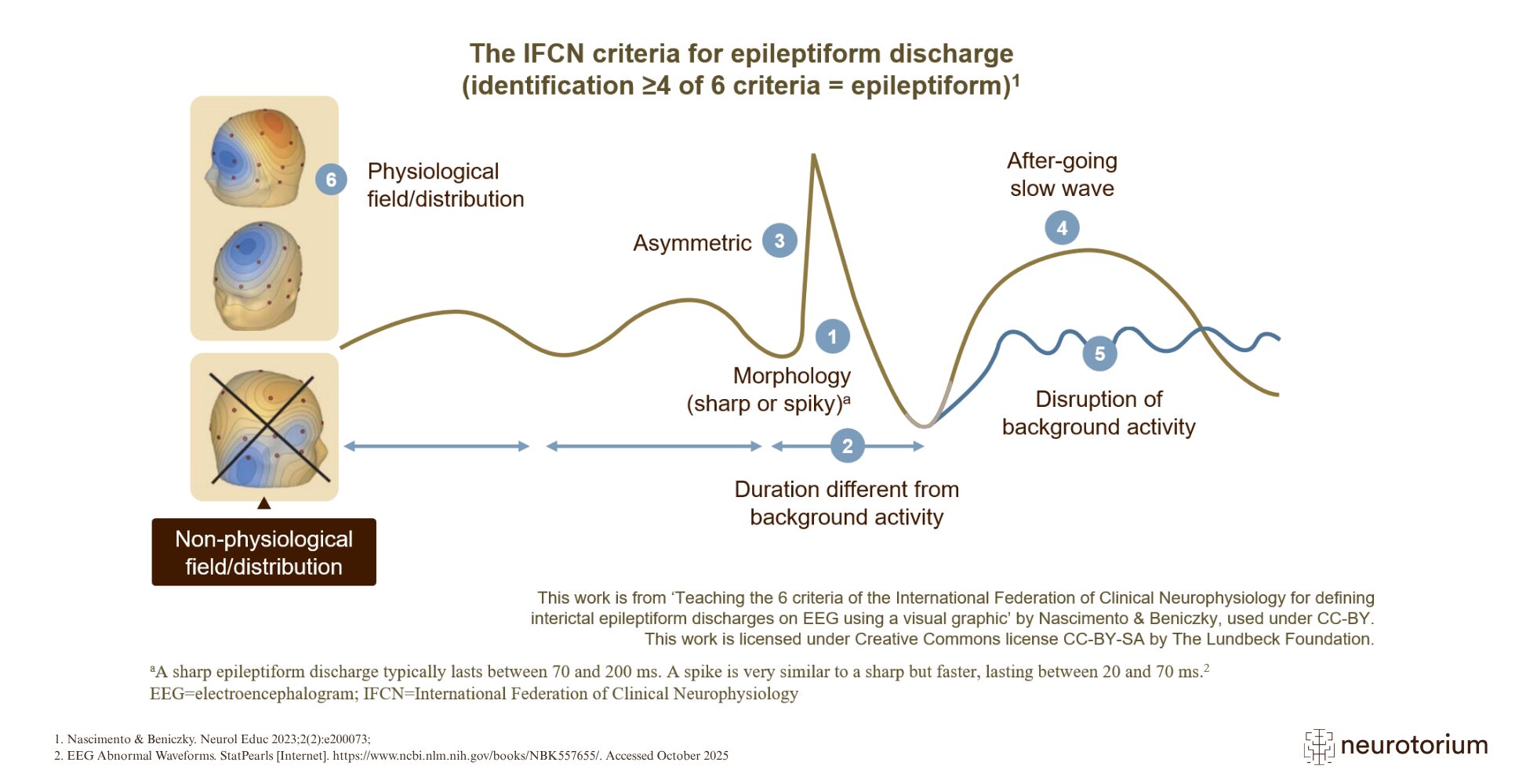
The slide shows the International Federation of Clinical Neurophysiology criteria for epileptiform discharge, based on identification of ≥4 of the 6 criteria:1
- sharp or spiky morphology (20–70 milliseconds for spike waves; 70–200 milliseconds for sharp waves)2
- different wave duration than background activity1
- waveform asymmetry1
- after-going slow wave1
- disruption of background activity: flattening or low-voltage alpha or beta frequency activity after
(most frequently) or before sharp transient1 - distribution suggestive of cerebral source/physiologic field.1
(Criteria 4 and 5 are independent.)
The paroxysmal depolarizing shift (PDS) is a large-amplitude depolarization associated with action potential bursting. It represents the cellular counterpart of the interictal spike that occurs between focal seizures on an EEG.3
Six characteristic features in an EEG can be used to identify interictal epileptiform discharges.1
EEG=electroencephalogram; IFCN=International Federation of Clinical Neurophysiology
Related content

In this video, Professor Dr. Nathalie Jetté reviews depression as a common yet often under-recognized comorbidity in epilepsy.

In this video, Professor Dr. Gretchen Birbeck examines epilepsy-associated stigma as a global public-health challenge
In this video, Professor Dr. Jacqueline French reviews practical, first-line decision-making for anti-seizure medication selection