

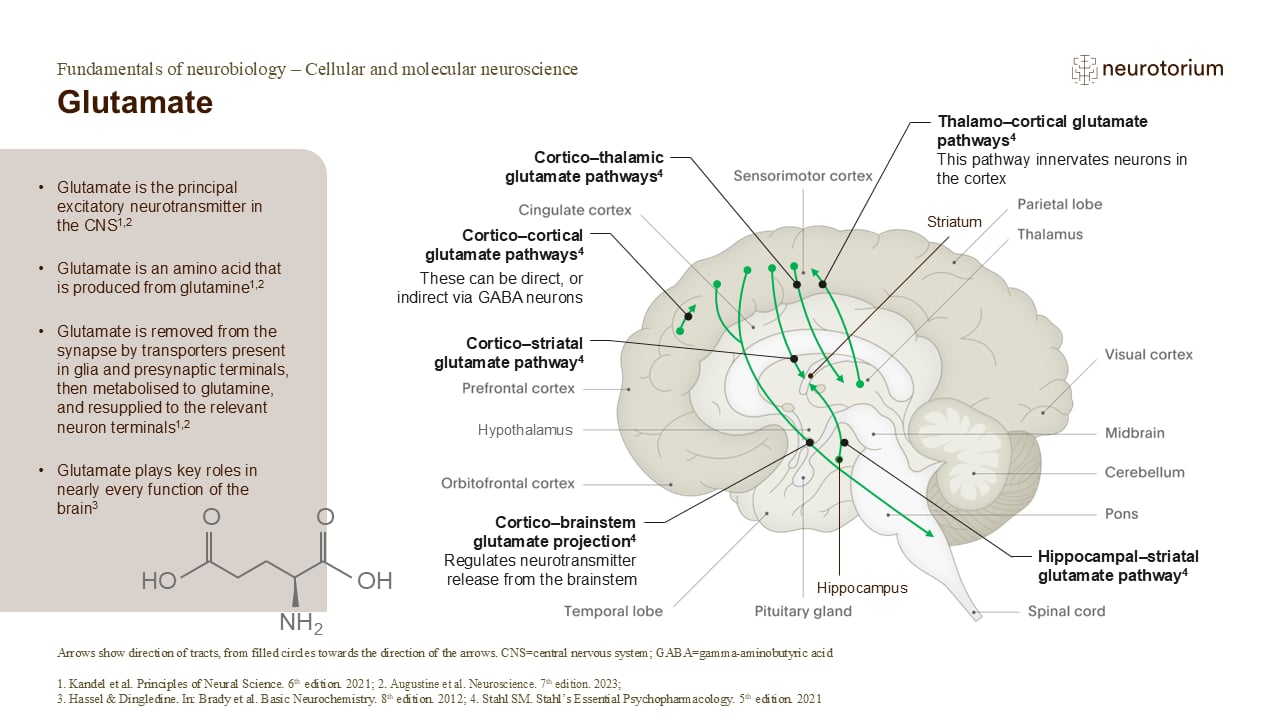
Control of the CNS can be thought of in terms of a balance between ‘go’ (excitatory) and ‘stop’ (inhibitory) signals.5 If the sum of the ‘go’ signals that a neuron receives outweighs the sum of the ‘stop’ signals, then that neuron is more likely to fire an action potential.4,5
Glutamate is the main excitatory neurotransmitter.2 Nearly all excitatory neurons in the CNS are glutamatergic – more than half of the neurons in the brain.2,6 It is noteworthy, though, that high concentrations of glutamate are neurotoxic, capable of triggering excitotoxicity.6 There are three types of receptor to which glutamate can bind (named after the synthetic agonists that activate them), each of which has slightly different properties:3
- NMDA (N-methyl-d-aspartate)
- AMPA (α-amino-3-hydroxyl-5-methyl-4-isoxazole-propionate)
- kainate (kainic acid).
References:
1. Neurotransmitters. In: Kandel ER, Koester JD, Mack SH, Siegelbaum SA (eds). Principles of Neural Science. 6th edition. McGraw-Hill, 2021.
2. Neurotransmitters. In: Augustine GJ, Groh J, Huettel S, et al. (eds). Neuroscience. 7th edition. Oxford University Press, 2023.
3. Hassel B, Dingledine R. Glutamate and glutamate receptors. In: Brady ST, Siegel CJ, Albers RW, Price DL (eds). Basic Neurochemistry: Principles of Molecular, Cellular and Medical Neurobiology. 8th edition. Academic Press, 2012.
4. Stahl SM. Psychosis, schizophrenia, and the neurotransmitters networks dopamine, serotonin, and glutamate. In: Stahl’s Essential Psychopharmacology. Neuroscientific Basis and Practical Applications. 5th edition. © Cambridge University Press, 2021.
5. Ochoa-de la Paz LN, Gulias-Cañizo R, D´Abril Ruíz-Leyja E, et al., The role of GABA neurotransmitter in the human central nervous system, physiology, and pathophysiology. Revista Mexicana de Neurociencia 2021; 22 (2): 67–76.
6. Zhou Y, Danbolt NC. Glutamate as a neurotransmitter in the healthy brain. J Neural Transm (Vienna) 2014; 121 (8): 799–817.