

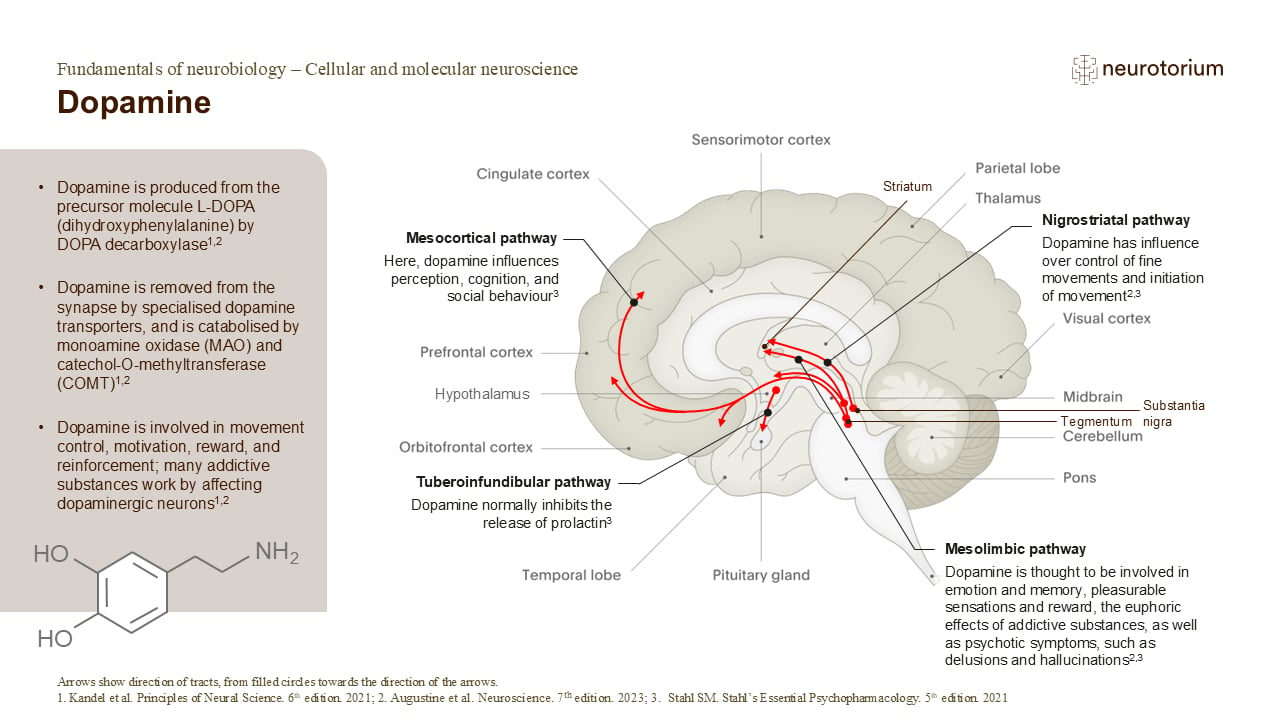
Dopamine receptors influence the activity of the second messenger, cyclic AMP, which is involved in many biochemical processes within a neuron.4 Dopamine receptor subtypes D1 and D5 increase the levels of cyclic AMP, whereas D2, D3, and D4 subtypes decrease the levels of cyclic AMP (both mechanisms work via the promotion or inhibition, respectively, of adenyl cyclase, which catalyses the conversion of ATP to cAMP).4 Depending on which receptor subtype the neurotransmitter binds with on the postsynaptic neuron, dopamine can increase or decrease cellular activity.5
Dopamine also plays a key role in the regulation of prolactin – a hormone, produced and released into the bloodstream by the pituitary gland, involved in the secretion of milk and breast growth; unusually high amounts are responsible for impotence and loss of libido in men, and changes in the menstrual cycle in women.6 Certain D2 receptor antagonists such as some antipsychotics, can cause hyperprolactinaemia.6
References:
1. Neurotransmitters. In: Kandel ER, Koester JD, Mack SH, Siegelbaum SA (eds). Principles of Neural Science. 6th edition. McGraw-Hill, 2021.
2. Neurotransmitters. In: Augustine GJ, Groh J, Huettel S, et al. (eds). Neuroscience. 7th edition. Oxford University Press, 2023.
3. Stahl SM. Psychosis, schizophrenia, and the neurotransmitters networks dopamine, serotonin, and glutamate. In: Stahl’s Essential Psychopharmacology. Neuroscientific Basis and Practical Applications. 5th edition. © Cambridge University Press, 2021.
4. Beaulieu JM, Gainetdinov RR. The physiology, signaling, and pharmacology of dopamine receptors. Pharmacol Rev 2011; 63 (1): 182–217.
5. Speranza L, di Porzio U, Viggiano D, et al. Dopamine: The neuromodulator of long-term synaptic plasticity, reward and movement control. Cells 2021; 10 (4): 735.
6. Al-Chalabi M, Bass AN, Alsalman I. Physiology, prolactin. StatPearls [internet]. 2023.