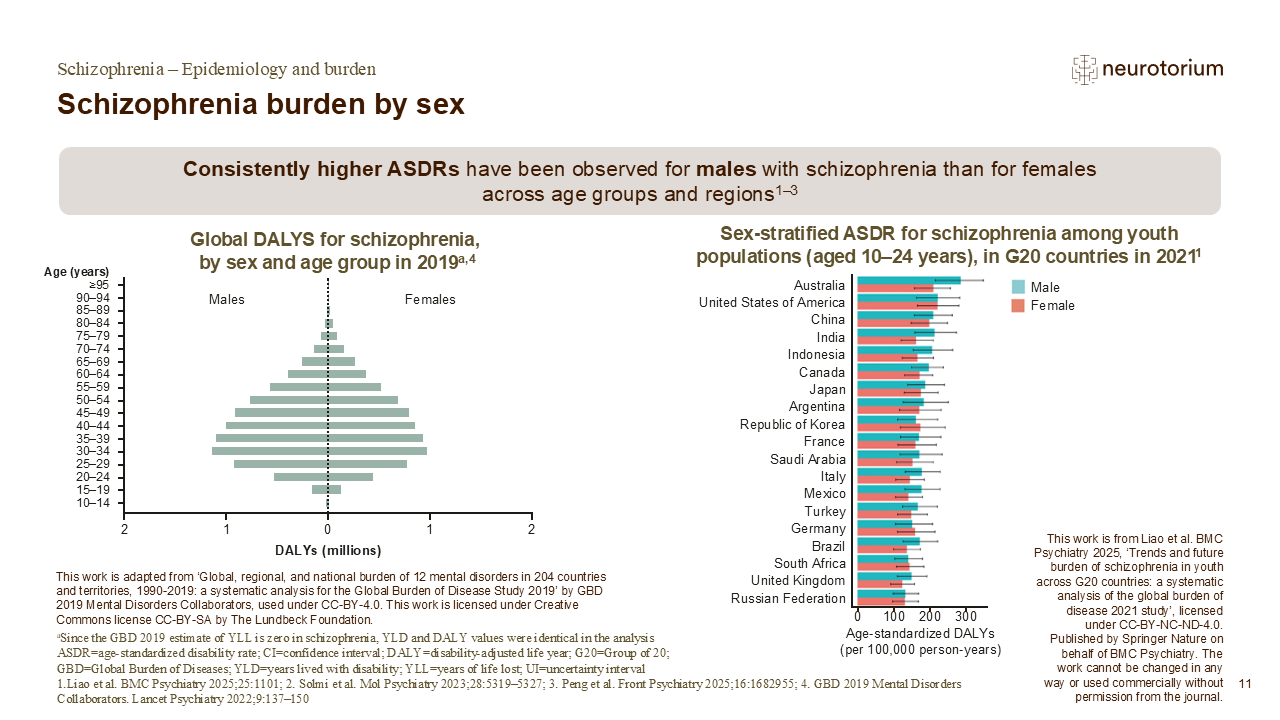
Similar to 2019 estimates, the GBD study reported higher ASDRs for males (189.0 per 100,000 [95% UI: 139.9, 243.7]) with schizophrenia than females (166.4 per 100,000 [95% UI: 122.8, 213.9]) in 2021, suggesting consistent temporal trends.5
A GBD analysis of 2021 data for individuals aged 15–39 years showed an ASDR of 255.52 per 100,000 (95% UI: 180.97, 345.67) for males with schizophrenia versus 222.77 per 100,000 (157.48, 301.86) for females.3
Abbreviations: ASDR=age-standardized disability rate; GBD=Global Burden of Diseases; UI=uncertainty interval
References:
1.Liao W, Chen Z, Wu W, et al. Trends and future burden of schizophrenia in youth across G20 countries: a systematic analysis of the global burden of disease 2021 study. BMC Psychiatry 2025; 25: 1101.
2.Solmi M, Seitidis G, Mavridis D, et al. Incidence, prevalence, and global burden of schizophrenia – data, with critical appraisal, from the Global Burden of Disease (GBD) 2019. Mol Psychiatry 2023; 28: 5319–5327.
3.Peng B, Hu F, He Q, et al. Global, regional, and national burden and trends of schizophrenia among adolescents and young adults aged 15-39 years from 1990 to 2021: an analysis of the global burden of disease study 2021. Front Psychiatry 2025; 16: 1682955.
4.GBD 2019 Mental Disorders Collaborators. Global, regional, and national burden of 12 mental disorders in 204 countries and territories, 1990-2019: a systematic analysis for the Global Burden of Disease Study 2019. Lancet Psychiatry 2022; 9: 137–150.
5.Zhan Z, Wang J, Shen T, et al. Results of the global burden of disease study for schizophrenia: trends from 1990 to 2021 and projections to 2050. Front Psychiatry 2025; 16: 1629032.