

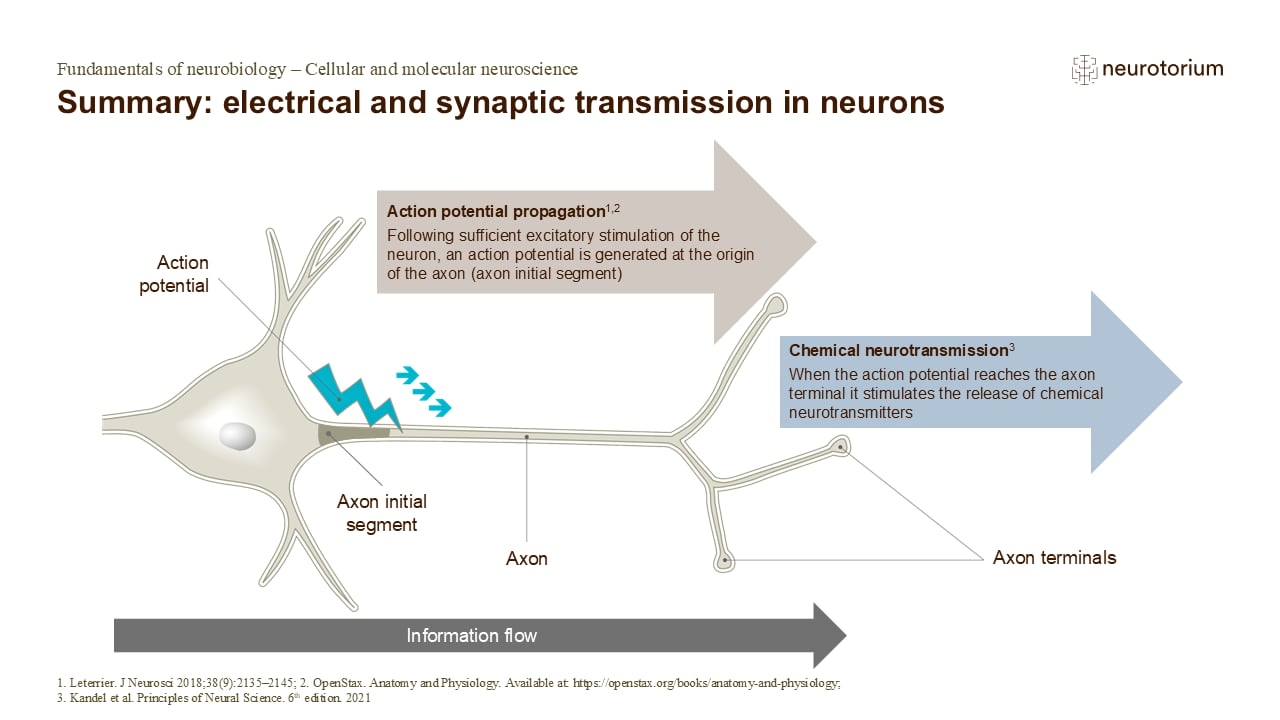
Chemical neurotransmission
An action potential is generated at the origin of the axon following sufficient excitatory stimulation of the neuron.2 The action potential is created by movement of ions across the cell membrane and it travels along the length of the axon from the cell body to the axon terminals.2 When the action potential reaches the axon terminal it stimulates the release of chemical neurotransmitters that pass the information to the next neuron.3
Electrical neurotransmission
As well as the ‘classical’ chemical synapse shown on the slide, purely electrical synapses exist in the body.3 At these synapses the gap junction between the neurons is large enough that the ion current can flow directly across the synapse depolarizing the receiving membrane.3 Although direct electrical neurotransmission has a much lower synaptic delay, chemical neurotransmission is capable of more variable and complex interactions.3
References:
1. Leterrier C. The axon initial segment: An updated viewpoint. J Neurosci 2018; 38 (9): 2135–2145.
2. OpenStax. The action potential. In: Anatomy and Physiology. Available at: https://openstax.org/books/anatomy-and-physiology.
3. Overview of synaptic transmission. In: Kandel ER, Koester JD, Mack SH, Siegelbaum SA (eds). Principles of Neural Science. 6th edition. McGraw-Hill, 2021.