

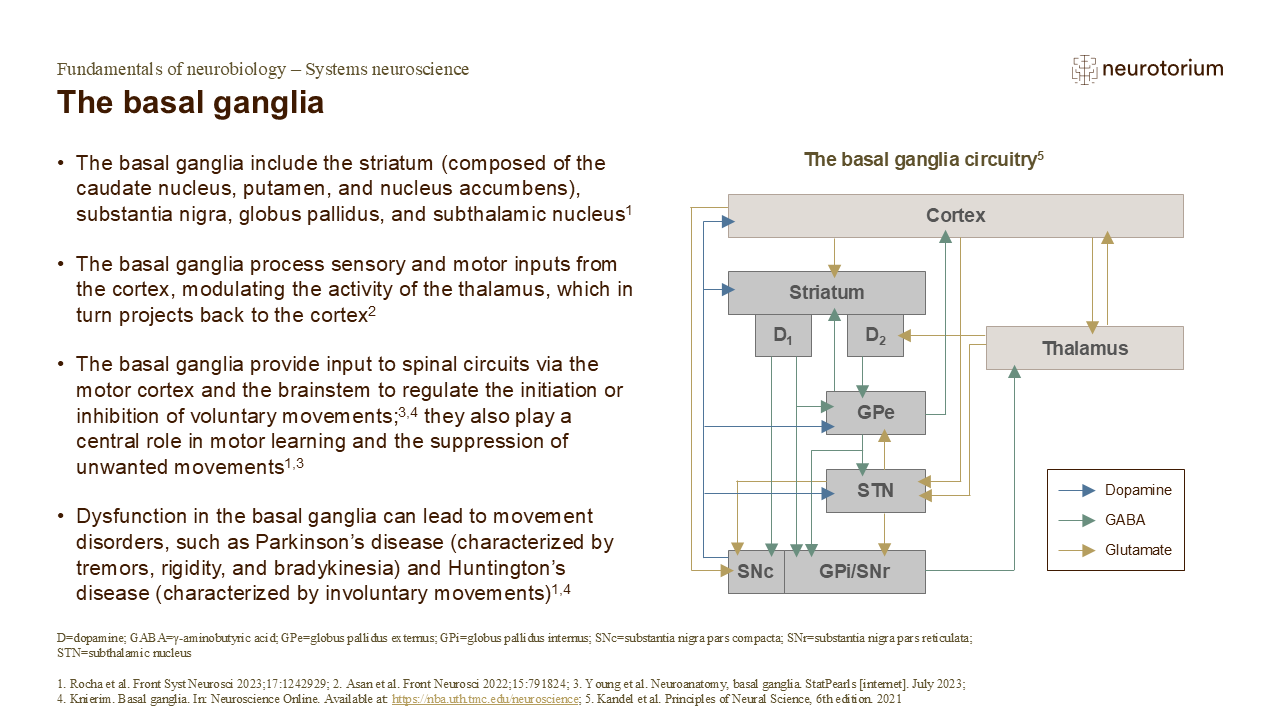
Apart from the motor cortex and the thalamus, basal ganglia also project to a wide range of areas in the brainstem and, via the thalamus, to non-motor areas of the cortex and the limbic system.5 The basal ganglia contribute to a variety of cognitive, motivational and affective operations through selecting between incompatible cognitive representations, motivational goals, or sensorimotor options, and mediating reinforcement learning.5 The intrinsic circuits in the basal ganglia nuclei are similar across the limbic, associative, and sensorimotor regions, suggesting that similar computational processes are applied to inputs from multiple different sources.5
References:
1.Rocha GS, Freire MAM, Britto AM, et al. Basal ganglia for beginners: the basic concepts you need to know and their role in movement control. Front Syst Neurosci 2023; 17: 1242929.
2.Asan AS, McIntosh JR, Carmel JB. Targeting sensory and motor integration for recovery of movement after CNS injury. Front Neurosci 2022; 15: 791824.
3.Young CB, Reddy V, Sonne J. Neuroanatomy, basal ganglia. StatPearls [internet]. July 2023. Accessed September 2025.
4.Knierim J. Chapter 4: Basal ganglia. In: Neuroscience Online. Available at: https://nba.uth.tmc.edu/neuroscience. Accessed September 2025.
5.Kandel ER, Koester JD, Mack SH, Siegelbaum SA. Principles of Neural Science, 6th edition. McGraw-Hill Professional; 2021.