


Index for
slide deck
Systems neuroscience
Systems neuroscience
Sensory systems
Sensory systems
Principles of sensory systems (I)
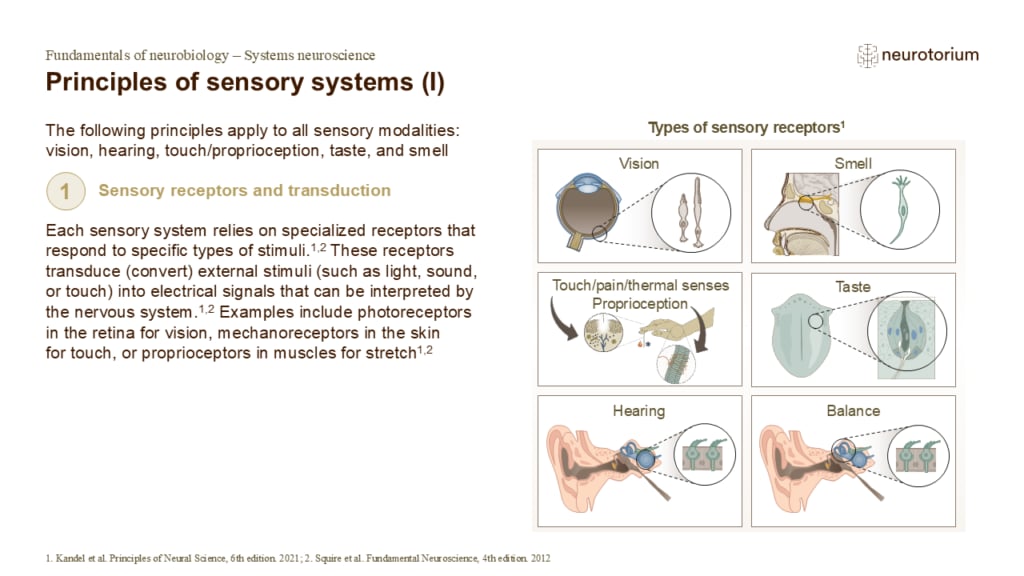
Receptors are crucial for transducing chemical, mechanical, thermal or light stimuli into signals that the rest of the nervous system will understand.2 They are highly specialized in their transduction: even receptor classes that are part of the same (e.g., somatosensory)…
Principles of sensory systems (II)
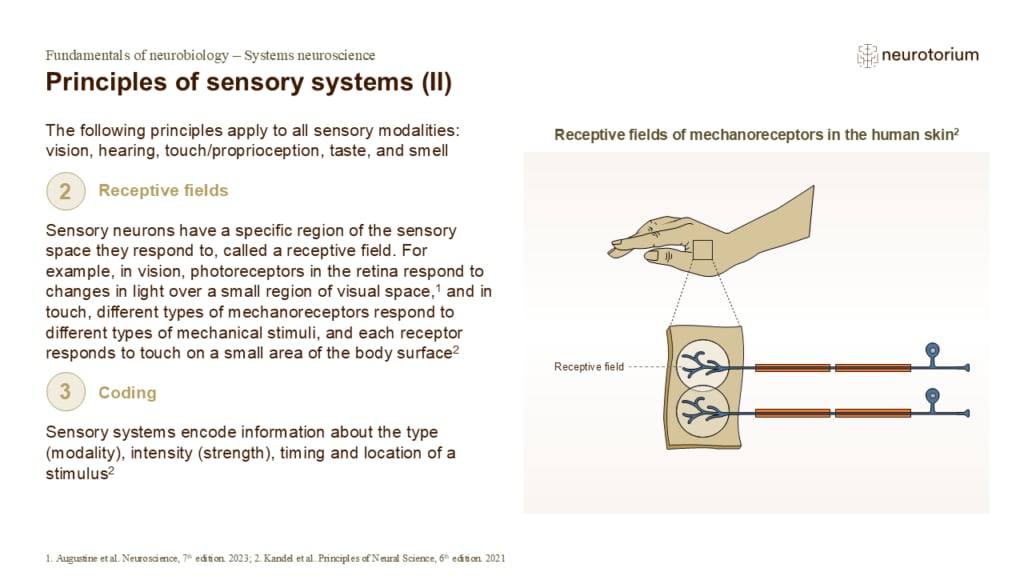
The receptive field of a neuron usually coincides with its perceptive field – the area from which a sensation is perceived to arise.2 The overlapping of receptive fields of individual neurons allows for perception to smoothly move from one sensory neuron to the next.2
The…
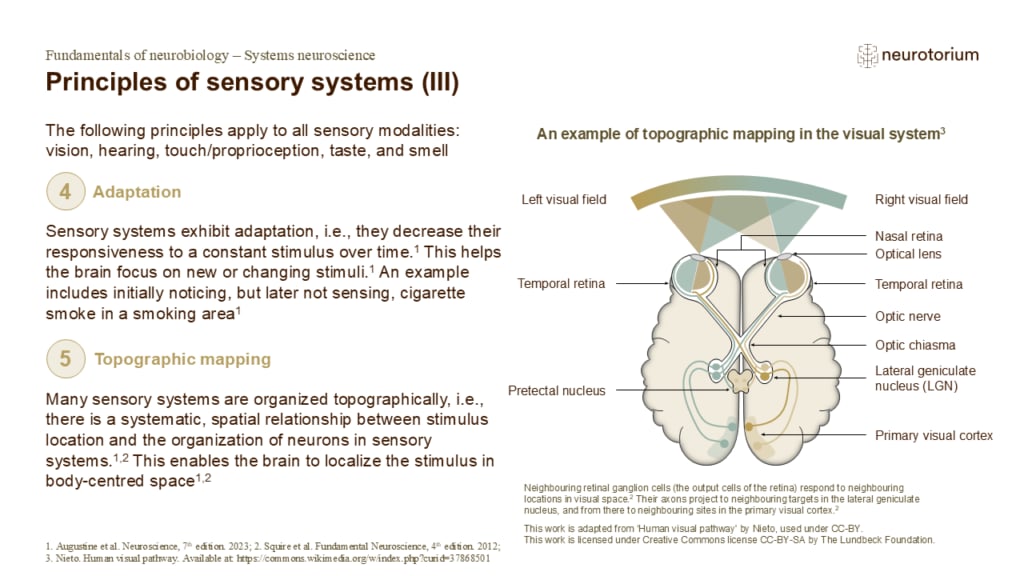
Principles of sensory systems (III)
‘Slowly adapting receptors’ respond to prolonged and constant stimulation, and generate action potentials throughout the entire stimulation period; ‘rapidly adapting receptors’ fire only at the beginning and at the end of a stimulus, and stop firing in response to stimula…
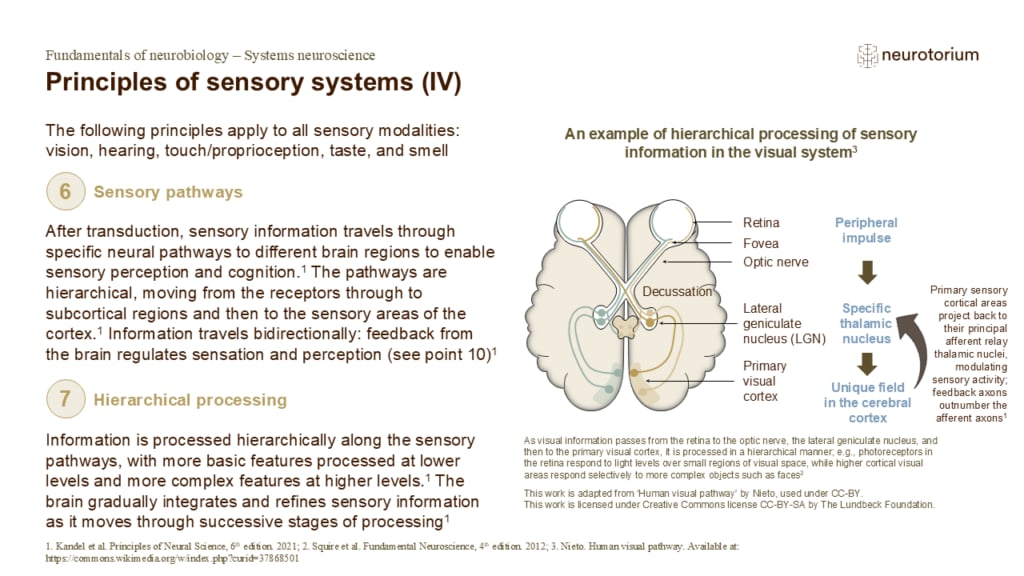
Principles of sensory systems (IV)
Principles of sensory systems (V)
Sensory perception and movement, as well as complex cognitive functions such as language, thought and memory, are made possible by the interlinkage of serial and parallel processing in different brain regions.2 Damage to a single specific area therefore may not result in …
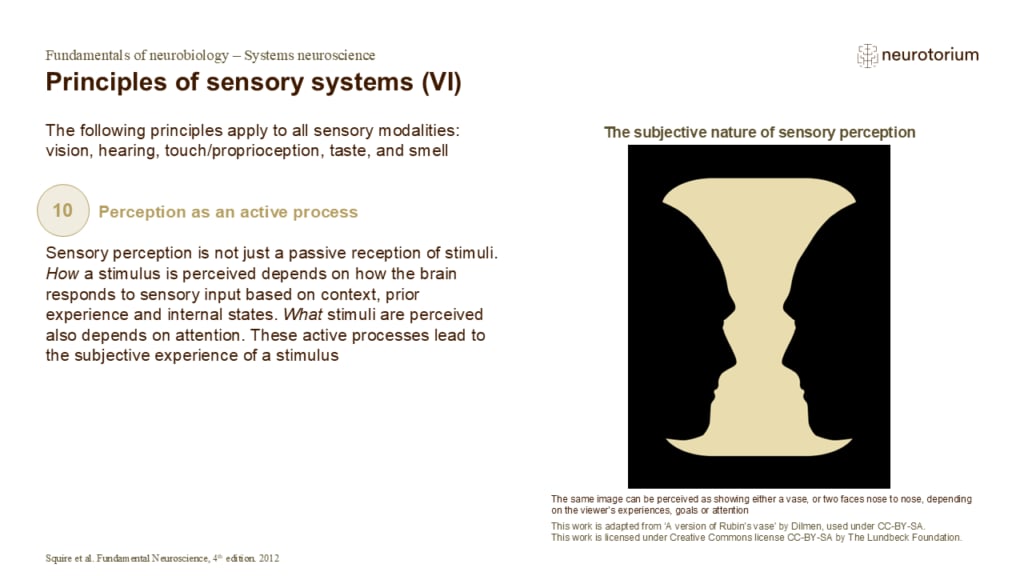
Principles of sensory systems (VI)
Interestingly, sensory information used to control actions is processed in neural pathways separate from the afferent pathways that contribute to conscious perception.2 For example, visual information seems to flow in two separate streams in the brain: a dorsal stream pro…
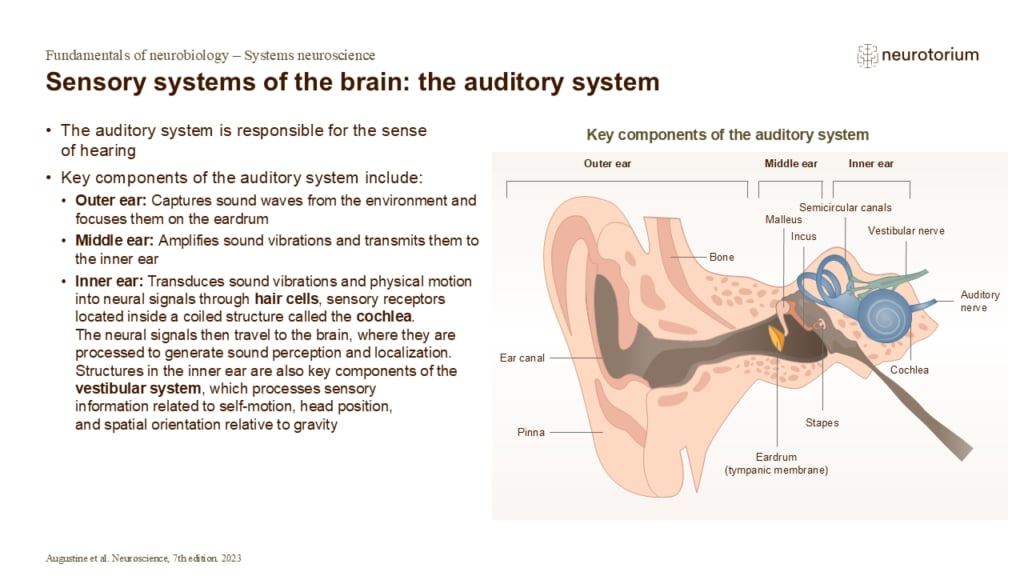
Sensory systems of the brain: the auditory system
Adults with normal hearing can detect sounds falling within the frequency range of 20 to 20,000 Hz; the higher end of the audible range usually decreases slightly with age.1 The human ear is especially sensitive to frequencies around 2,000 to 5,000 Hz.1 This appears to be…
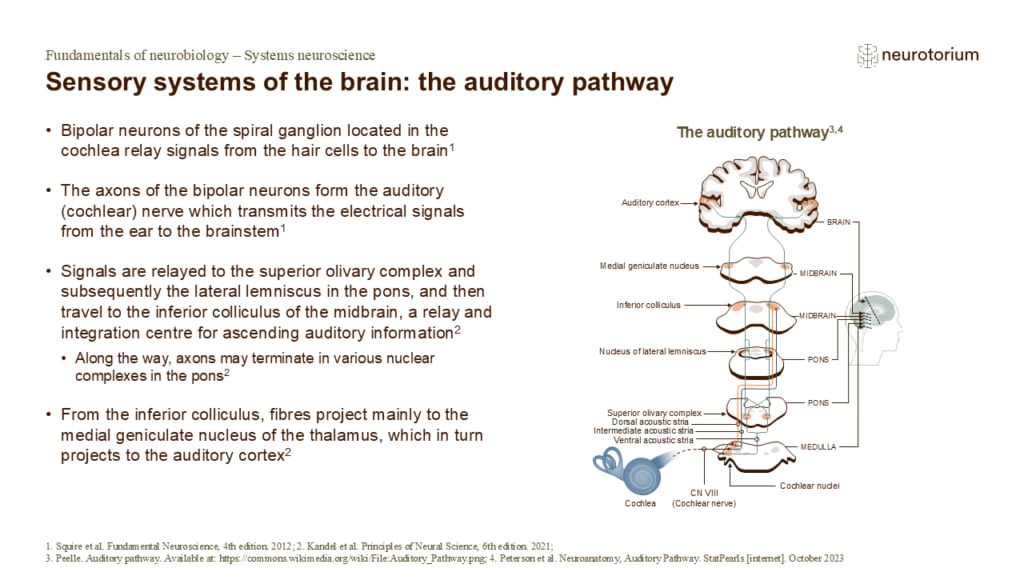
Sensory systems of the brain: the auditory pathway
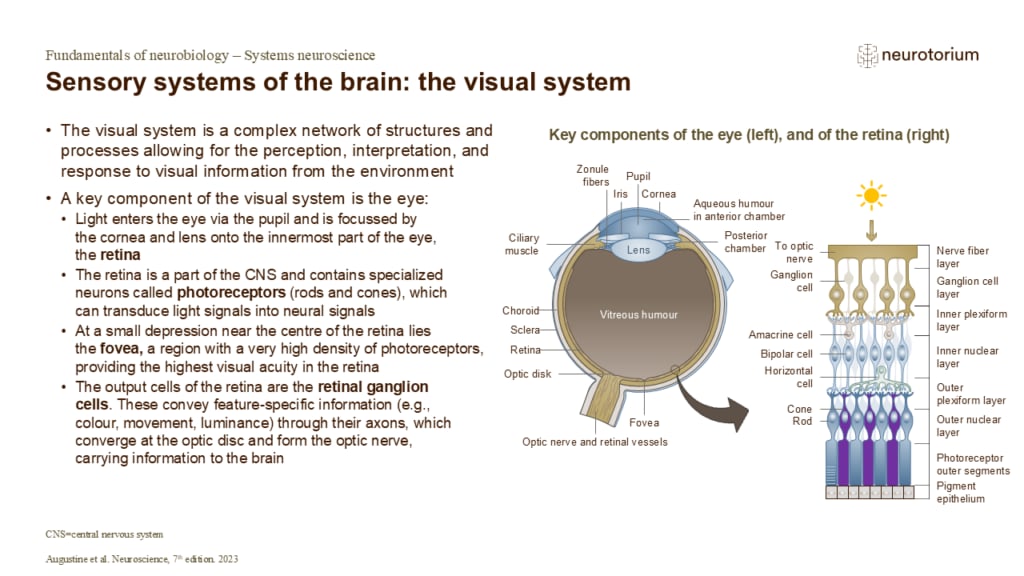
Sensory systems of the brain: the visual system
The retina is a thick (few hundred micrometres) sheet of neurons.2 It contains five major cell types, arranged in three cellular layers (i. photoreceptors [rods or cones]; ii. horizontal, bipolar and amacrine cells; iii. ganglion cells), separated by the outer and inner (…
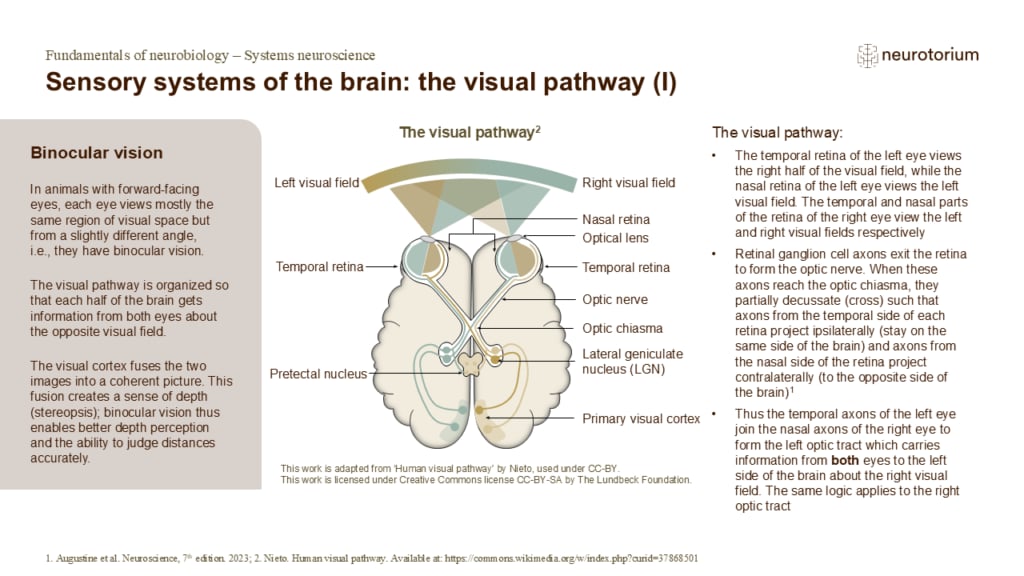
Sensory systems of the brain: the visual pathway (I)
Sensory systems of the brain: the visual pathway (II)
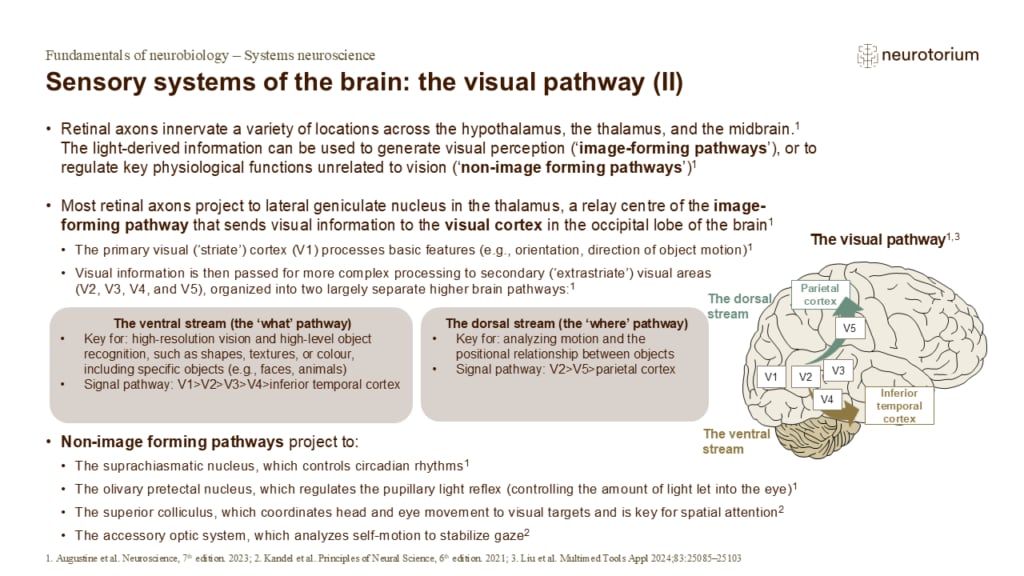
A greater portion of the brain is devoted to processing visual information than to any other sensory function:4 almost half of the cerebral cortex.2
Visual/light input is crucial for multiple other key biological functions apart from visual perception.2 An important examp…
Sensory systems of the brain: the olfactory system
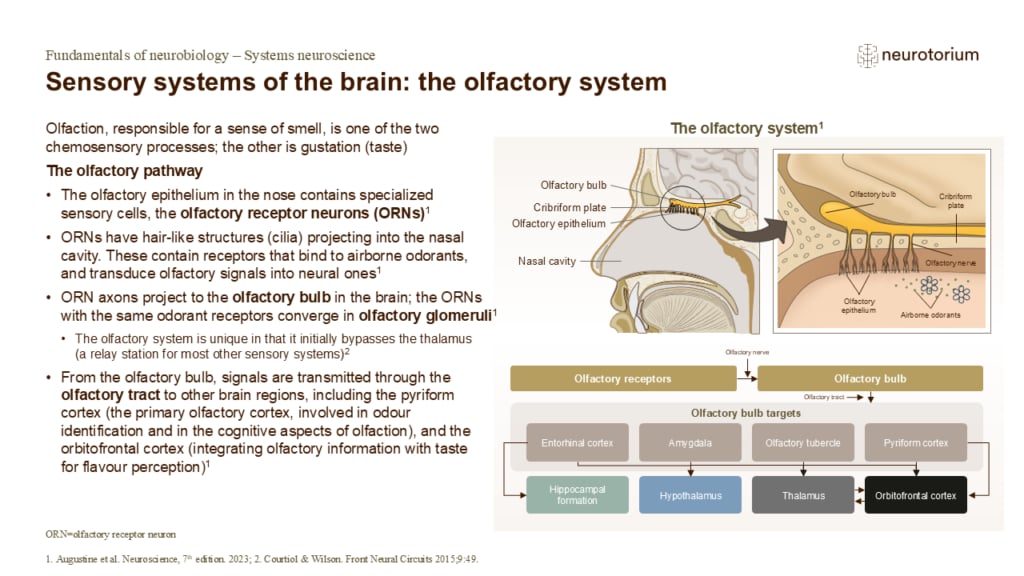
Apart from the main olfactory pathway, many species also have an accessory olfactory pathway for the detection of pheromones: species- and gender-specific chemical cues that provide information about an individual’s social, sexual and reproductive status.3 The sensory str…
Sensory systems of the brain: the gustatory system
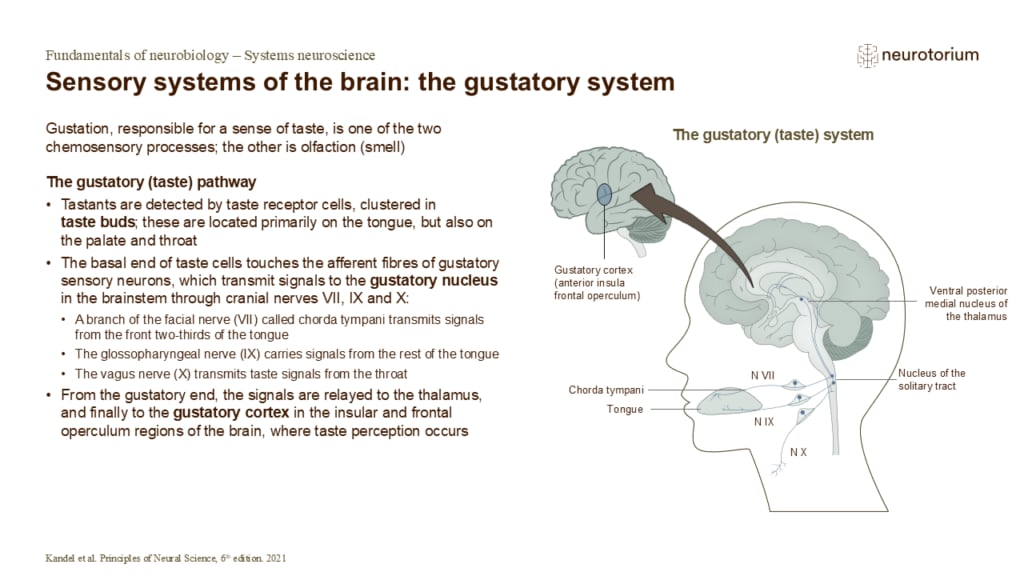
The gustatory system is a specialized sensory system dedicated to evaluating potential food sources, and is the main driver of feeding decisions.1 In contrast to the olfactory system, which can distinguish millions of kinds of odours, the gustatory system can only disting…
Sensory systems of the brain: the somatosensory system
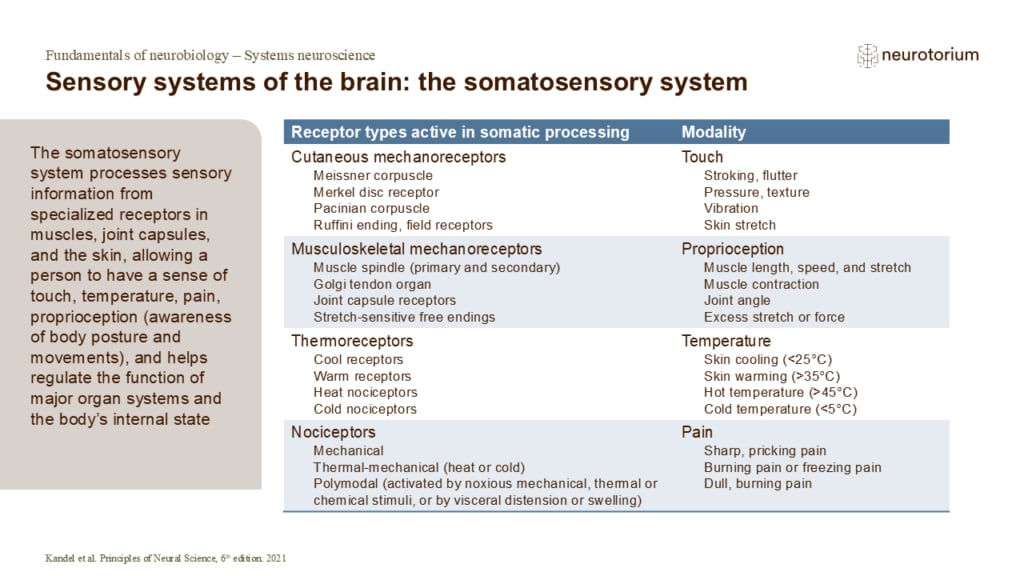
The primary sensory cells of the somatosensory system are the dorsal root ganglion (DRG) neurons.1 Individual neurons within a DRG respond selectively to specific types of stimuli because of specific morphological and molecular features of their peripheral terminals.1
Whe…
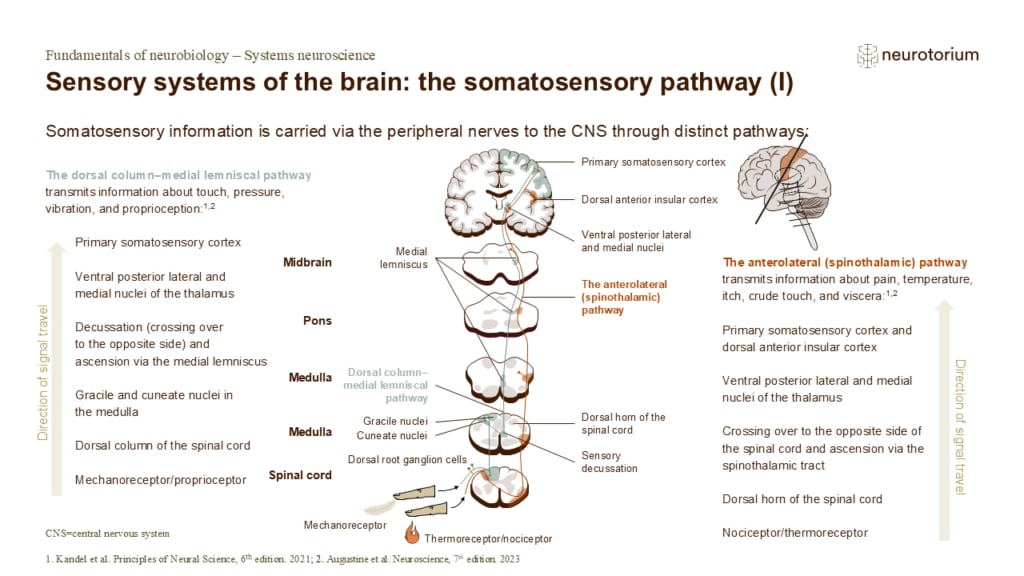
Sensory systems of the brain: the somatosensory pathway (I)
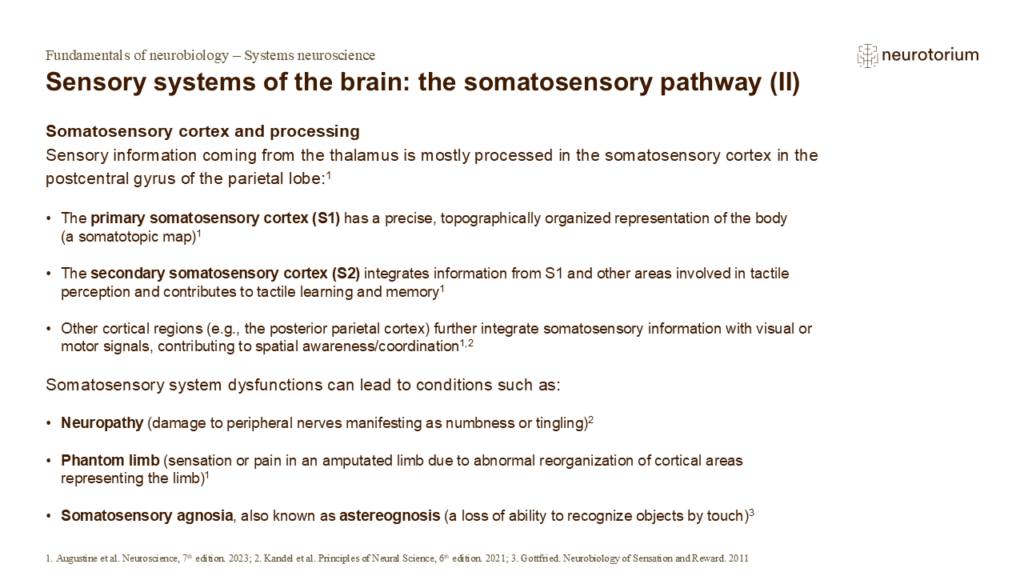
Sensory systems of the brain: the somatosensory pathway (II)
An important source of information about the function of different neural structures, including the posterior parietal cortex, are studies of naturally occurring or experimental lesions, which have demonstrated the crucial role of the parietal cortex in linking sensory in…
Related content
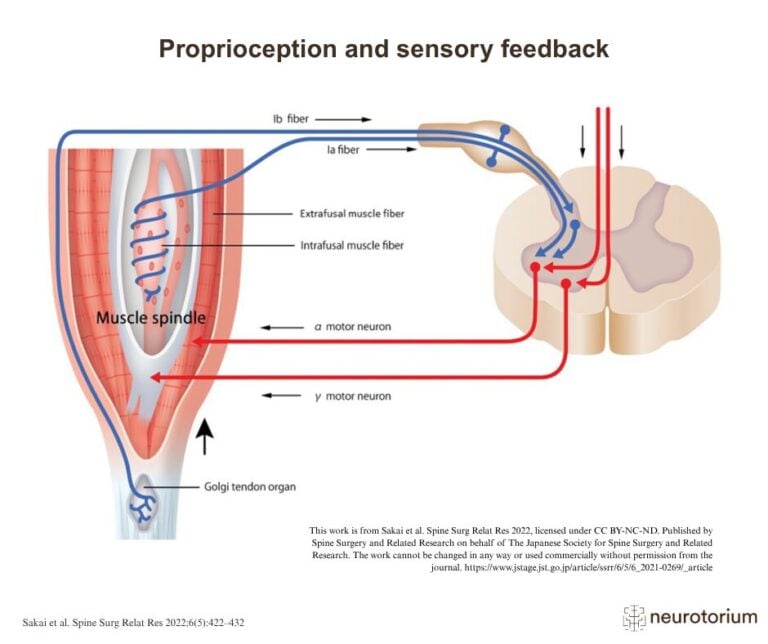
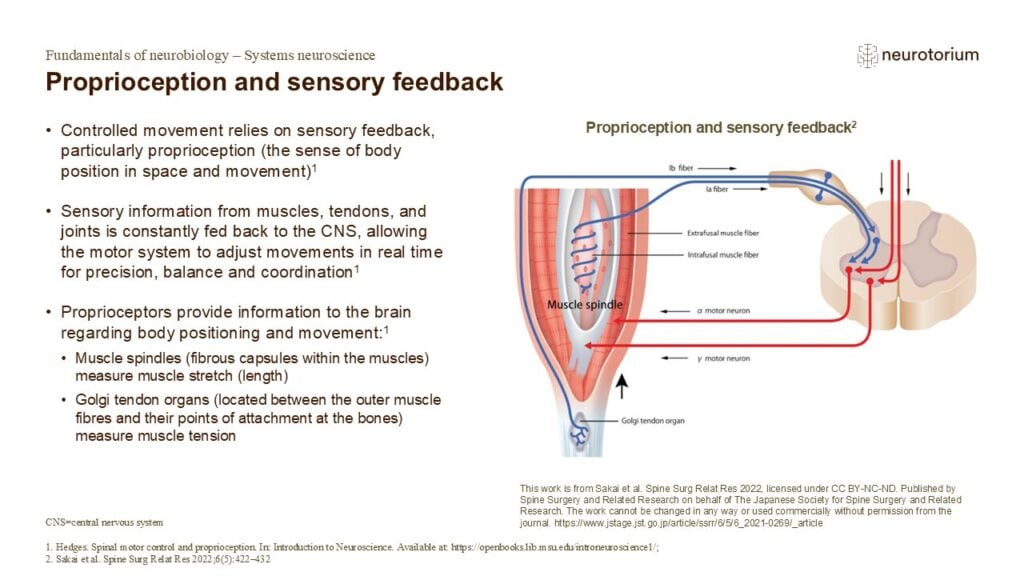
Controlled movement relies on sensory feedback, particularly proprioception (the sense of body position in space and movement).
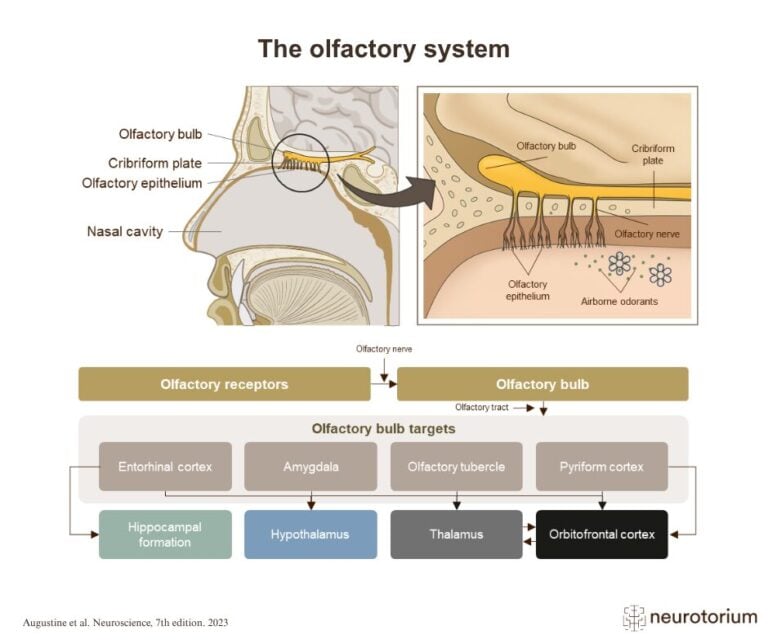
The olfactory system detects airborne odor molecules in the nasal cavity and transmits this information to the olfactory bulb. From there, signals are relayed to several brain regions involved in smell perception, memory, emotion, and behaviour.
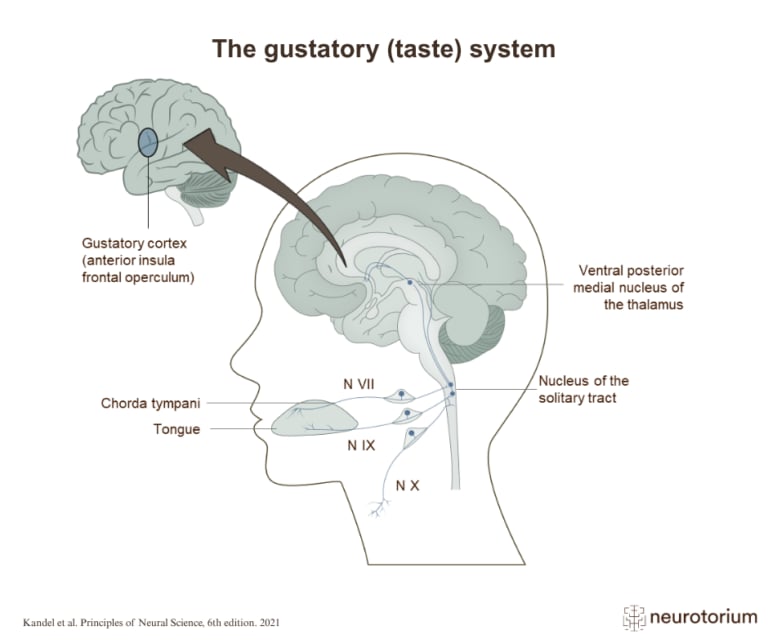
The gustatory system detects taste stimuli on the tongue and relays this information through brainstem and thalamic pathways to the gustatory cortex.