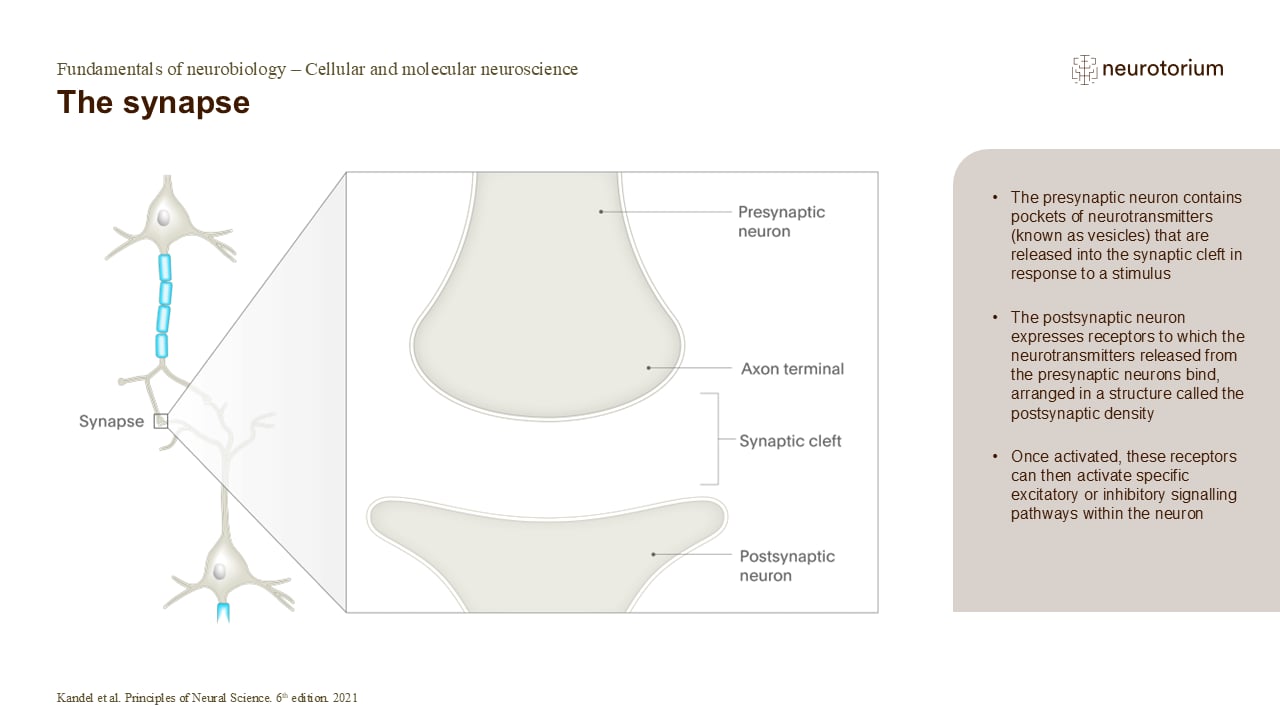
Neurons are not physically connected; two neurons are separated by a gap, known as a synaptic cleft.1 Because neurons do not touch, and an action potential does not ‘jump’ across a synaptic cleft at a chemical synapse, the electrical signal in the presynaptic neuron must be converted to a chemical signal to enable communication between neurons to occur.1 In response to the arrival of an action potential at presynaptic terminals, presynaptic neurons release chemical signals (neurotransmitters) that diffuse across the synaptic cleft and bind to receptors on the postsynaptic neurons, causing the generation of an electrical potential in the postsynaptic neuron.1
The synapse