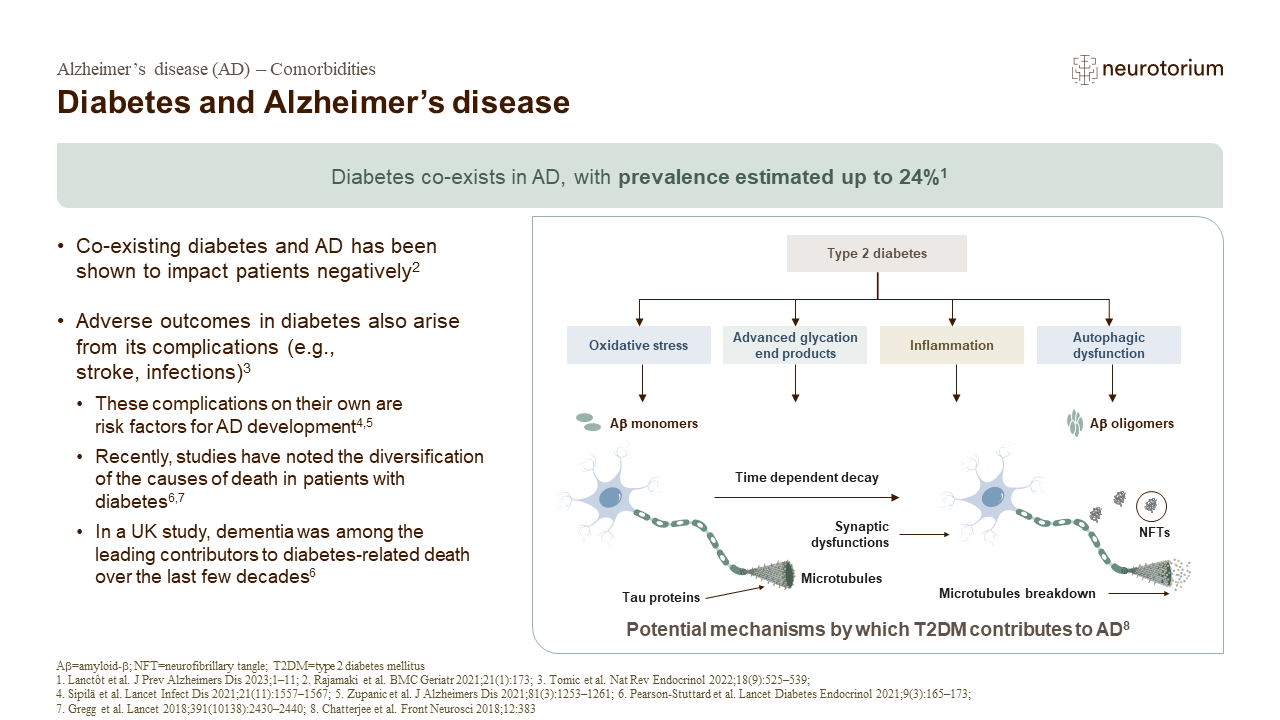
Diabetes and AD may share risk factors, including overlapping metabolic risk factors. Apolipoprotein E (APOE) also regulates lipid metabolism.9 This suggests that the aetiology of AD includes metabolic risk factors, which are also involved in the development of diabetes.10 Hyperglycaemia is the main characteristic of impaired glucose tolerance and diabetes,11 with evidence that hyperglycaemia is a potential risk factor for the development of cognitive dysfunction and dementia.12
An additional type of diabetes that has recently been identified – type 3 diabetes mellitus (T3DM) – manifests as insulin resistance within the brain.13 As a result, T3DM may impact neurocognition and contribute to the aetiology of AD.13 Scientists have attempted to define T3DM as a metabolic syndrome that may lead to abnormalities associated with progressive brain insulin resistance, accumulation of neurotoxins, and neuronal stress; resulting in neurodegeneration.14 Insulin resistance is now a well-known essential feature of T3DM; therefore, treatments for T3DM, such as those aimed at improving insulin sensitivity, may also be beneficial for patients at risk for AD at the early stages.13 Once dementia is diagnosed and pathological changes are evident, it is difficult to reverse the progression of disease.11 Therefore, an important goal for diabetes-related dementia is to identify individual risk factors and prevent the occurrence of diabetes and dementia.11
References:
1.Lanctôt KL, Hahn-Pedersen JH, Eichinger CS, et al. Burden of illness in people with Alzheimer’s disease: a systematic review of epidemiology, comorbidities and mortality. J Prev Alzheimers Dis 2023; 1–11.
2.Rajamaki B, Hartikainen S, Tolppanen AM. The effect of comorbidities on survival in persons with Alzheimer’s disease: a matched cohort study. BMC Geriatr 2021; 21 (1): 173.
3.Tomic D, Shaw JE, Magliano DJ. The burden and risks of emerging complications of diabetes mellitus. Nat Rev Endocrinol 2022; 18 (9): 525–539.
4.Sipilä PN, Heikkilä N, Lindbohm JV, et al. Hospital-treated infectious diseases and the risk of dementia: a large, multicohort, observational study with a replication cohort. Lancet Infect Dis 2021; 21 (11): 1557–1567.
5.Zupanic E, von Euler M, Winblad B, et al. Mortality after ischemic stroke in patients with Alzheimer’s disease dementia and other dementia disorders. J Alzheimers Dis 2021; 81 (3): 1253–1261.
6.Pearson-Stuttard J, Bennett J, Cheng YJ, et al. Trends in predominant causes of death in individuals with and without diabetes in England from 2001 to 2018: an epidemiological analysis of linked primary care records. Lancet Diabetes Endocrinol 2021; 9 (3): 165–173.
7.Gregg EW, Cheng YJ, Srinivasan M, et al. Trends in cause-specific mortality among adults with and without diagnosed diabetes in the USA: an epidemiological analysis of linked national survey and vital statistics data. Lancet 2018; 391 (10138): 2430–2440.
8.Chatterjee S, Mudher A. Alzheimer’s disease and type 2 diabetes: a critical assessment of the shared pathological traits. Front Neurosci 2018; 12: 383.
9.Carmel JF, Tarnus E, Cohn JS, et al. High expression of apolipoprotein E impairs lipid storage and promotes cell proliferation in human adipocytes. J Cell Biochem 2009; 106 (4): 608–617.
10.Cheng G, Huang C, Deng H, Wang H. Diabetes as a risk factor for dementia and mild cognitive impairment: a meta-analysis of longitudinal studies. Intern Med J 2012; 42 (5): 484–491.
11.Lee HJ, Seo HI, Cha HY, et al. Diabetes and Alzheimer’s disease: mechanisms and nutritional aspects. Clin Nutr Res 2018; 7 (4): 229–240.
12.Barbagallo M, Dominguez LJ. Type 2 diabetes mellitus and Alzheimer’s disease. World J Diabetes 2014; 5 (6): 889–893.
13.Nguyen TT, Ta QTH, Nguyen TKO, et al. Type 3 diabetes and its role implications in Alzheimer’s disease. Int J Mol Sci 2020; 21 (9): 3165.
14.Nguyen TT, Ta QTH, Nguyen TTD, et al. Role of insulin resistance in the Alzheimer’s disease progression. Neurochem Res 2020; 45 (7): 1481–1491.