

The biomarker classification system for AD provides three main classes of biomarkers: amyloid-β (Aβ; A), tau (T), and neurodegeneration (N), denoted as A/T/(N).4 While abnormal Aβ and p-tau are considered to be key features of AD in this framework, neurodegeneration may be a feature of other neurodegenerative diseases, which is why it is written in parentheses.5 Biomarkers for Aβ include amyloid PET and cerebrospinal fluid (CSF) concentrations of Aβ.6 Tau biomarkers include tau-PET and CSF concentrations of p-tau.6 For neurodegeneration, biomarkers include FDG-PET, MRI atrophy, CSF concentrations of total tau and of neurofilament light chain.6 The A/T/(N) framework allows identification of biological AD in living individuals and the tracking of AD through preclinical, MCI, and dementia stages.6
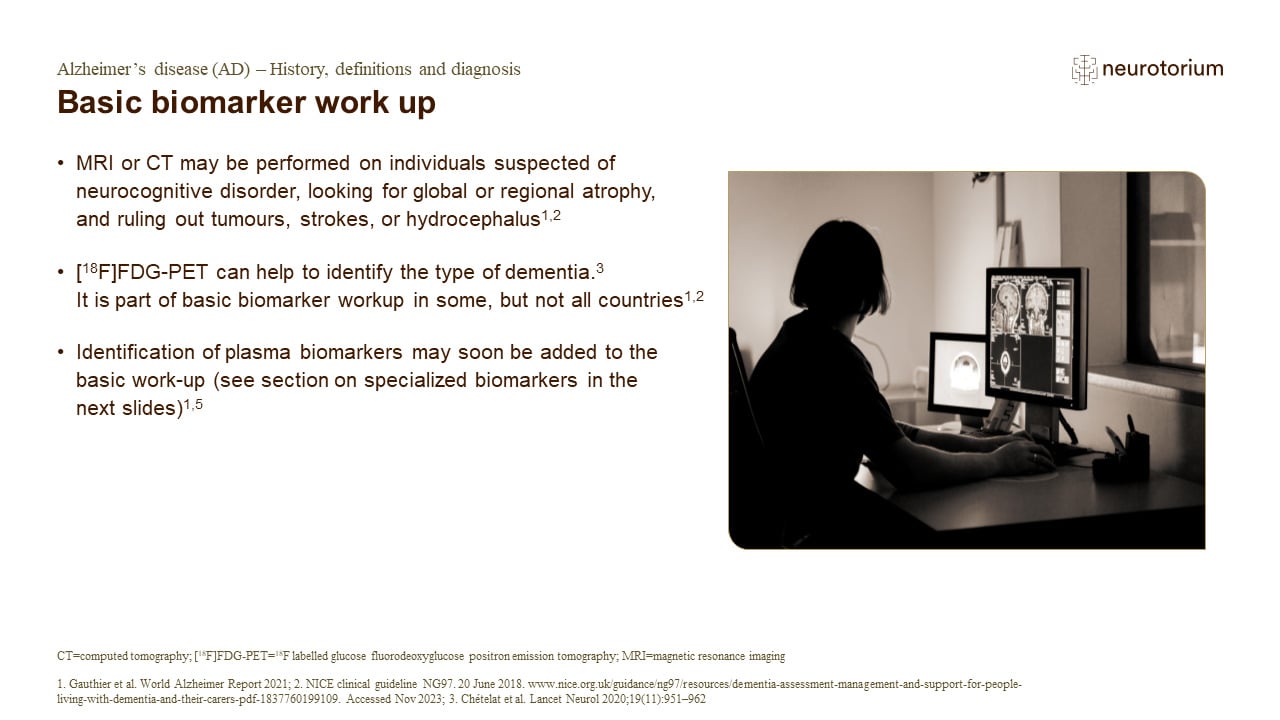
Detection of increased levels of neuropathologies in specific brain regions before presentation of global abnormalities is a unique feature of PET imaging.6 Using PET, amyloid and tau pathology can be identified.6 Additionally, FDG-PET can be used as an index of tripartite synaptic activity, which is the coupling between energy usage by neurons and astrocytes.6 MRI on the other hand, is used to assess brain structure and can identify atrophy in regions of the brain such as the hippocampus.7
More recently, the development of ultrasensitive assays for Aβ and p-tau in plasma provides evidence that AD biomarker assessments using minimally invasive, scalable, and accessible methods, is a possibility.6 Similar to CSF samples, single blood samples make it possible to assess several aspects of the AD pathological processes.6 If available, plasma assessments may be used for routine pre-screening, while CSF or PET examinations are used to confirm the presence of pathology before the initiation of treatment.6
References:
1.Gauthier S, Rosa-Neto P, Morais JA, Webster C. World Alzheimer Report 2021: Journey through the diagnosis of dementia. Available at: https://www.alzint.org/u/World-Alzheimer-Report-2021.pdf. Accessed 15 November 2023.
2.National Institute for Health and Care Excellence. NICE clinical guideline NG97. 20 June 2018. Available at: www.nice.org.uk/guidance/ng97/resources/dementia-assessment-management-and-support-for-people-living-with-dementia-and-their-carers-pdf-1837760199109. Accessed 15 November 2023