

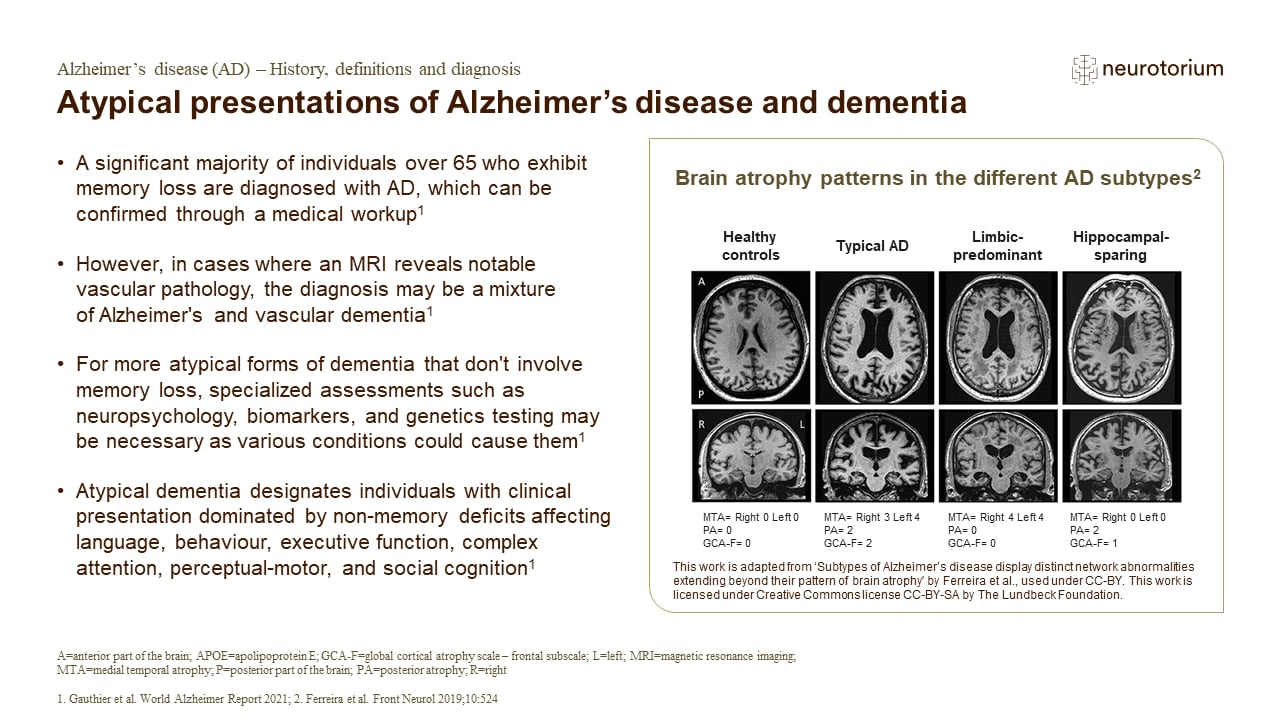
The most common clinical presentation of typical AD involves a slow, progressive amnestic disorder which reflects the predominant early distribution of neurofibrillary tangles (NFTs) in medial temporal-lobe structures.3 These changes can be observed as medial temporal atrophy using MRI.2 In typical AD subtype, expected patterns of both limbic and cortical involvement are observed.2 In limbic-predominant AD, medial temporal atrophy is abnormal, with normal posterior atrophy and global cortical atrophy.2 In the hippocampal sparing AD subtype (young-onset, non-amnestic presentation, and APOE e4 negative), there tends to be greater cortical pathology relative to sparing of the hippocampus.3 Abnormal posterior atrophy and/or abnormal global cortical atrophy are observed with normal medial temporal atrophy.2 Disproportionate differences are observed in age onset, clinical presentation, and APOE e4 positivity between hippocampal sparing AD and typical AD.3
Eventually, the distribution of NFTs evolves into an amnestic-predominant multi-domain dementia.3 Non-amnestic phenotypes, however, are characterized based on initial dominant difficulties in visual, language, executive, behavioural, and motor domains, which disproportionately affects individuals with young-onset dementia (symptoms occur before age 65).3,4 For younger patients with non-amnestic symptoms, or those lacking the ‘typical’ hippocampal volume loss, AD dementia may go undetected. 3 Due to their young age and unusual symptoms, life stresses, or new-onset psychiatric illnesses may be used to explain the symptoms of patients with non-amnestic AD.3 Several different disease processes may cause atypical, early-onset dementia, therefore it is important that an accurate diagnosis is made.1 In addition, for individuals with atypical, early-onset dementia, advanced diagnostic tests in specialized centres are required.1
References:
1.Gauthier S, Rosa-Neto P, Morais JA, Webster C. World Alzheimer Report 2021: Journey through the diagnosis of dementia. Available at: https://www.alzint.org/u/World-Alzheimer-Report-2021.pdf. Accessed 15 November 2023