

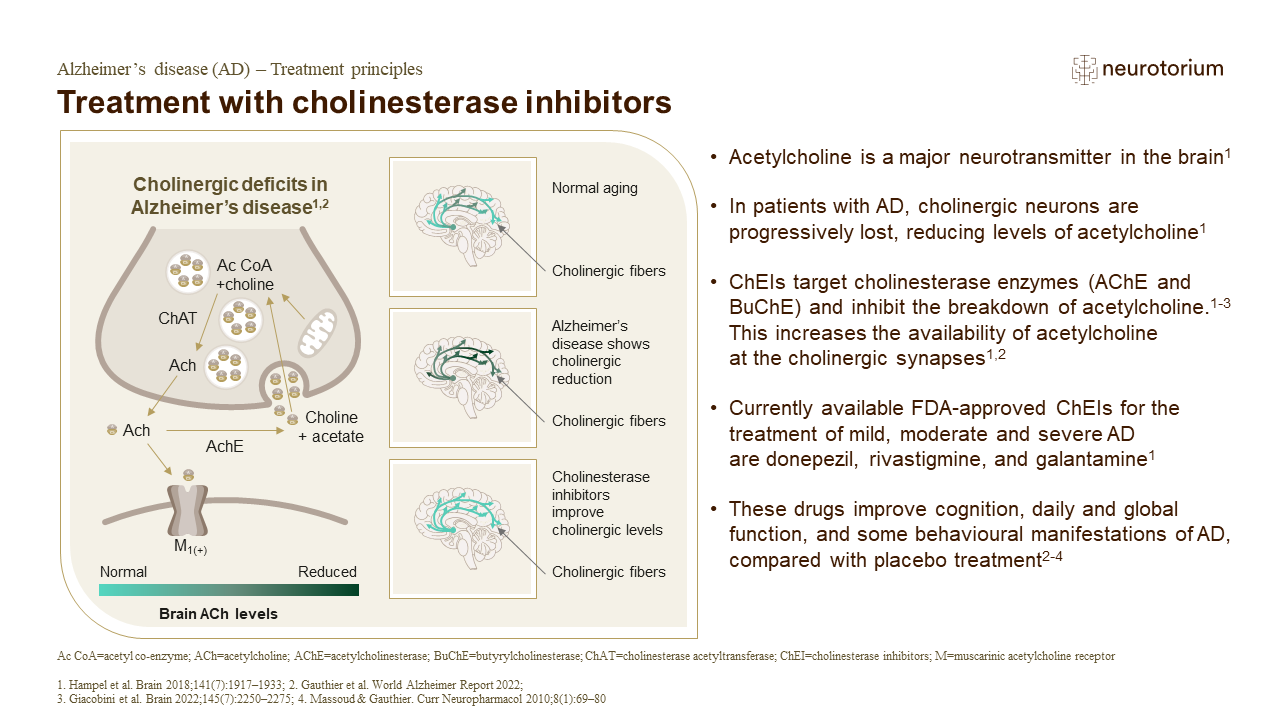
Currently, the main available treatment of cognitive and behavioural symptoms in AD involves enhancement of cholinergic neurotransmission using cholinesterase inhibitors.3 There are currently three cholinergic-based drugs that represent the standard of care for AD.3 The use of these treatments is supported by the early impairment of the cholinergic system and its strong association to cognitive deficits.3 Cholinesterase inhibitor therapies for AD have generally been considered as short-term interventions with symptomatic effects lasting between 3 and 6 months.3 However, trials suggest that stabilization of symptoms and maintenance of clinical effects for more than one year may be feasible.5 Data has demonstrated that long-term effects, for up to 3 years, may be experienced using donepezil, rivastigmine, and galantamine.5
2. Gauthier S, Webster C, Servaes S, et al. World Alzheimer Report 2022: Life after diagnosis: navigating treatment, care and support. Available at: https://www.alzint.org/u/World-Alzheimer-Report-2022.pdf. Accessed October 2023.