

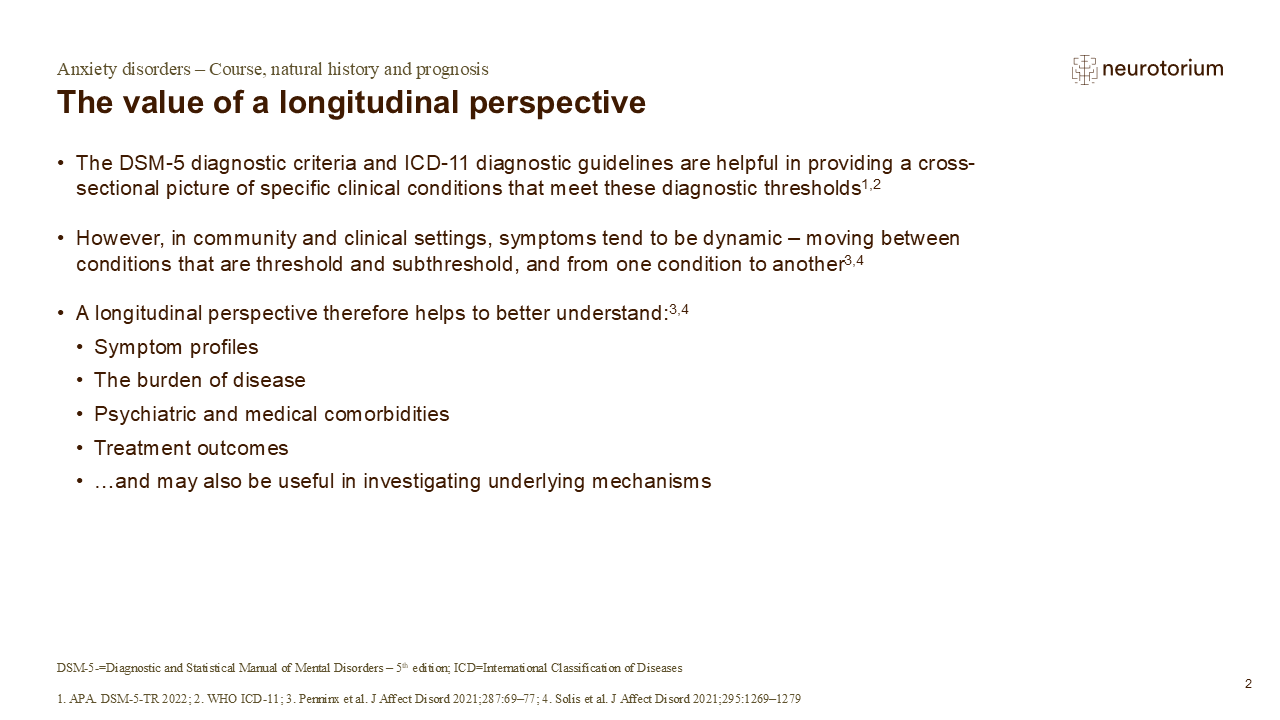
DSM diagnostic criteria may not fully capture the persistence of depressive and anxiety symptoms over time, as recovery according to DSM criteria does not necessarily coincide with symptomatic recovery.4 This was demonstrated by the Netherlands Study of Depression and Anxiety (NESDA), which evaluated data from 1,701 patients who had a depressive and/or anxiety disorder at baseline. At 9-year follow-up, only 8.5% of patients were considered to have a chronic illness according to the categorical DSM criteria, compared with 66.8% of patients considered to have a chronic illness according to dimensional symptom severity evaluation pathways.4 On the other hand, the rates of ‘combined’ recovery (i.e., those who had intermittently or consistently recovered) were much higher according to the DSM criteria than according to the dimensional symptom severity evaluation pathways (58.6% vs 7.5%).4 Some of this discrepancy may be due to the dimensional approach relying on self-report questionnaires assessing a period of 1–2 weeks, while the categorical approach used structural DSM diagnostic interviews evaluating a six-month period that accounted for patients’ level of functioning.4 However, these results suggest that using DSM diagnoses alone to describe the clinical course of depression and/or anxiety may overestimate the rates of recovery and underestimate rates of chronicity, and inadequately capture the persistence of symptoms and the clinical course of these disorders.4
2. World Health Organization. International Classification of Diseases – 11th edition. Available at: https://icd.who.int/en. Accessed July 2025.