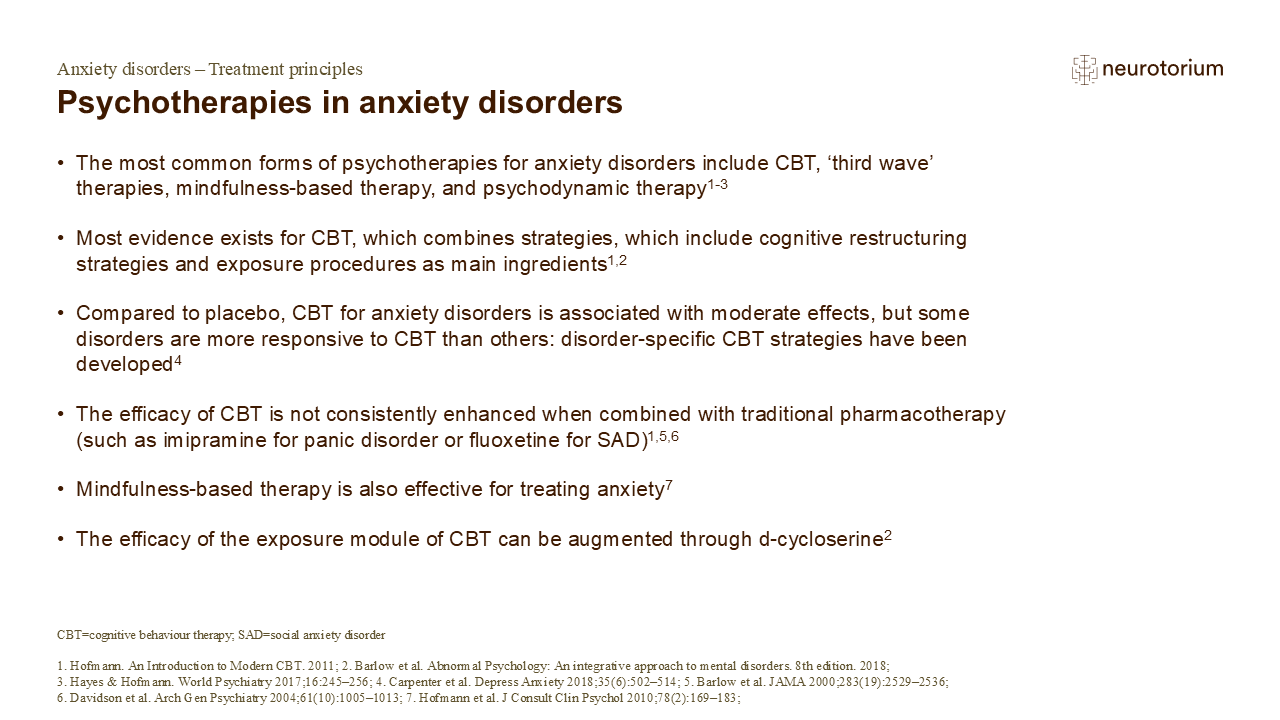
CBT has been widely-studied for the treatment of anxiety disorders, which includes cognitive restructuring and exposure.1,2 A meta-analysis has shown that effect sizes for diagnosis-specific symptoms, anxiety, depression, and quality of life differed across different types of anxiety disorder.4 The greatest effect sizes were observed in obsessive-compulsive disorder and generalized anxiety disorder.4
References:
1. Hofmann SG. An Introduction to Modern CBT. New York: Wiley, 2011.
2. Barlow DH, Durand VM, Hofmann SG. Abnormal psychology: An integrative approach. 8th edition. Boston: Cengage; 2018.
3. Hayes SC, Hofmann SG. The third wave of CBT and the rise of process-based care. World Psychiatry 2017; 16: 245–246.
4. Carpenter JK, Andrews LA, Witcraft SM, et al. Cognitive behavioral therapy for anxiety and related disorders: a meta-analysis of randomized placebo-controlled trials. Depress Anxiety 2018; 35 (6): 502–514.
5. Barlow DH, Gorman JM, Shear MK, Woods SW. Cognitive-behavioral therapy, imipramine, or their combination for panic disorder: a randomized controlled trial. JAMA 2000; 283 (19): 2529–2536.
6. Davidson JR, Foa EB, Huppert JD, et al. Fluoxetine, comprehensive cognitive behavioral therapy, and placebo in generalized social phobia. Arch Gen Psychiatry 2004; 61 (10): 1005–1013.
7. Hofmann SG, Sawyer AT, Witt AA, Oh D. The effect of mindfulness-based therapy on anxiety and depression: a meta-analytic review. J Consult Clin Psychol 2010; 78 (2): 169–183.