

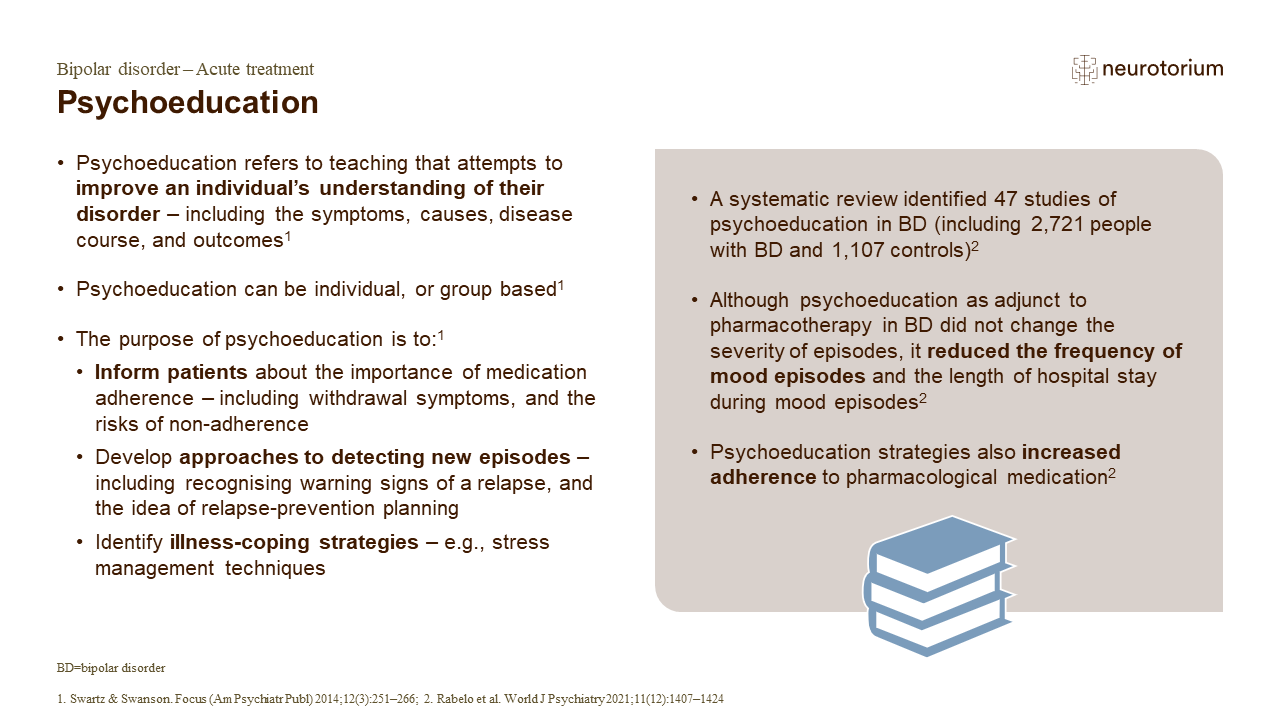
The purpose of psychoeducation in bipolar disorder is to provide patients with information about the disorder, and to try to communicate the importance of medication in its treatment, thereby empowering patients.1 When delivered as adjunct to standard-of-care pharmacotherapy, psychoeducation has been shown to reduce the frequency of mood episodes.2,3
References:
1. Swartz HA, Swanson J. Psychotherapy for bipolar disorder in adults: a review of the evidence. Focus (Am Psychiatr Publ) 2014; 12 (3): 251–266.
2. Rabelo JL, Cruz BF, Ferreira JDR, Viana BM, Barbosa IG. Psychoeducation in bipolar disorder: a systematic review. World J Psychiatry 2021; 11 (12): 1407–1424.
3. Miklowitz DJ, Efthimiou O, Furukawa TA, et al. Adjunctive psychotherapy for bipolar disorder: a systematic review and component network meta-analysis. JAMA Psychiatry 2021; 78 (2): 141–150.