

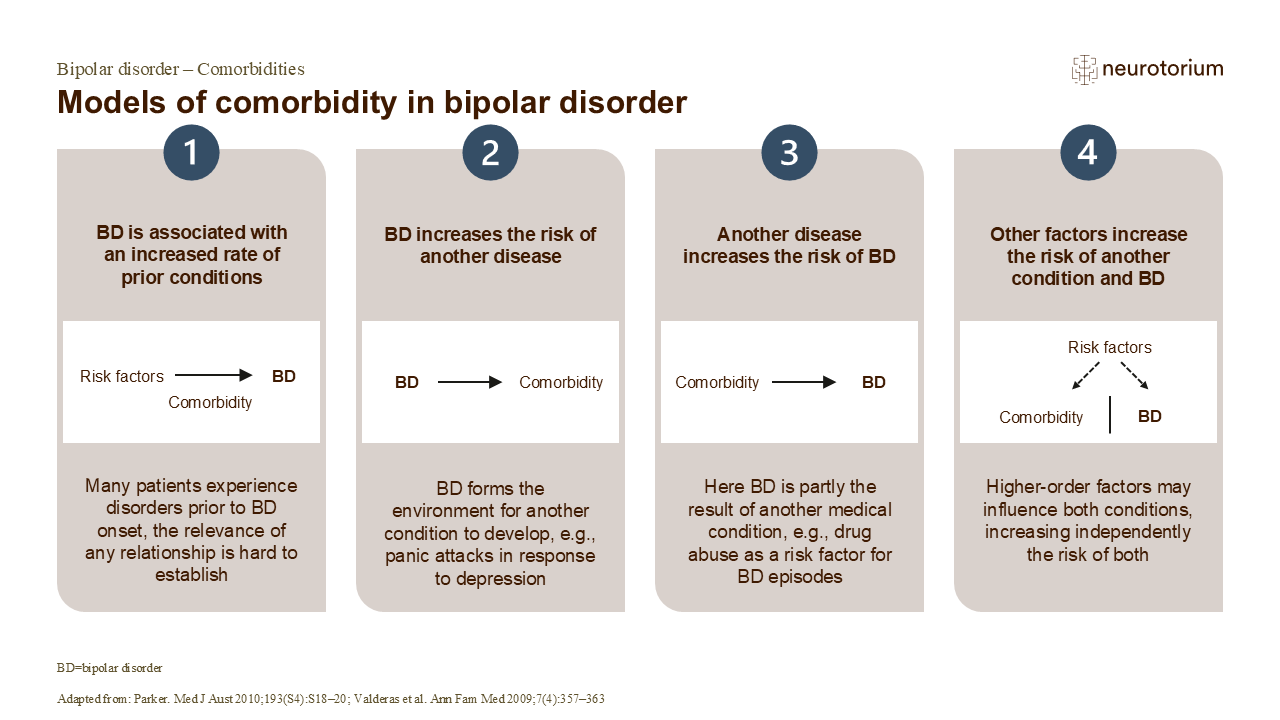
Disentangling the relationships between two disorders, in an individual patient and across populations, is complicated.1,2 Consider a person who has diabetes; patients with diabetes have an increased risk of certain eye disorders, because elevated glucose can lead to eye complications.2 For this reason, people with diabetes are often routinely screened for certain eye problems.2 During this screening, an optometrist may detect other, non-hyperglycaemic eye disorders.2 Therefore, in a sample of people with diabetes, one might expect a higher rate of eye disorders than seen in the general population, not because they are causally related, but because there are other factors mediating this correlation (in this instance one disorder makes another easier to diagnose).2
References:
1. Parker GB. Comorbidities in bipolar disorder: models and management. Med J Aust 2010; 193 (S4): S18–20.
2. Valderas JM, Starfield B, Sibbald B, et al. Defining comorbidity: implications for understanding health and health services. Ann Fam Med 2009; 7 (4): 357–363.