

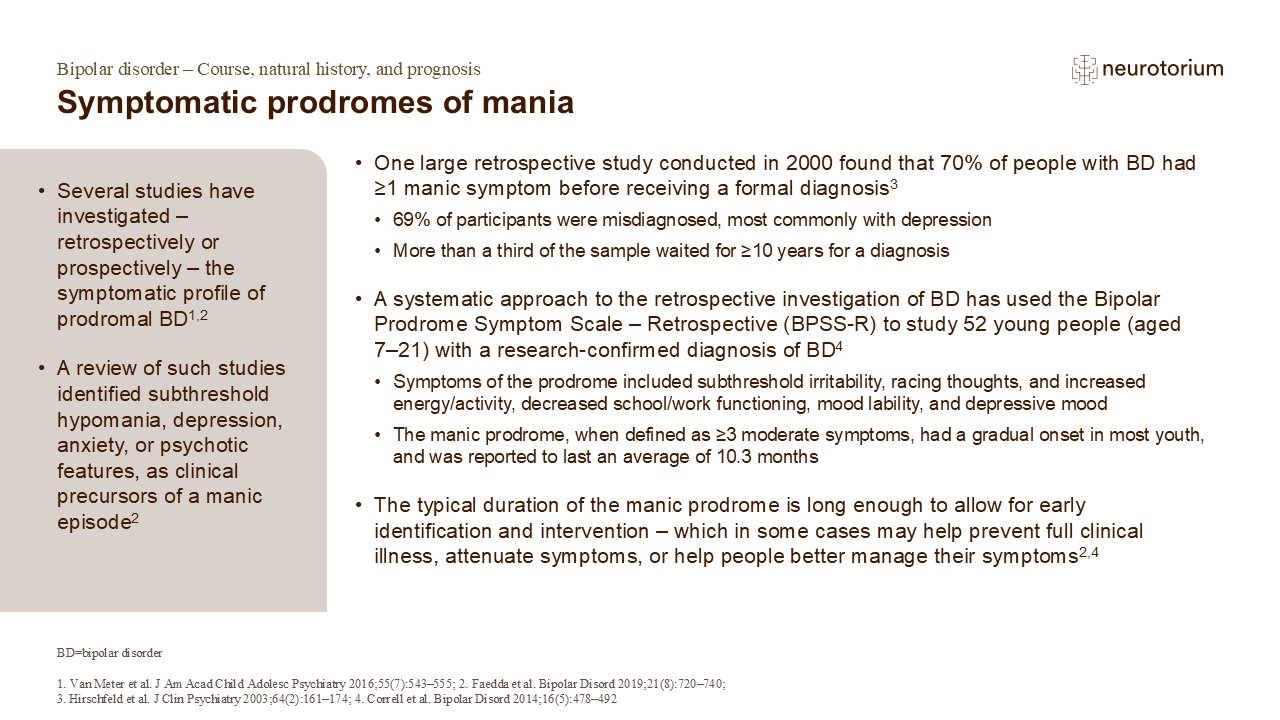
Another approach to studying the prodrome of mania is to define a set of factors to identify ‘bipolar at-risk’ people, such as having first‐degree family history of BD, cyclothymic features, and subthreshold depressive or manic symptoms.2 When studied in controlled, prospective conditions, people fulfilling these bipolar at-risk criteria were more likely to develop bipolar disorder than control individuals seeking psychiatric help.2 Taken together, the various lines of evidence point towards a manic prodrome consisting of subthreshold hypomania, depression, anxiety, or psychotic features.2
References:
1. Van Meter AR, Burke C, Youngstrom EA, et al. The bipolar prodrome: meta-analysis of symptom prevalence prior to initial or recurrent mood episodes. J Am Acad Child Adolesc Psychiatry 2016; 55 (7): 543–555.
2. Faedda GL, Baldessarini RJ, Marangoni C, et al. An International Society of Bipolar Disorders task force report: precursors and prodromes of bipolar disorder. Bipolar Disord 2019; 21 (8): 720–740.
3. Hirschfeld RM, Lewis L, Vornik LA. Perceptions and impact of bipolar disorder: how far have we really come? Results of the national depressive and manic-depressive association 2000 survey of individuals with bipolar disorder. J Clin Psychiatry 2003; 64 (2): 161–174.
4. Correll CU, Hauser M, Penzner JB, et al. Type and duration of subsyndromal symptoms in youth with bipolar I disorder prior to their first manic episode. Bipolar Disord 2014; 16 (5): 478–492.