

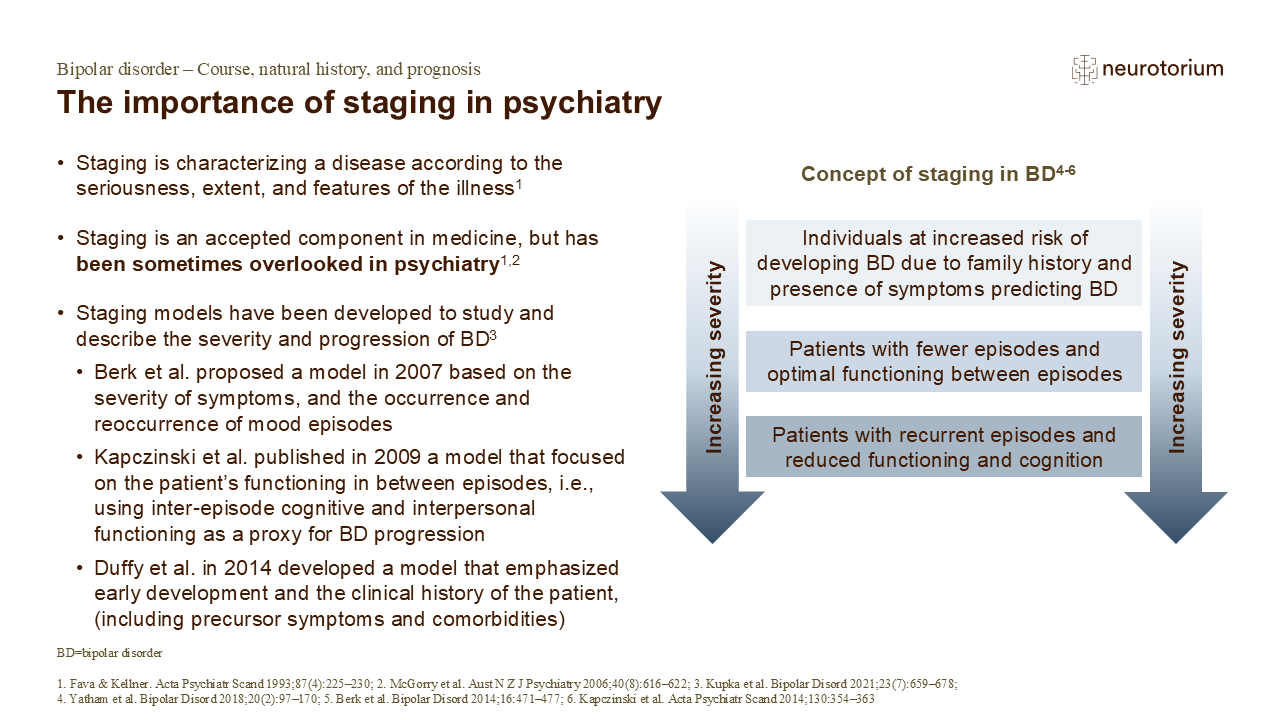
Staging places an individual with a psychiatric disorder on a spectrum that encompasses clinical progression, ranging from prodromal or pre-disease all the way to a chronic disease state.5 In bipolar disorder, this can generally be thought of with Stage 0 representing the pre-disease state, middle stages representing disease onset and the first episode, and later stages representing the chronic disease state.5 However, many different staging models have been developed for bipolar disease, with different numerical systems.3,5
References:
1. Fava GA, Kellner R. Staging: a neglected dimension in psychiatric classification. Acta Psychiatr Scand 1993; 87 (4): 225–230.
2. McGorry PD, Hickie IB, Yung AR, et al. Clinical staging of psychiatric disorders: a heuristic framework for choosing earlier, safer and more effective interventions. Aust N Z J Psychiatry 2006; 40 (8): 616–622.
3. Kupka R, Duffy A, Scott J, et al. Consensus on nomenclature for clinical staging models in bipolar disorder: a narrative review from the International Society for Bipolar Disorders (ISBD) Staging Task Force. Bipolar Disord 2021; 23 (7): 659–678.
4. Yatham LN, Kennedy SH, Parikh SV, et al. Canadian Network for Mood and Anxiety Treatments (CANMAT) and International Society for Bipolar Disorders (ISBD) 2018 guidelines for the management of patients with bipolar disorder. Bipolar Disord 2018; 20 (2): 97–170.
5. Berk M, Post R, Ratheesh A, et al. Staging in bipolar disorder: from theoretical framework to clinical utility. World Psychiatry 2017; 16 (3): 236–244.
6. Kapczinski F, Magalhaes PV, Balanza-Martinez V, et al. Staging systems in bipolar disorder: an International Society for Bipolar Disorders Task Force Report. Acta Psychiatr Scand 2014; 130 (5): 354–363.