

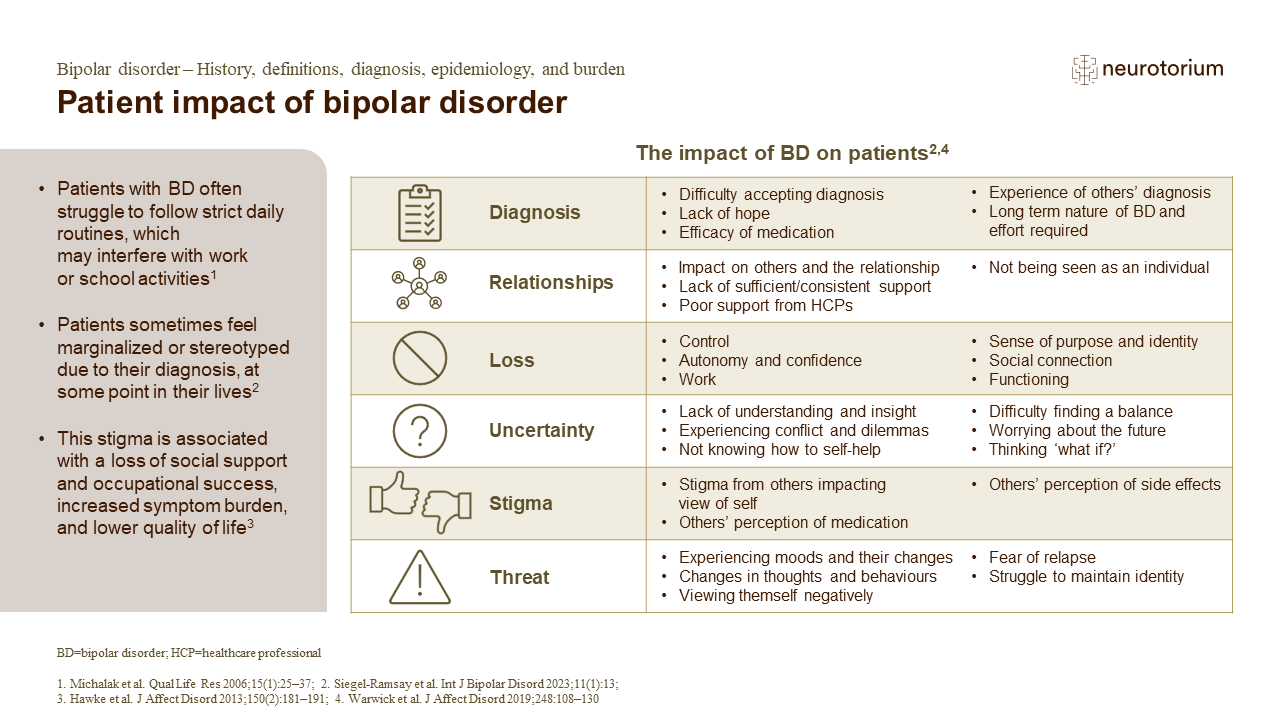
In a qualitative study, patients highlighted several aspects of the BD diagnostic process as challenging, including inadequate referral, late or incorrect diagnosis, healthcare professionals failing to recognize early warning signs, and lack of awareness within society.5 Treatment-related challenges included the difficulty of being hospitalized, which can be traumatizing and secluding, and the difficulty of finding appropriate treatment.5
References:
1. Michalak EE, Yatham LN, Kolesar S, Lam RW. Bipolar disorder and quality of life: a patient-centered perspective. Qual Life Res 2006; 15 (1): 25–37.
2. Siegel-Ramsay JE, Sharp SJ, Ulack CJ, et al. Experiences that matter in bipolar disorder: a qualitative study using the capability, comfort and calm framework. Int J Bipolar Disord 2023; 11 (1): 13.
3. Hawke LD, Parikh SV, Michalak EE. Stigma and bipolar disorder: a review of the literature. J Affect Disord 2013; 150 (2): 181–191.
4. Warwick H, Mansell W, Porter C, Tai S. ‘What people diagnosed with bipolar disorder experience as distressing’: a meta-synthesis of qualitative research. J Affect Disord 2019; 248: 108–130.
5. Maassen EF, Regeer BJ, Regeer EJ, et al. The challenges of living with bipolar disorder: a qualitative study of the implications for health care and research. Int J Bipolar Disord 2018; 6 (1): 23.