

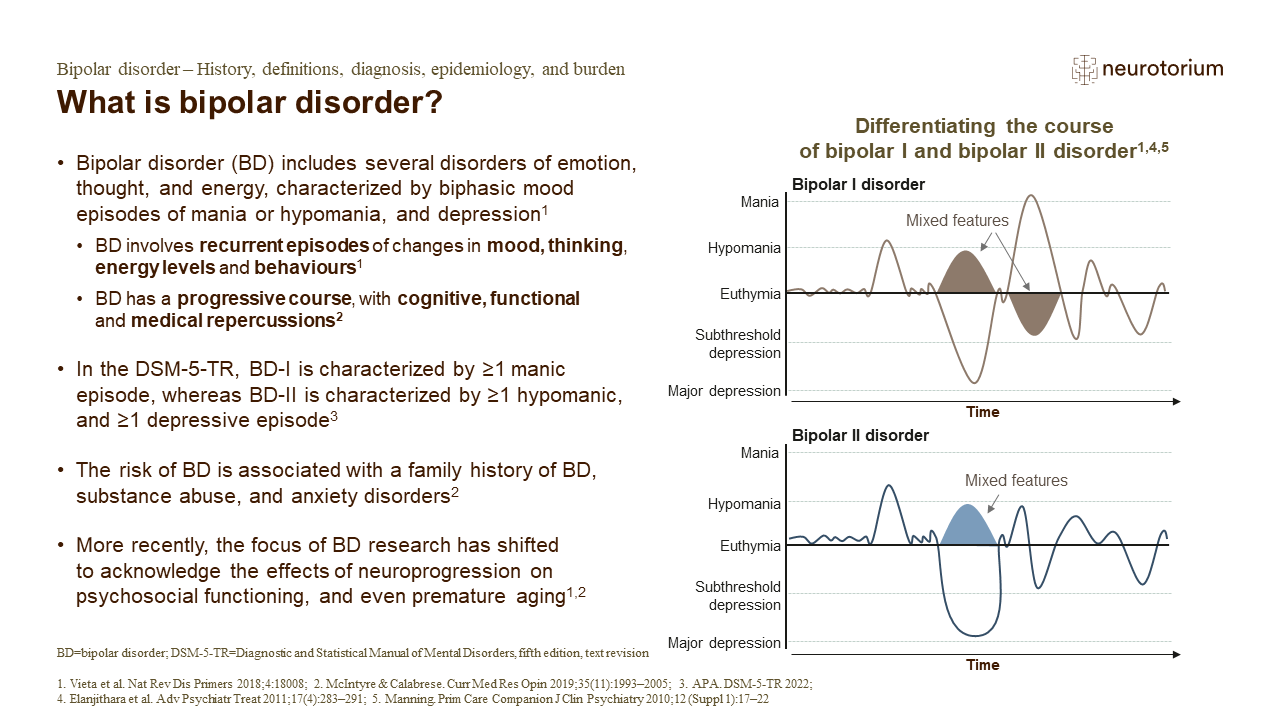
Bipolar disorder is a chronic and recurrent mood disorder, affecting >1% of the global population.1,6 The disorder is heritable, and commonly presents with physical and nonphysical comorbidities.1 In clinical settings, diagnosing BD can be difficult due to overlap of symptomology with other disorders, and often patients and their families struggle to understand the significance of certain symptoms.1 Careful clinical assessment is crucial to ensure accurate diagnosis and treatment.1
References:
1. Vieta E, Berk M, Schulze TG, et al. Bipolar disorders. Nat Rev Dis Primers 2018; 4: 18008.
2. McIntyre RS, Calabrese JR. Bipolar depression: the clinical characteristics and unmet needs of a complex disorder. Curr Med Res Opin 2019; 35 (11): 1993–2005.
3. American Psychiatric Association (APA). Diagnostic and Statistical Manual of Mental Disorders. Fifth edition, text revision. Washington DC: APA; 2022.
4. Elanjithara TE, Frangou S, McGuire P. Treatment of the early stages of bipolar disorder. Adv Psychiatr Treat 2011; 17 (4): 283–291.
5. Manning JS. Tools to improve differential diagnosis of bipolar disorder in primary care. Prim Care Companion J Clin Psychiatry 2010; 12 (Suppl 1): 17–22.
6. Merikangas KR, Jin R, He JP, et al. Prevalence and correlates of bipolar spectrum disorder in the world mental health survey initiative. Arch Gen Psychiatry 2011; 68 (3): 241–251.