

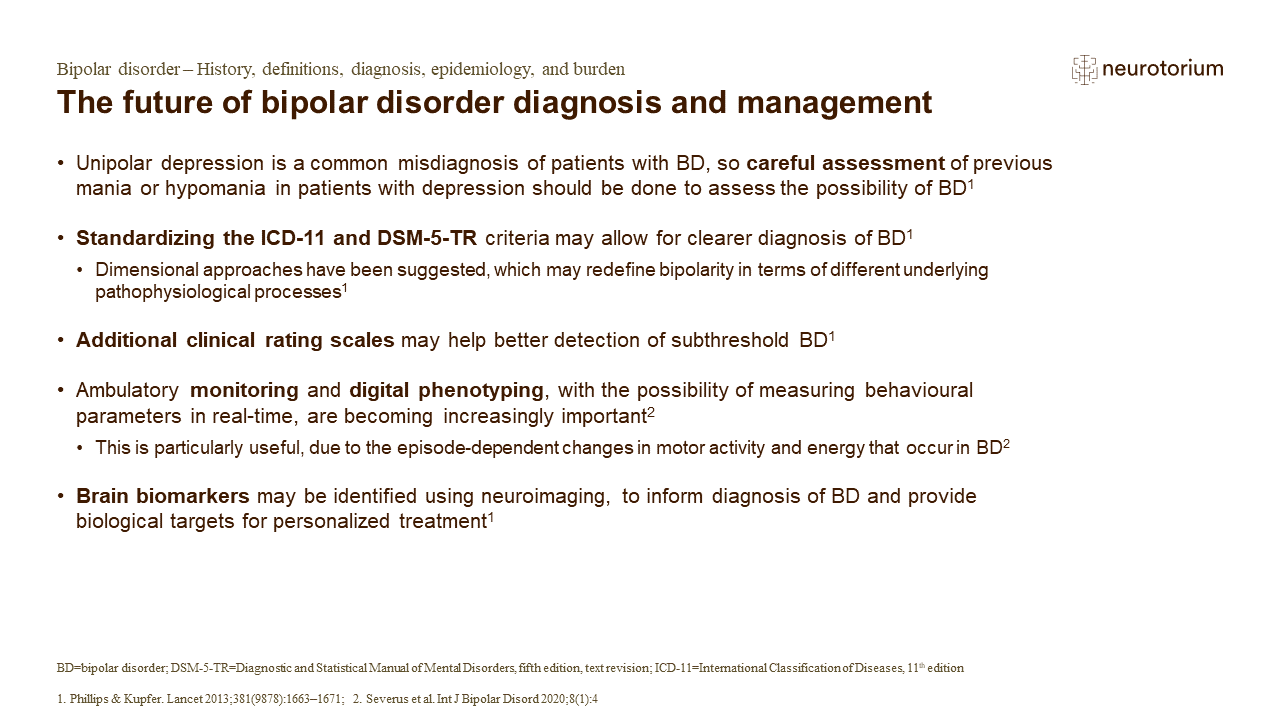
Diagnostic criteria that only focus on psychopathological findings and illness history will limit the possibility of more reliable and valid diagnoses.2 Dimensional approaches propose the reclassification of psychiatric disorders, such as bipolar disorder and unipolar depression, along an affective-disorder continuum.1 The Mood Spectrum Self-Report (MOODS-SR) is a self-report rating scale assessing the lifetime spectra of affective symptoms, and has been shown to identify hypomanic or manic symptoms in patients diagnosed with unipolar depression.1,3 Similarly, recommendations from the Research Domain Criteria of the US National Institute of Mental Health suggest the reclassification of psychiatric illnesses based on ‘informational processing domains’, rather than phenomenological observation.1 This approach would benefit from advancements in neuroimaging and the development of biomarkers for bipolar disorder.1
References:
1. Phillips ML, Kupfer DJ. Bipolar disorder diagnosis: challenges and future directions. Lancet 2013; 381 (9878): 1663–1671.
2. Severus E, Bauer M. Diagnosing bipolar disorders: ICD-11 and beyond. Int J Bipolar Disord 2020; 8 (1): 4.
3. Cassano GB, Rucci P, Frank E, et al. The mood spectrum in unipolar and bipolar disorder: arguments for a unitary approach. Am J Psychiatry. 2004; 161: 1264–1269.