

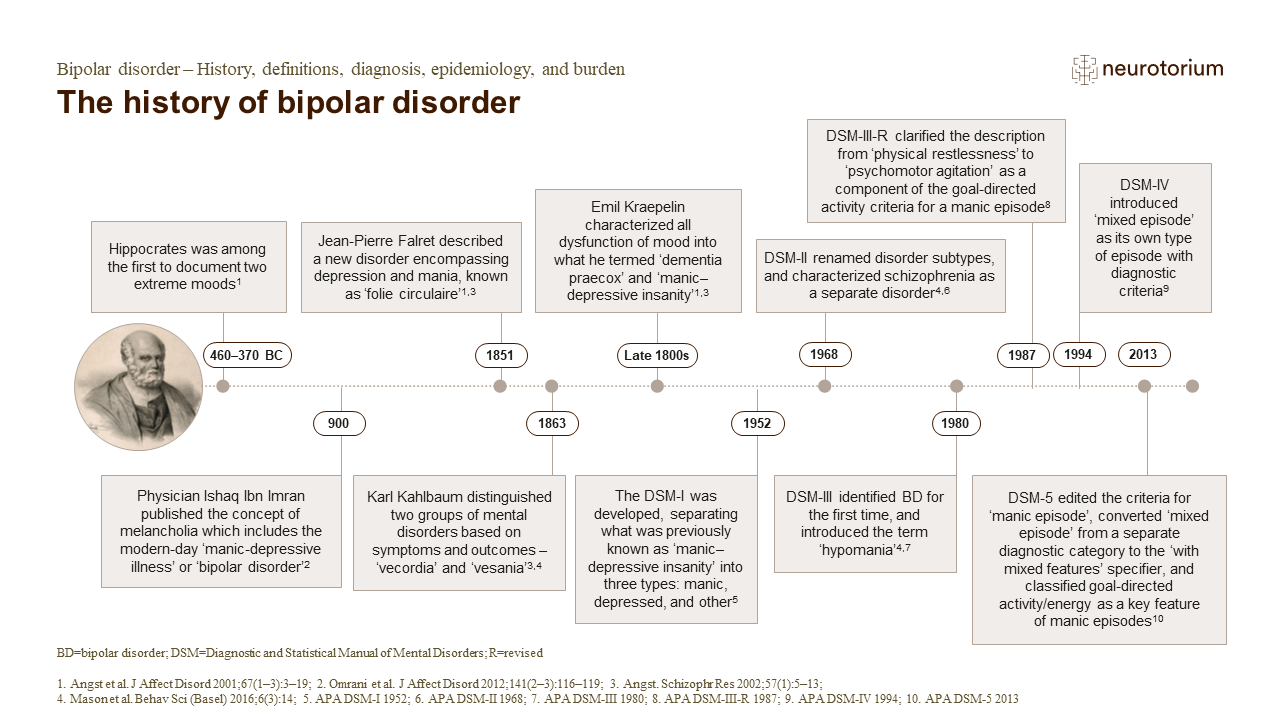
The two extreme moods of melancholia and mania have been documented as early as the time of Hippocrates.1 In 900, Ishaq Ibn Imran wrote the monograph on melancholia, which today, is the oldest surviving manuscript dedicated to this topic.2 Up until the 19th century, melancholia and mania were believed to be two completely different disorders, characterized by a variety of psychiatric symptoms.4 Jean-Pierre Falret termed a new disorder ‘folie circulaire’, which was characterized by a continuous cycle of depression, mania, and free intervals of varying length in between.1,3 His contemporary Jules Baillarger described ‘folie à double forme’ in which mania and melancholia change into one another, however there was no requirement for a free interval between the two.4 In 1863, Karl Kahlbaum suggested two large groups of mental disorders distinguished on the basis of symptoms and outcome – ‘vecordia’, which denoted limited disturbance of the mind, and ‘vesania’, which denoted a complete disturbance of the mind.4 Emil Kraeplin developed the work of Kahlbaum and Falret, and attempted to combine mania, depression, and all psychotic states into what he termed ‘dementia praecox’ and ‘manic–depressive insanity’,1,3,4 now referred to as schizophrenia and bipolar disorder, respectively.4
The DSM-I (1952) provided the first attempt to categorize and standardize mental illness.4 It classified manic-depression as a psychotic disorder, “characterized by a varying degree of personality integration and a failure to test and evaluate correctly external reality in various spheres”.5 Three types were described: manic, which is most similar to the modern day description of mania; depressed, which is most similar to what we know as major depressive disorder, and other, which included mixed states or cycling as a feature.4,5 Since then, the classification has undergone a variety of changes, to bipolar disorder encompassing three subtypes – bipolar I disorder, bipolar II disorder, and cyclothymia.6-11
References:
1. Angst J, Marneros A. Bipolarity from ancient to modern times: conception, birth and rebirth. J Affect Disord 2001; 67 (1–3): 3–19.
2. Omari A, Holtzman NS, Akiskal HS, Ghaemi SN. Ibn Imran’s 10th century treatise on melancholy. J Affect Disord 2012; 141 (2–3): 116–119.
3. Angst J. Historical aspects of the dichotomy between manic–depressive disorders and schizophrenia. Schizophr Res 2002; 57 (1): 5–13.
4. Mason BL, Brown ES, Croarkin PE. Historical underpinnings of bipolar disorder diagnostic criteria. Behav Sci (Basel) 2016; 6 (3): 14.
5. American Psychiatric Association (APA). Diagnostic and Statistical Manual of Mental Disorders. First edition. Washington DC: APA; 1952.
6. American Psychiatric Association (APA). Diagnostic and Statistical Manual of Mental Disorders. Second edition. Washington DC: APA; 1968.
7. American Psychiatric Association (APA). Diagnostic and Statistical Manual of Mental Disorders. Third edition. Washington DC: APA; 1980.
8. American Psychiatric Association (APA). Diagnostic and Statistical Manual of Mental Disorders. Third edition, revision. Washington DC: APA; 1987.
9. American Psychiatric Association (APA). Diagnostic and Statistical Manual of Mental Disorders. Fourth edition. Washington DC: APA; 1994.
10. American Psychiatric Association (APA). Diagnostic and Statistical Manual of Mental Disorders. Fifth edition. Arlington VA: APA; 2013.
11. American Psychiatric Association (APA). Diagnostic and Statistical Manual of Mental Disorders. Fifth edition, text revision. Washington DC: APA; 2022.