

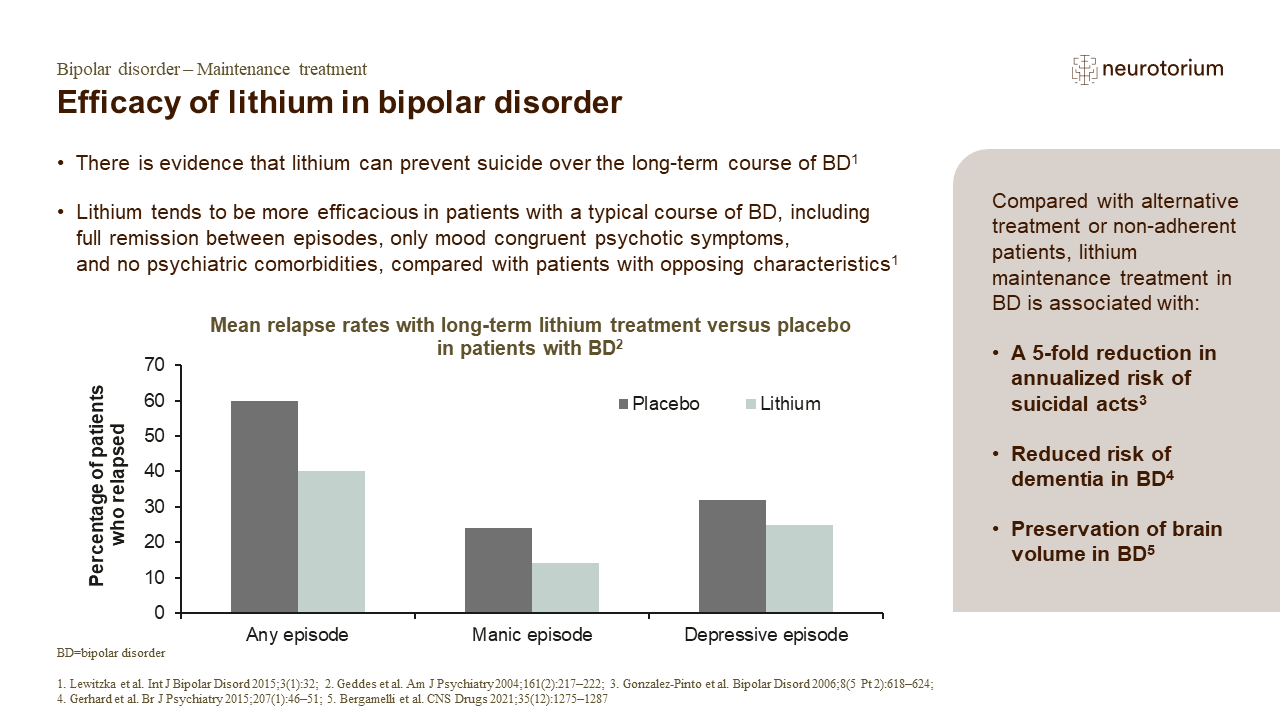
Two hypotheses about lithium’s protective effects in relation to suicide have been suggested.1 One suggests that because lithium is a mood stabilizer, patients with a good response to lithium have fewer, less severe, and/or less frequent affective episodes, which in turn reduces the risk of suicidal behaviour.1 The second hypothesis suggests that lithium decreases aggression and impulsivity in patients with mood disorders.1
References:
1. Lewitzka U, Severus E, Bauer R, et al. The suicide prevention effect of lithium: more than 20 years of evidence-a narrative review. Int J Bipolar Disord 2015; 3 (1): 32.
2. Geddes JR, Burgess S, Hawton K, et al. Long-term lithium therapy for bipolar disorder: systematic review and meta-analysis of randomized controlled trials. Am J Psychiatry 2004; 161 (2): 217–222.
3. Gonzalez-Pinto A, Mosquera F, Alonso M, et al. Suicidal risk in bipolar I disorder patients and adherence to long-term lithium treatment. Bipolar Disord 2006; 8 (5 Pt 2): 618–624.
4. Gerhard T, Devanand DP, Huang C, et al. Lithium treatment and risk for dementia in adults with bipolar disorder: population-based cohort study. Br J Psychiatry 2015; 207 (1): 46–51.
5. Bergamelli E, Del Fabro L, Delvecchio G, et al. The impact of lithium on brain function in bipolar disorder: an updated review of functional magnetic resonance imaging studies. CNS Drugs 2021; 35 (12): 1275–1287.