

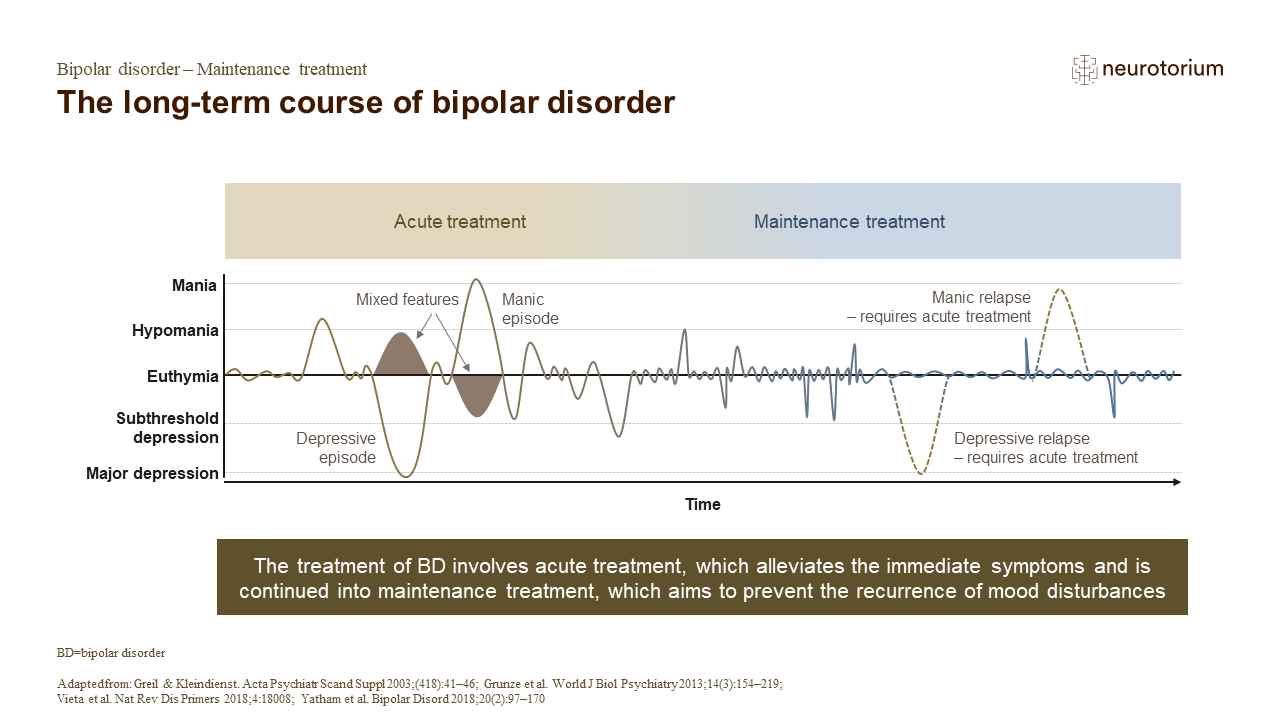
Some studies have attempted to better understand the longitudinal course of bipolar disorder. Two such prospective, longitudinal studies investigated the symptomatic status of patients with bipolar I disorder,5 and bipolar II disorder.6 Evidence showed that bipolar I and bipolar II disorder can differ in terms of symptom severity and clinical characteristics.5-7 Whilst both the bipolar disorder I and II cohorts showed similarly increased rates of substance abuse compared with the general population, patients with bipolar II disorder experienced higher rates of anxiety disorders than those with bipolar I disorder.7 Furthermore, people with bipolar disorder I tended to have more severe initial episodes, and were more likely to be inpatients.7
References:
1. Greil W, Kleindienst N. Concepts in the treatment of bipolar disorder. Acta Psychiatr Scand Suppl 2003; (418): 41–46.
2. Grunze H, Vieta E, Goodwin GM, et al; WFSBP Task Force on Treatment Guidelines for Bipolar Disorders. The World Federation of Societies of Biological Psychiatry (WFSBP) guidelines for the biological treatment of bipolar disorders: update 2012 on the long-term treatment of bipolar disorder. World J Biol Psychiatry 2013; 14 (3): 154–219.
3. Vieta E, Berk M, Schulze TG, et al. Bipolar disorders. Nat Rev Dis Primers 2018; 4: 18008.
4. Yatham LN, Kennedy SH, Parikh SV, et al. Canadian Network for Mood and Anxiety Treatments (CANMAT) and International Society for Bipolar Disorders (ISBD) 2018 guidelines for the management of patients with bipolar disorder. Bipolar Disord 2018; 20 (2): 97–170.
5. Judd LL, Akiskal HS, Schettler PJ, et al. The long-term natural history of the weekly symptomatic status of bipolar I disorder. Arch Gen Psychiatry 2002; 59 (6): 530–537.
6. Judd LL, Akiskal HS, Schettler PJ, et al. A prospective investigation of the natural history of the long-term weekly symptomatic status of bipolar II disorder. Arch Gen Psychiatry 2003; 60 (3): 261–269.
7. Judd LL, Akiskal HS, Schettler PJ, et al. The comparative clinical phenotype and long term longitudinal episode course of bipolar I and II: a clinical spectrum or distinct disorders? J Affect Disord 2003; 7 (1–2): 19–32.