

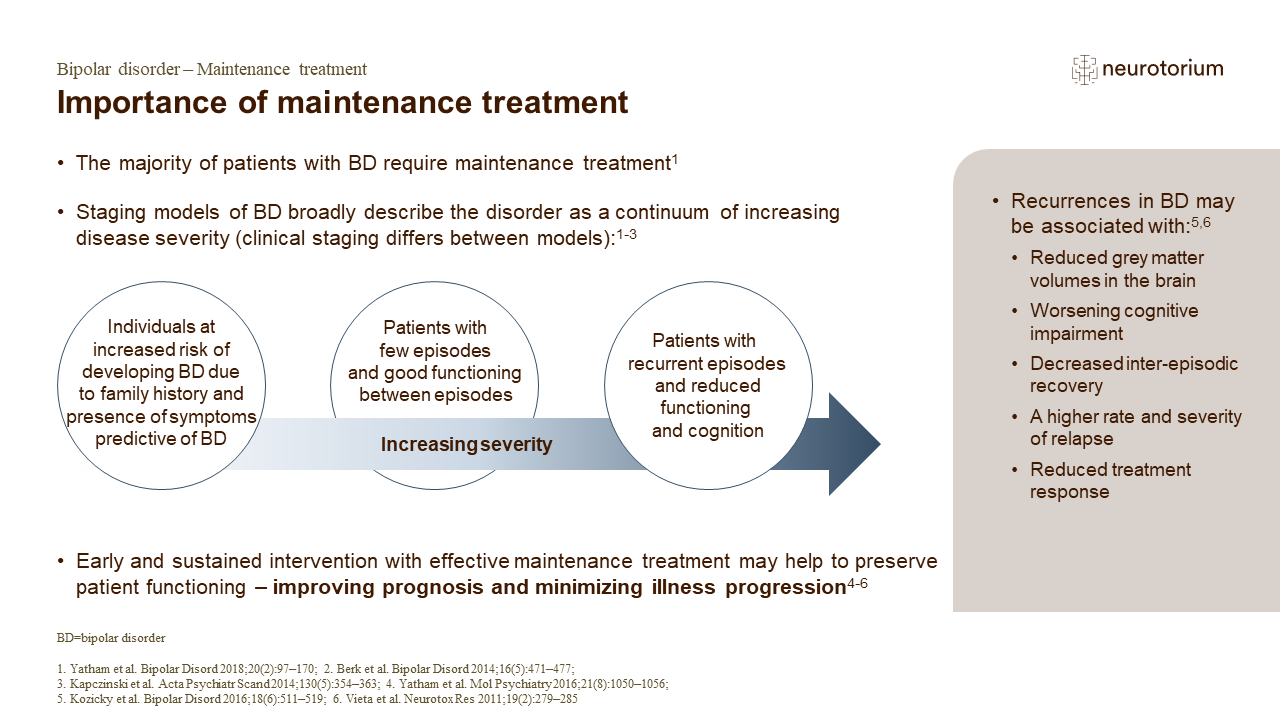
Staging models for bipolar disorder can help to improve understanding of the illness trajectory and mechanisms underlying the progression of disease.4,6 Increased knowledge of the disease course, as a result, may improve treatment planning and prognosis.6
References:
1. Yatham LN, Kennedy SH, Parikh SV, et al. Canadian Network for Mood and Anxiety Treatments (CANMAT) and International Society for Bipolar Disorders (ISBD) 2018 guidelines for the management of patients with bipolar disorder. Bipolar Disord 2018; 20 (2): 97–170.
2. Berk M, Berk L, Dodd S, et al. Stage managing bipolar disorder. Bipolar Disord 2014; 16 (5): 471–477.
3. Kapczinski F, Magalhães PV, Balanzá-Martinez V, et al. Staging systems in bipolar disorder: an International Society for Bipolar Disorders Task Force Report. Acta Psychiatr Scand 2014; 130 (5): 354–363.
4. Yatham LN, Beaulieu S, Schaffer A, et al. Optimal duration of risperidone or olanzapine adjunctive therapy to mood stabilizer following remission of a manic episode: a CANMAT randomized double-blind trial. Mol Psychiatry 2016; 21 (8): 1050–1056.
5. Kozicky JM, McGirr A, Bond DJ, et al. Neuroprogression and episode recurrence in bipolar I disorder: a study of gray matter volume changes in first-episode mania and association with clinical outcome. Bipolar Disord 2016; 18 (6): 511–519.
6. Vieta E, Reinares M, Rosa AR. Staging bipolar disorder. Neurotox Res 2011; 19 (2): 279–285.