

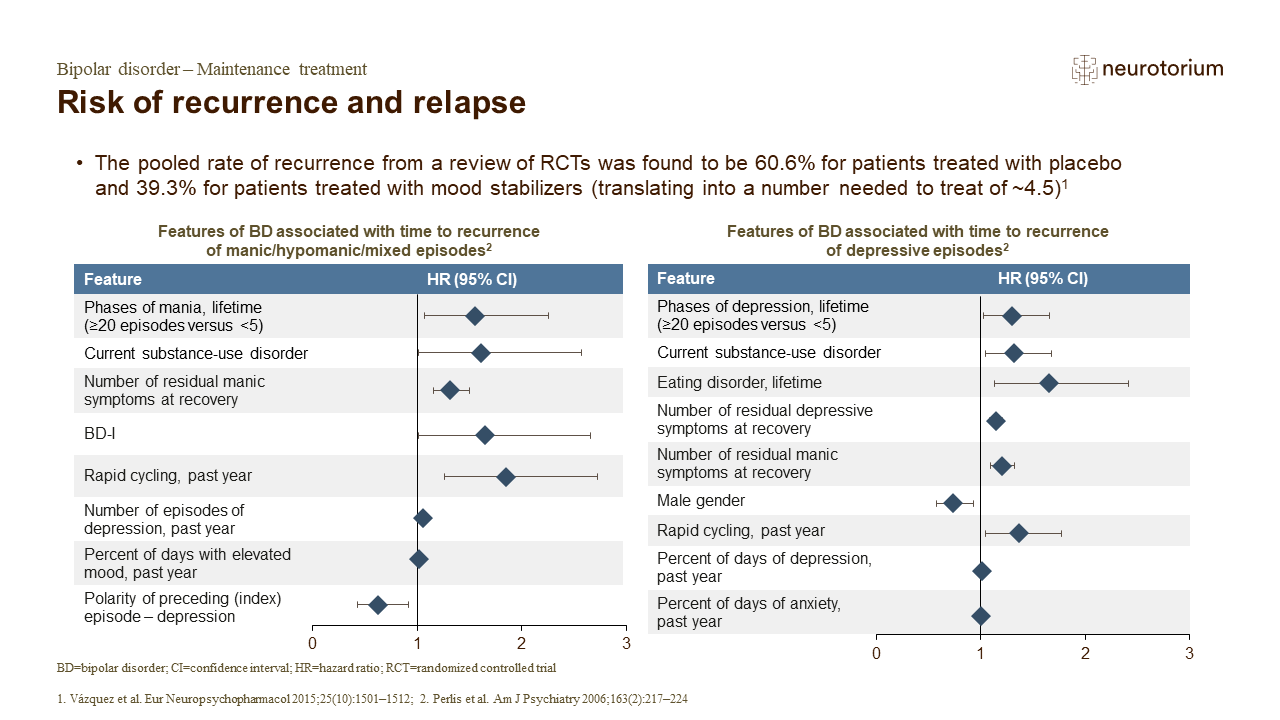
Traditionally, the term ‘recurrence’ has been used to refer to symptoms that re-emerge after the point of remission, whereas ‘relapse’ is used to refer to the re-emergence of symptoms in the index episode.3 A systematic review of long-term, naturalistic studies of treated patients with bipolar disorder was conducted to assess the effectiveness of treatment under clinically realistic, non-experimental conditions, compared with long-term randomized controlled trials in bipolar disorder.1 The pooled recurrence rates in people receiving active treatment for bipolar disorder were 55.2% in naturalistic studies, and 39.3% in randomized controlled trials, with risk of recurrence associated with a younger age of onset, and a history of rapid cycling.1
References:
1. Vázquez GH, Holtzman JN, Lolich M, et al. Recurrence rates in bipolar disorder: systematic comparison of long-term prospective, naturalistic studies versus randomized controlled trials. Eur Neuropsychopharmacol 2015; 25 (10): 1501–1512.
2. Perlis RH, Ostacher MJ, Patel JK, et al. Predictors of recurrence in bipolar disorder: primary outcomes from the Systematic Treatment Enhancement Program for Bipolar Disorder (STEP-BD). Am J Psychiatry 2006; 163 (2): 217–224.
3. Grunze H, Vieta E, Goodwin GM, et al; WFSBP Task Force on Treatment Guidelines for Bipolar Disorders. The World Federation of Societies of Biological Psychiatry (WFSBP) guidelines for the biological treatment of bipolar disorders: update 2012 on the long-term treatment of bipolar disorder. World J Biol Psychiatry 2013; 14 (3): 154–219.