

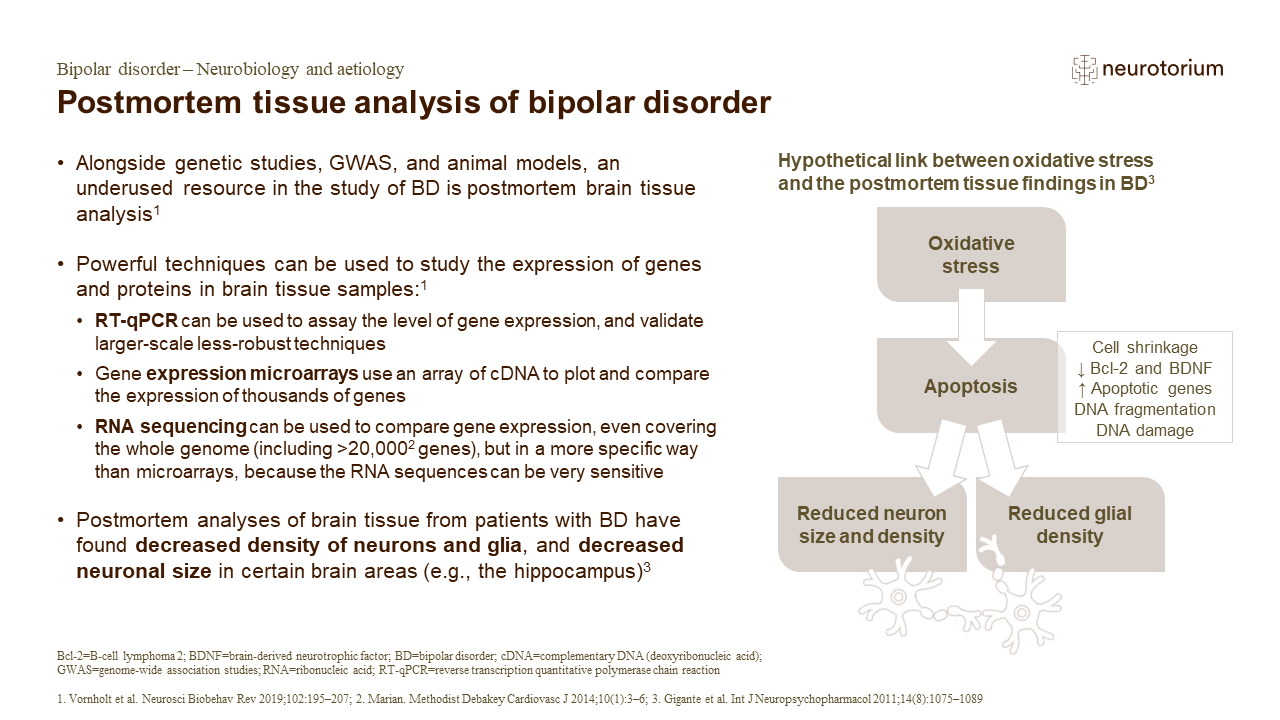
Whilst genome-wide association studies are a powerful technique, bringing into focus several genes that might be involved in the pathology of bipolar disorder, several other genetic loci identified by genome-wide studies are outside of protein-coding regions, implying some involvement in regulation of gene expression.1,4 Indeed, a limitation of genome-wide analysis is the lack of gene-level data about expression.1,4 Postmortem brain analysis can fill-in this gap, by allowing analysis of DNA and RNA expression in the brain, potentially connecting the insights from genome-wide studies with the phenotype seen in people with bipolar disorder.1 However, postmortem analysis can be logistically challenging; one clear methodological disadvantage of postmortem studies of brain tissue is the danger of deterioration of the sample before it is processed.1
References:
1. Vornholt E, Luo D, Qiu W, et al. Postmortem brain tissue as an underutilized resource to study the molecular pathology of neuropsychiatric disorders across different ethnic populations. Neurosci Biobehav Rev 2019; 102: 195–207.
2. Marian AJ. Sequencing your genome: what does it mean? Methodist Debakey Cardiovasc J 2014; 10 (1): 3–6.
3. Gigante AD, Young LT, Yatham LN, et al. Morphometric post-mortem studies in bipolar disorder: possible association with oxidative stress and apoptosis. Int J Neuropsychopharmacol 2011; 14 (8): 1075–1089.
4. Mullins N, Forstner AJ, O’Connell KS, et al. Genome-wide association study of more than 40,000 bipolar disorder cases provides new insights into the underlying biology. Nat Genet 2021; 53 (6): 817–829.