

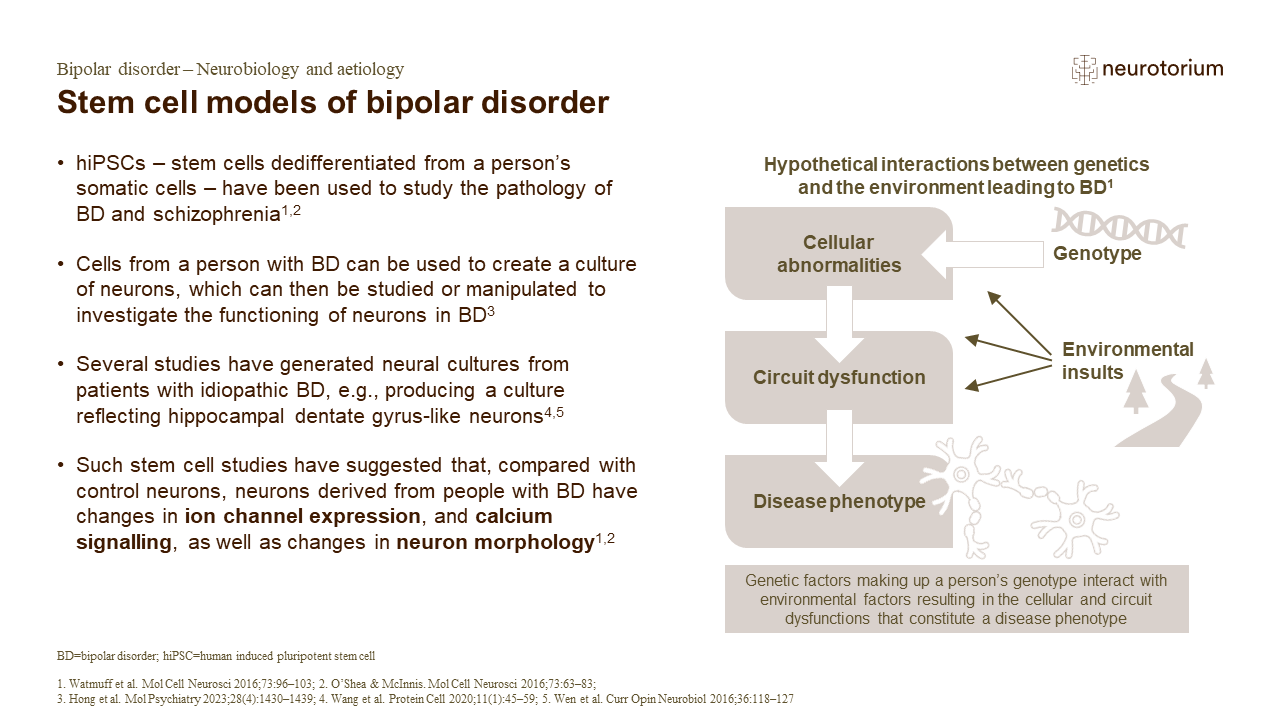
Whilst human induced pluripotent stem cells (hiPSCs) are a powerful tool for interrogating the mechanics of human disease (being genetically identical to the donor’s own cells, although not mature), there are limitations to their use.3 This is because differences in the sources of somatic cells and differences in the laboratory methods used to create a tissue culture lead to a risk of variability in the results across studies.3 Insights from stem cell studies should be used to compliment other models of human disease, to help develop novel pharmacological therapies for conditions such as bipolar disorder.3
References:
1. Watmuff B, Berkovitch SS, Huang JH, et al. Disease signatures for schizophrenia and bipolar disorder using patient-derived induced pluripotent stem cells. Mol Cell Neurosci 2016; 73: 96–103.
2. O’Shea KS, McInnis MG. Neurodevelopmental origins of bipolar disorder: iPSC models. Mol Cell Neurosci 2016; 73: 63–83.
3. Hong Y, Yang Q, Song H, Ming GL. Opportunities and limitations for studying neuropsychiatric disorders using patient-derived induced pluripotent stem cells. Mol Psychiatry 2023; 28 (4): 1430–1439.
4. Wang M, Zhang L, Gage FH. Modeling neuropsychiatric disorders using human induced pluripotent stem cells. Protein Cell 2020; 11 (1): 45–59.
5. Wen Z, Christian KM, Song H, Ming GL. Modeling psychiatric disorders with patient-derived iPSCs. Curr Opin Neurobiol 2016; 36: 118–127.