

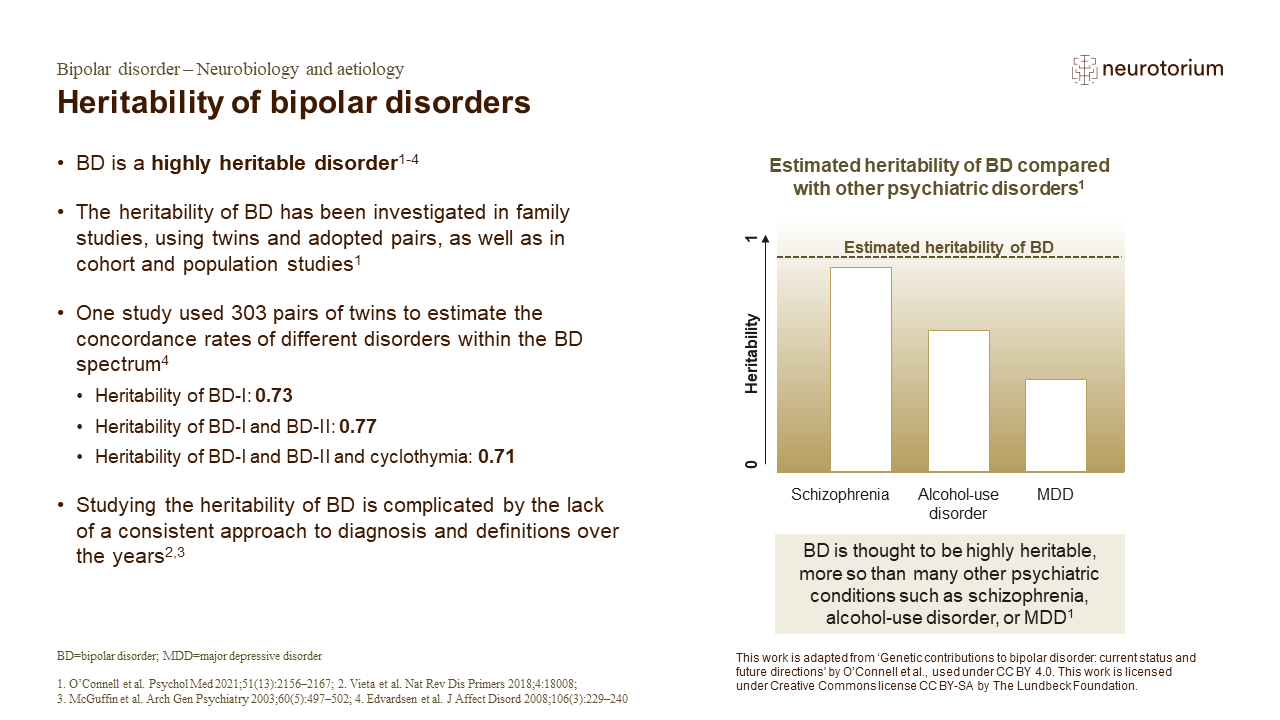
As outlined on the slide, bipolar disorder is a highly heritable disorder.1-4 The pathology of bipolar disorder is thought to be best explained by a model that takes account of this clear genetic involvement, interacting with a person’s environment and biochemistry, although the disease process is as-yet poorly understood.2
References:
1. O’Connell KS, Coombes BJ. Genetic contributions to bipolar disorder: current status and future directions. Psychol Med 2021; 51 (13): 2156–2167.
2. Vieta E, Berk M, Schulze TG, et al. Bipolar disorders. Nat Rev Dis Primers 2018; 4: 18008.
3. McGuffin P, Rijsdijk F, Andrew M, et al. The heritability of bipolar affective disorder and the genetic relationship to unipolar depression. Arch Gen Psychiatry 2003; 60 (5): 497–502.
4. Edvardsen J, Torgersen S, Røysamb E, et al. Heritability of bipolar spectrum disorders. Unity or heterogeneity? J Affect Disord 2008; 106 (3): 229–240.