

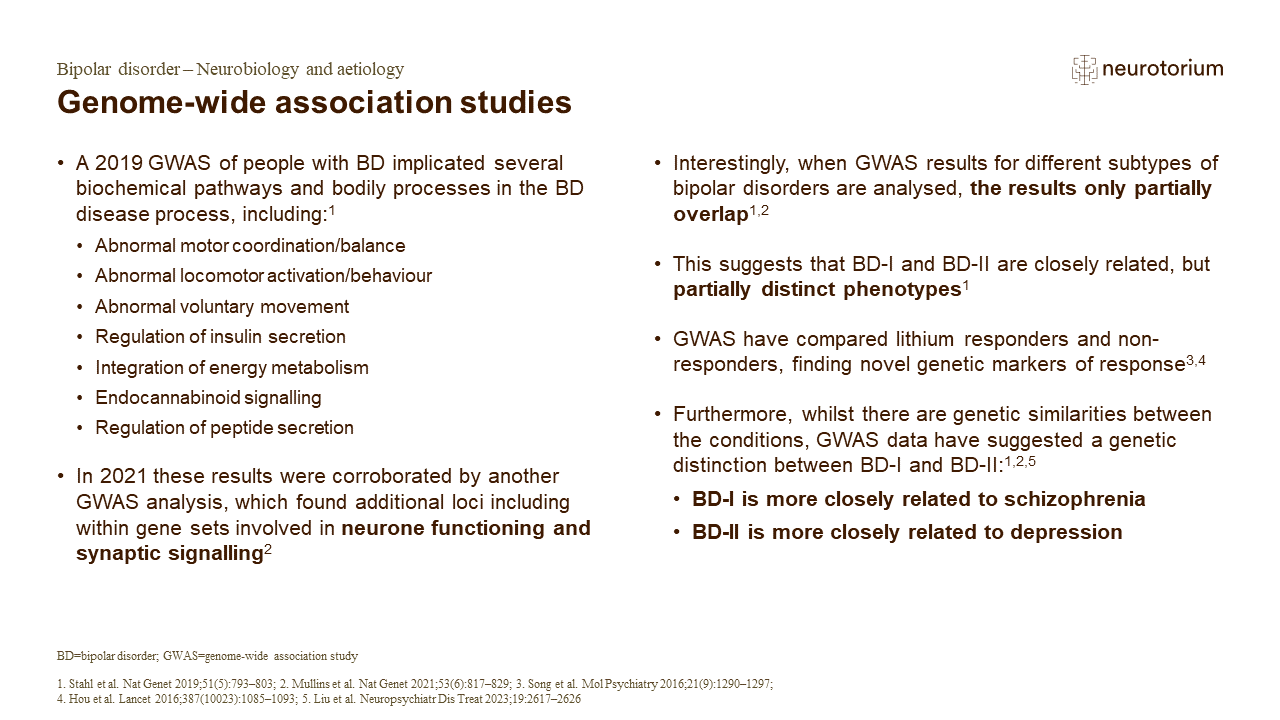
It was once believed that genome-wide association studies (GWAS) might unlock the secrets of disease – that harnessing the power of genetic understanding would clarify disease processes and thereby help design new treatments.6 Whilst not this Holy Grail, GWAS analyses are powerful tools which – by comparing whole genomes of people with a disease and those without a disease – can identify genes and pathways involved in disease pathology.1,2,6 GWAS analyses of bipolar disorder, as outlined on the slide, have highlighted the possible importance of neuronal functioning in the disease pathology.1,2
References:
1. Stahl EA, Breen G, Forstner AJ, et al.; Bipolar Disorder Working Group of the Psychiatric Genomics Consortium. Genome-wide association study identifies 30 loci associated with bipolar disorder. Nat Genet 2019; 51 (5): 793–803.
2. Mullins N, Forstner AJ, O’Connell KS, et al. Genome-wide association study of more than 40,000 bipolar disorder cases provides new insights into the underlying biology. Nat Genet 2021; 53 (6): 817–829.
3. Song J, Bergen SE, Di Florio A, et al. Genome-wide association study identifies SESTD1 as a novel risk gene for lithium-responsive bipolar disorder. Mol Psychiatry 2016; 21 (9): 1290–1297.
4. Hou L, Heilbronner U, Degenhardt F, et al. Genetic variants associated with response to lithium treatment in bipolar disorder: a genome-wide association study. Lancet 2016; 387 (10023): 1085–1093.
5. Liu H, Wang L, Yu H, et al. Polygenic risk scores for bipolar disorder: progress and perspectives. Neuropsychiatr Dis Treat 2023; 19: 2617–2626.
6. Gershon ES, Alliey-Rodriguez N, Liu C. After GWAS: searching for genetic risk for schizophrenia and bipolar disorder. Am J Psychiatry 2011; 168 (3): 253–256.