

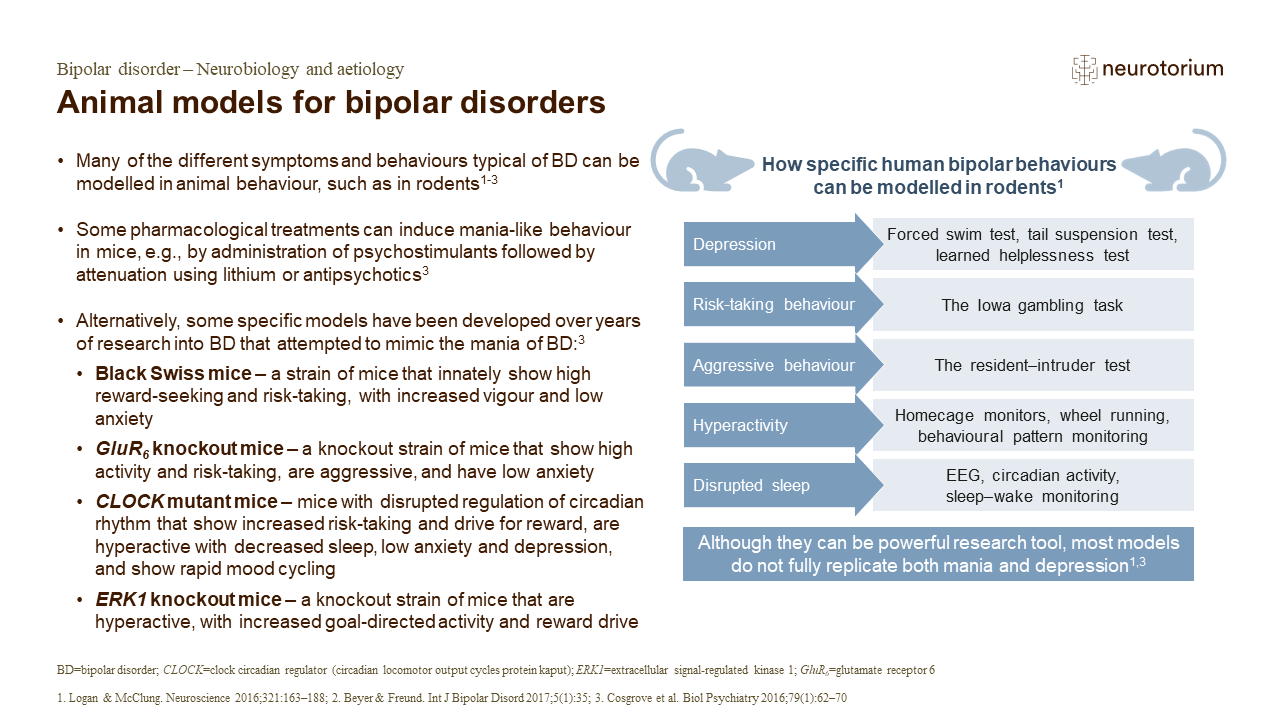
As detailed on the slide, animal models can be used to model some of the characteristic symptoms of bipolar disorder.1-3 However, whilst useful, these models cannot fully replicate the complex behaviours of humans with bipolar disorder, and the complex genetics of bipolar disorder; higher order functioning in humans, such as emotions and complex cognition, are effectively impossible to model in animals in a controlled way.3 Therefore, to translate findings from animal models into clinically applicable conclusions, they must be considered alongside the clinical presentation of the illness.3
References:
1. Logan RW, McClung CA. Animal models of bipolar mania: the past, present and future. Neuroscience 2016; 321: 163–188.
2. Beyer DKE, Freund N. Animal models for bipolar disorder: from bedside to the cage. Int J Bipolar Disord 2017; 5 (1): 35.
3. Cosgrove VE, Kelsoe JR, Suppes T. Toward a valid animal model of bipolar disorder: how the research domain criteria help bridge the clinical–basic science divide. Biol Psychiatry 2016; 79 (1): 62–70.