

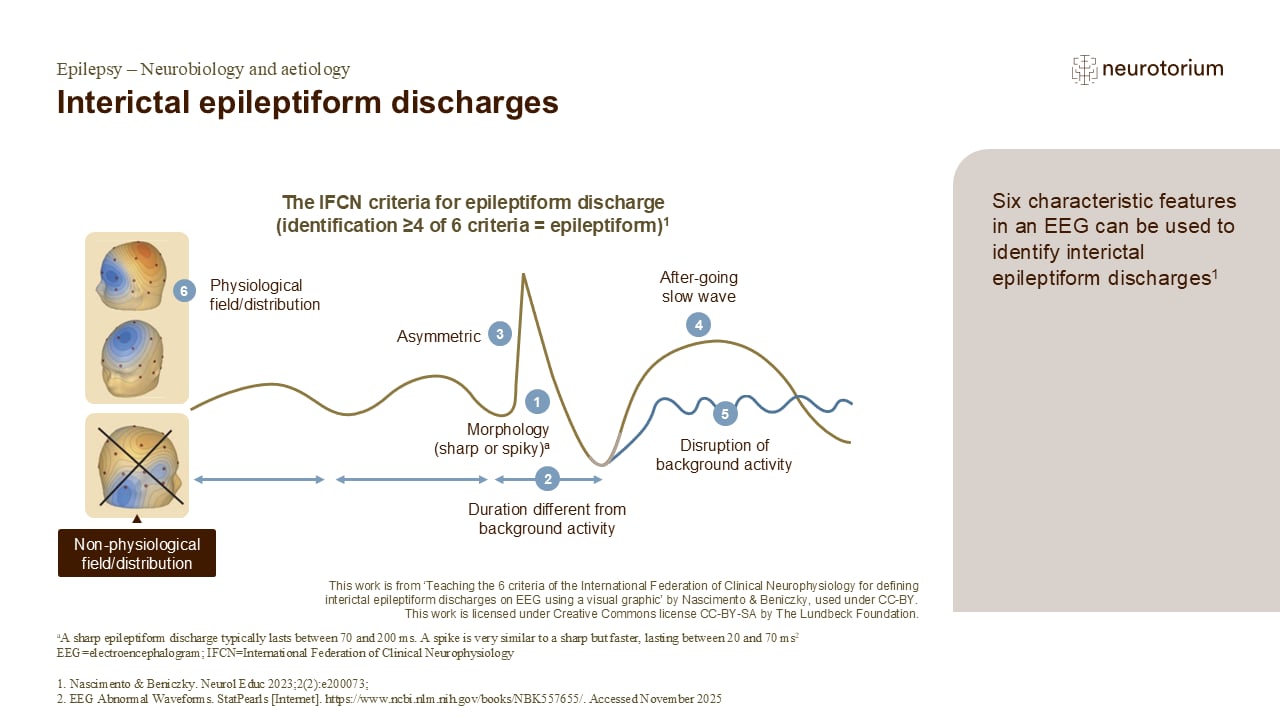
The slide shows the International Federation of Clinical Neurophysiology criteria for epileptiform discharge, based on identification of ≥4 of the 6 criteria:1
1.sharp or spiky morphology1 (20–70 milliseconds for spike waves; 70–200 milliseconds for sharp waves2)
2.different wave duration than background activity1
3.waveform asymmetry1
4.after-going slow wave1
5.disruption of background activity: flattening or low-voltage alpha or beta frequency activity after
(most frequently) or before sharp transient1
6.distribution suggestive of cerebral source/physiologic field.1
Note that Criteria 4 and 5 are independent of each other.1
The paroxysmal depolarizing shift (PDS) is a large-amplitude depolarization associated with action potential bursting, it represents the cellular counterpart of the interictal spike that occurs between focal seizures on an EEG.3
References: